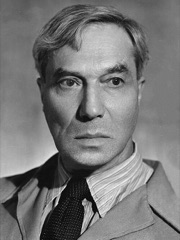
Boris Pasternak
1890–1960 · Russian poet and novelist, author of Doctor Zhivago, who was awarded the Nobel Prize in Literature in 1958.
Boris Pasternak was born in Moscow in 1890. His father, Leonid Pasternak, was a well-known painter and illustrator, and his mother, Rosa Kaufman, was a concert pianist; Leo Tolstoy and the composer Alexander Scriabin were among the family's acquaintances. Boris first studied music composition, then philosophy at Moscow University and briefly at Marburg in Germany, before turning to poetry. His collection My Sister, Life (1922) made him one of the leading Russian poets of his generation. Under Stalin he survived the purges that killed many writers and earned a living largely by translating, including Shakespeare and Goethe's Faust. His novel Doctor Zhivago, the story of a doctor and poet caught up in the Russian Revolution and civil war, was rejected for publication in the Soviet Union and first appeared in Italy in 1957. In 1958 he was awarded the Nobel Prize in Literature but, under heavy pressure from the Soviet government, declined it. He died near Moscow in 1960.
Boris Pasternak is also an author in the library: author page and works.
Faith: Grew up in a Russian Jewish household; Christianity became a theme of his later work. Source: Encyclopaedia Britannica

Key dates
- 1890 Born in Moscow
- 1922 My Sister, Life published
- 1957 Doctor Zhivago published in Italy
- 1958 Awarded the Nobel Prize, which he declines
- 1960 Dies at Peredelkino
Fun facts
- His mother was a concert pianist, and as a young man he first wanted to be a musician. (Source: Boris Pasternak (Wikipedia))
- An asteroid, 3508 Pasternak, is named after him. (Source: Boris Pasternak (Wikipedia))
Read about them
Grades 9–12
- Doctor Zhivago · In the library
More lives
Marguerite de Angeli · Richard and Florence Atwater · Mariano Azuela · Samuel Beckett · W. E. B. Du Bois · Bertolt Brecht