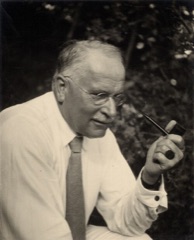
Carl Gustav Jung
1875–1961 · Swiss psychiatrist who founded analytical psychology and introduced ideas such as the collective unconscious, archetypes and introversion.
Carl Gustav Jung was born in 1875 in Kesswil, Switzerland, the son of a Protestant pastor, and grew up near Basel. He studied medicine at the University of Basel and in 1900 began work at the Burghölzli psychiatric hospital in Zurich under Eugen Bleuler, where he studied patients with schizophrenia, then called dementia praecox, and developed word-association tests. His book The Psychology of Dementia Praecox (1907) drew Sigmund Freud's attention, and the two worked closely until they broke with each other in 1913 over theory. Jung then went through a period of intense inner experiences, which he recorded in what became The Red Book. He founded what he called analytical psychology, with ideas such as the collective unconscious, archetypes, and introverted and extraverted personality types. He traveled to Africa, India and the American Southwest and wrote on religion, myth, alchemy and dreams. He taught for many years in Zurich and died at his home in Küsnacht in 1961.
Carl Gustav Jung is also an author in the library: author page and works.
Faith: Son of a pastor. Source: Encyclopaedia Britannica
Further reading
- Jung: A Very Short Introduction by Anthony Stevens (Oxford University Press, 2001), ISBN 9780192854582
Key dates
- 1875 Born in Kesswil, Switzerland
- 1900 Joins the Burghölzli hospital in Zurich
- 1907 The Psychology of Dementia Praecox; meets Freud
- 1913 Breaks with Freud
- 1921 Psychological Types published
- 1961 Dies in Küsnacht
Fun facts
- As a boy he carved a tiny figure into the end of the wooden ruler from his pencil case and hid the case in the attic. (Source: Carl Jung (Wikipedia))
Record-breaker
Firsts and records, worded as the sources give them ("first known", "at the time").
- He was the first to build the ideas of 'introversion' and 'extraversion' into a full theory of personality. (Source: Carl Jung (Wikipedia))
Read about them
Grades 9–12
- The Psychology of Dementia Praecox · In the library
More lives
Mariano Azuela · Frederick Banting · Mikhail Bulgakov · Edith Cavell · Marie Curie · Alexander Fleming