Cyril and Methodius
c. 826–869 and c. 815–885 · Greek brothers from Thessalonica, missionaries to the Slavs, who devised the first Slavic alphabet and translated the liturgy and Scriptures.
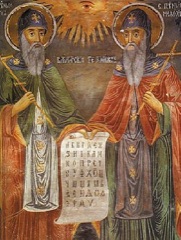
Constantine, who took the name Cyril as a monk shortly before his death, and his elder brother Methodius were born in Thessalonica in the Byzantine Empire and grew up speaking the Slavic dialect of the surrounding region. Constantine became a scholar and teacher in Constantinople, and Methodius an administrator and then a monk. In 862 or 863 Prince Rastislav of Great Moravia asked the emperor for teachers who could instruct his people in their own language. The brothers were sent, and for the mission Constantine devised the Glagolitic alphabet, from which the later Cyrillic script, named in his honour, developed. They translated the Gospels and the liturgy into Old Church Slavonic, which met opposition from Frankish clergy who held that worship should be in Latin, Greek or Hebrew. In Rome Pope Hadrian II approved the Slavonic liturgy. Cyril died in Rome in 869; Methodius became archbishop of Sirmium, endured imprisonment, and died in Moravia in 885. Both are honoured in the Orthodox and Catholic churches. They are honoured as apostles to the Slavs.
Faith: Byzantine Christian missionaries to the Slavs, venerated as saints in Eastern Orthodoxy, Roman Catholicism, Anglicanism and Lutheranism. Source: Encyclopaedia Britannica

Key dates
- 863 Mission to Great Moravia begins
- c. 863 Glagolitic alphabet devised
- 867–868 Slavonic liturgy approved in Rome
- 869 Cyril dies in Rome
- 885 Methodius dies in Moravia
More lives
Thomas Becket · Bede · Benedict of Nursia · Bernard of Clairvaux · Bonaventure · Cædmon