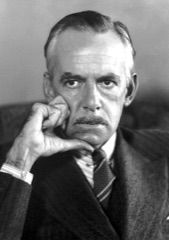
Eugene O'Neill
1888–1953 · American playwright, winner of four Pulitzer Prizes and the 1936 Nobel Prize in Literature, author of Long Day's Journey into Night.
Eugene O'Neill was born in 1888 in a New York City hotel room, the son of the touring actor James O'Neill, and spent much of his childhood traveling with his parents or at boarding schools. He attended Princeton University for a year, then spent several years at sea as a sailor, prospected for gold in Honduras, and lived in poverty in New York. While recovering from tuberculosis in a sanatorium in 1912–1913, he decided to become a playwright. His early one-act plays about the sea were staged by the Provincetown Players. Beyond the Horizon (1920) won the first of his four Pulitzer Prizes for Drama. His plays, including The Emperor Jones, Anna Christie, Strange Interlude, Mourning Becomes Electra, which sets the Greek Oresteia in New England after the Civil War, and The Iceman Cometh, brought serious tragedy to the American stage. He won the Nobel Prize in Literature in 1936. His autobiographical masterpiece, Long Day's Journey into Night, was staged after his death in Boston in 1953 and won a final Pulitzer.
Eugene O'Neill is also an author in the library: author page and works.
Faith: Raised Catholic and educated at Catholic schools; his adult beliefs are not well documented. Source: Wikipedia
Key dates
- 1888 Born in New York City
- 1912–1913 Decides to write plays while recovering from tuberculosis
- 1920 First Pulitzer Prize, for Beyond the Horizon
- 1931 Mourning Becomes Electra staged
- 1936 Nobel Prize in Literature
- 1953 Dies in Boston
Watch


Videos load from YouTube in privacy-enhanced mode only when you press play.
Read about them
Grades 9–12
- Mourning Becomes Electra · In the library
More lives
Marguerite de Angeli · Richard and Florence Atwater · Mariano Azuela · Samuel Beckett · W. E. B. Du Bois · Bertolt Brecht