Frank Lloyd Wright
1867–1959 · American architect of Fallingwater and the Guggenheim Museum, creator of the Prairie style.
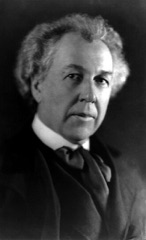
Frank Lloyd Wright was born in Richland Center, Wisconsin. His mother gave him Froebel kindergarten blocks, which he said shaped his sense of form. He studied engineering briefly, then went to Chicago and worked for the architect Louis Sullivan. In 1893 he opened his own practice in Oak Park, Illinois, where he developed the Prairie style: long, low houses with flat overhanging roofs, open interior spaces and bands of windows, meant to suit the flat Midwestern landscape. He believed in organic architecture, buildings in harmony with their sites and their materials. His personal life was turbulent, and in 1914 a worker murdered seven people and set fire to his Wisconsin home, Taliesin. He rebuilt it and designed the Imperial Hotel in Tokyo, which survived the 1923 earthquake. In the 1930s, when he was nearly seventy, he designed Fallingwater, a house built over a waterfall in Pennsylvania, and founded a school for apprentices at Taliesin and later at Taliesin West in Arizona. His last major work, the spiral Guggenheim Museum in New York, opened months after his death in 1959.
Faith: Raised in a Unitarian family; his adult beliefs are not well documented. Source: Wikipedia

Key dates
- 1893 Opens his own practice
- 1909 Robie House in Chicago
- 1911 Builds Taliesin in Wisconsin
- 1935–1937 Fallingwater
- 1959 Dies; Guggenheim Museum opens
Read about them
As an Amazon Associate I earn from qualifying purchases. As a Bookshop.org affiliate I earn from qualifying purchases, which also support independent bookstores.
Grades 3–5
- Who Was Frank Lloyd Wright? by Ellen Labrecque (2015; ISBN 9780448483139)
Bookshop.org · Amazon
More lives
Virginia Lee Burton · Russell Hoban · Norton Juster · Robert McCloskey · Esphyr Slobodkina