Hildegard of Bingen
1098–1179 · German abbess, visionary writer, composer and naturalist; a Doctor of the Church.
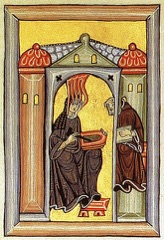
Hildegard was born in the Rhineland of Germany, the tenth child of a noble family. As a young girl she was placed in the care of Jutta, a holy woman living enclosed beside the monastery of Disibodenberg, and she later took vows as a Benedictine nun. From childhood she experienced visions of light. In 1141 she began writing down her visions in a book called Scivias, Know the Ways, and Pope Eugene III approved her work. Around 1150 she founded her own convent at Rupertsberg near Bingen. She wrote books on theology, on medicine and the healing properties of plants and stones, and a play set to music. She composed some seventy chants, with soaring melodies, and invented a secret language. She corresponded with popes, emperors and Bernard of Clairvaux, and in her sixties she made preaching tours through Germany, unusual for a woman of her time. In her eighties she refused to let her convent dig up a man buried there whom church officials considered excommunicated. She died in 1179. In 2012 she was canonized and named a Doctor of the Church.
Faith: German mystic of the Rupertsberg near Bingen, honored as Saint Hildegard with a feast day on 17 September. Source: Catholic Encyclopedia (1913)

Key dates
- 1136 Becomes leader of her community
- 1141 Begins writing Scivias
- c. 1150 Founds the convent at Rupertsberg
- 1179 Dies at Rupertsberg
- 2012 Named a Doctor of the Church
Fun facts
- The plant genus Hildegardia is named after her because of her work on herbal medicine. (Source: Hildegard of Bingen (Wikipedia))
Record-breaker
Firsts and records, worded as the sources give them ("first known", "at the time").
- Her Ordo Virtutum is arguably the oldest surviving morality play. (Source: Hildegard of Bingen (Wikipedia))
More lives
Thomas Becket · Bede · Benedict of Nursia · Bernard of Clairvaux · Bonaventure · Cædmon