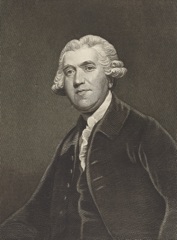
Josiah Wedgwood
1730–1795 · English potter who industrialized pottery-making and campaigned against the slave trade.
Josiah Wedgwood was born in Burslem, Staffordshire, the youngest of twelve children in a family of potters. After his father died he left school at nine to work at the family pottery. Smallpox weakened his right leg, and years later it had to be amputated, but he became a master potter through constant experiment, recording thousands of tests in notebooks. He developed a durable cream-colored earthenware that Queen Charlotte admired, so he called it Queensware, and later Jasperware, a fine unglazed stoneware in blue and white. In 1769 he opened a large factory called Etruria, organized with a careful division of labor, and he promoted a canal to carry clay and finished pottery safely. He pioneered showrooms, catalogues and money-back guarantees. A member of the Lunar Society with scientists such as Erasmus Darwin, he invented a pyrometer to measure kiln heat. In 1787 he produced a medallion showing a kneeling enslaved man with the words Am I Not a Man and a Brother?, which became the emblem of the abolition movement. He died in 1795; Charles Darwin was his grandson.
Faith: Attended an English Presbyterian chapel that later became Unitarian. Source: Wikipedia
Key dates
- 1759 Opens his own pottery
- 1765 Queen Charlotte's order leads to Queensware
- 1769 Opens the Etruria works
- 1787 Anti-slavery medallion
- 1795 Dies at Etruria