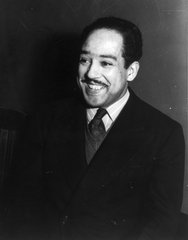
Langston Hughes
1901–1967 · Harlem Renaissance poet of The Negro Speaks of Rivers, Mother to Son and Dreams, who brought blues and jazz rhythms into American verse.
Langston Hughes was born in Joplin, Missouri, in 1901 and spent much of his childhood in Lawrence, Kansas, with his grandmother Mary Patterson Langston. He finished high school in Cleveland, Ohio. In 1921 The Crisis, the NAACP magazine edited by W. E. B. Du Bois, printed his poem ‘The Negro Speaks of Rivers’, and in 1922 it printed ‘Mother to Son’. After a year at Columbia University he sailed as a crewman on a freighter to West Africa and Europe and stayed for a time in Paris. His first book of poems, The Weary Blues, appeared in 1926, and he graduated from Lincoln University in Pennsylvania in 1929. Over four decades he wrote poems, the novel Not Without Laughter (1930), plays, children’s books, the memoir The Big Sea (1940), and a long-running newspaper column whose comic character Jesse B. Semple became famous. He drew on blues, jazz and church music for the rhythms of his verse. He died in New York in 1967.
Langston Hughes is also an author in the library: author page and works.
Faith: At twelve, during a 1914 revival at St. Luke AME Church in Lawrence, Kansas, Hughes went forward to be saved but did not have the experience of seeing Jesus that he had been promised, a story he told in The Big Sea (1940). He never became a church member as an adult, and ‘Goodbye Christ’ (1932) came from the years when he was most critical of Christianity, though he rejected being called antireligious. Black church language, spirituals and gospel music run through his work, and his own ‘Last Rites’ asked for a memorial outside any church, with no prayers or sermons but with gospel, jazz and blues. Source: Black Perspectives (AAIHS), review of Wallace Best, Langston’s Salvation
See also: W. E. B. Du Bois

Key dates
- 1901 Born in Joplin, Missouri
- 1921 The Crisis prints The Negro Speaks of Rivers
- 1922 Mother to Son appears in The Crisis
- 1923 Dreams printed in The World Tomorrow; sails to West Africa as a crewman
- 1926 The Weary Blues, his first book
- 1929 Graduates from Lincoln University
- 1940 Publishes his memoir The Big Sea
- 1967 Dies in New York
Major works
- The Negro Speaks of Rivers (1921) · His first widely noticed poem, printed in The Crisis.
- Mother to Son (1922) · In the library
- Dreams (1923) · In the library
- The Weary Blues (1926) · His first collection of poems.
- Not Without Laughter (1930) · A novel of a Black boy growing up in Kansas.
- The Big Sea (1940) · Memoir.
Fun facts
- His ashes are interred beneath a floor medallion in the entrance hall of the Schomburg Center for Research in Black Culture in Harlem. (Source: Langston Hughes (Wikipedia))
Read about them
Grades 3–5
- Dreams · In the library
Grades 6–8
- Mother to Son · In the library
More lives
Marguerite de Angeli · Richard and Florence Atwater · Mariano Azuela · Samuel Beckett · W. E. B. Du Bois · Bertolt Brecht