Martin Luther
1483–1546 · German monk and professor whose challenge to the Church began the Protestant Reformation.
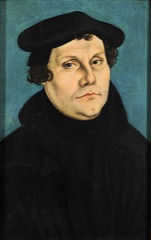
Martin Luther was the son of a copper miner in Saxony. He was studying law when, caught in a violent thunderstorm in 1505, he vowed to become a monk, and he entered an Augustinian monastery. He became a professor of the Bible at the University of Wittenberg. Troubled about how a sinner could be right with God, he came to believe from Paul's letters that people are made righteous by God's grace through faith, not by their own works. In 1517 he wrote the Ninety-Five Theses against the sale of indulgences. The printing press spread his writings across Germany. Refusing to take back his books at the Diet of Worms in 1521, he was declared an outlaw; his prince, Frederick the Wise, hid him in Wartburg Castle, where he translated the New Testament into German. He married a former nun, Katharina von Bora, wrote hymns such as A Mighty Fortress Is Our God, and wrote catechisms for families. His late writings against the Jews were harsh and are widely rejected today. He died in 1546.
Martin Luther is also an author in the library: author page and works.
Faith: Former Augustinian monk who became the central figure of the Protestant Reformation. Source: Stanford Encyclopedia of Philosophy
Further reading
- Martin Luther: A Very Short Introduction by Scott H. Hendrix (Oxford University Press, 2010), ISBN 9780199574339
Key dates
- 1483 Born at Eisleben
- 1505 Enters the monastery
- 1517 Ninety-Five Theses
- 1521 Diet of Worms
- 1522 German New Testament published
- 1546 Dies at Eisleben
Watch

Videos load from YouTube in privacy-enhanced mode only when you press play.
Read about them
As an Amazon Associate I earn from qualifying purchases. As a Bookshop.org affiliate I earn from qualifying purchases, which also support independent bookstores.
Grades 9–12
- Selected Sermons and Reformation Treatises · In the library
- The Bondage of the Will (De Servo Arbitrio) · In the library
- The Leipzig Disputation · In the library
- Here I Stand: A Life of Martin Luther by Roland H. Bainton (Abingdon Press, 2013; ISBN 9781426775963)
Bookshop.org · Amazon
More lives
Fra Angelico · Thieleman J. van Braght · John Bunyan · Robert Burton · John Calvin · Thomas Cranmer