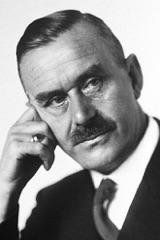
Thomas Mann
1875–1955 · German novelist, author of Buddenbrooks and The Magic Mountain, and winner of the Nobel Prize in Literature.
Thomas Mann was born in 1875 in Lübeck, in northern Germany, into a wealthy merchant family; his father was a grain merchant and city senator. After his father's death the family firm was dissolved, and the family moved to Munich, where Thomas began writing. His first novel, Buddenbrooks (1901), traces the decline of a merchant family over four generations, much like his own. In 1905 he married Katia Pringsheim, and they had six children, several of whom also became writers. His novella Death in Venice appeared in 1912. The Magic Mountain (1924), set in a Swiss sanatorium before the First World War, explores ideas about time, illness and European society. In 1929 he received the Nobel Prize in Literature. When Hitler came to power in 1933 he fled to Switzerland, and in 1939 he moved to the United States, teaching at Princeton and later living in Los Angeles. During the war he broadcast radio talks to Germany. His later novels include Joseph and His Brothers and Doctor Faustus. In 1952 he returned to Switzerland, where he died in 1955.
Thomas Mann is also an author in the library: author page and works.
Faith: Baptised Lutheran, his father's religion. Source: Wikipedia

Key dates
- 1875 Born in Lübeck, Germany
- 1901 Buddenbrooks published
- 1912 Death in Venice published
- 1924 The Magic Mountain published
- 1929 Nobel Prize in Literature
- 1933 Goes into exile
- 1955 Dies in Switzerland
Read about them
Grades 9–12
- Death in Venice · In the library
More lives
Marguerite de Angeli · Richard and Florence Atwater · Mariano Azuela · Samuel Beckett · W. E. B. Du Bois · Bertolt Brecht