Story maps · Grades 11–12
Anna Karenina: A Story Map
The PDF is one tabloid page (11 × 17 in). On letter paper, choose “Fit to page.”
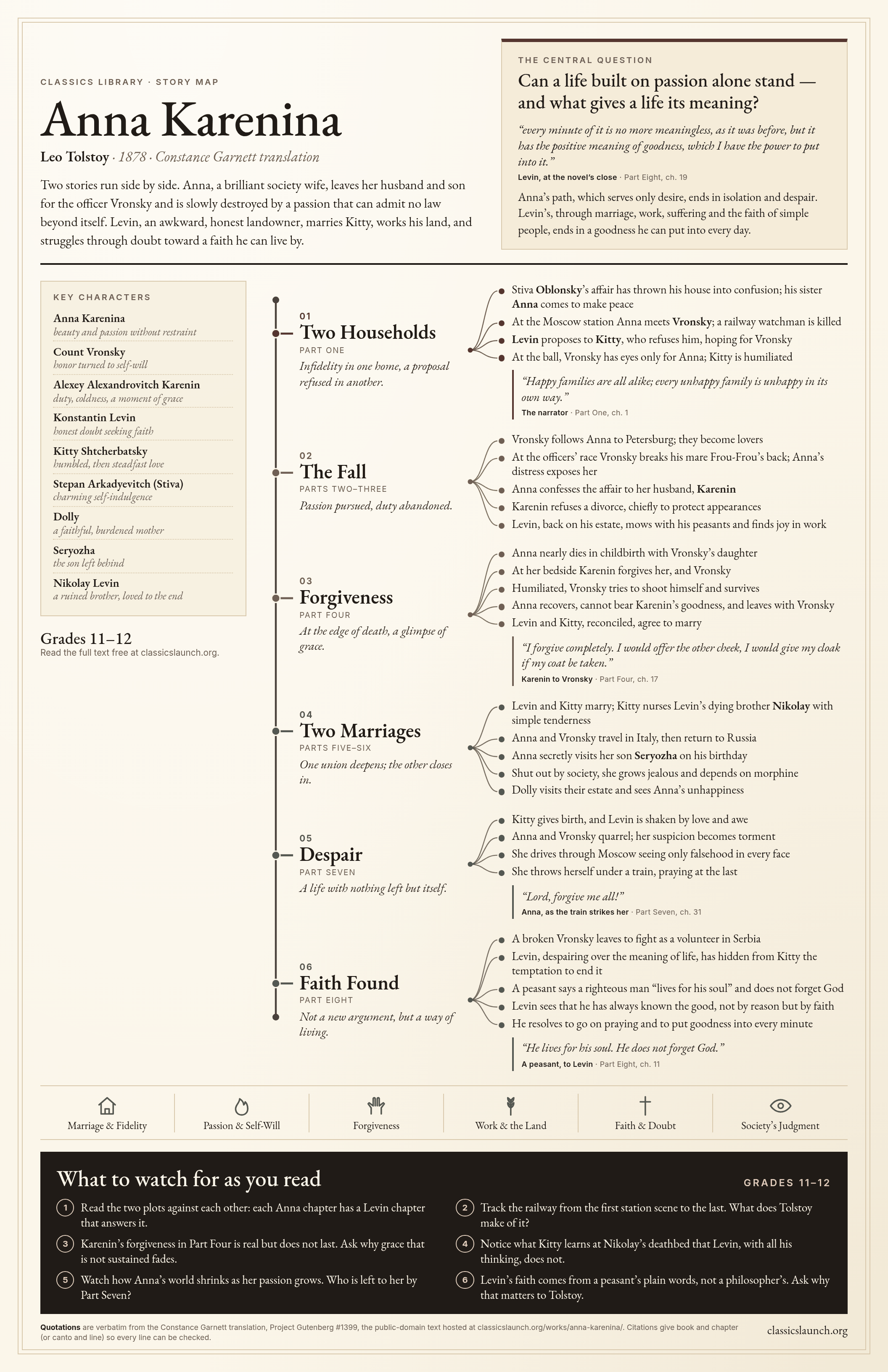
Two stories run side by side. Anna, a brilliant society wife, leaves her husband and son for the officer Vronsky and is slowly destroyed by a passion that can admit no law beyond itself. Levin, an awkward, honest landowner, marries Kitty, works his land, and struggles through doubt toward a faith he can live by.
The central question
Can a life built on passion alone stand — and what gives a life its meaning?
“every minute of it is no more meaningless, as it was before, but it has the positive meaning of goodness, which I have the power to put into it.”
Anna’s path, which serves only desire, ends in isolation and despair. Levin’s, through marriage, work, suffering and the faith of simple people, ends in a goodness he can put into every day.
- 01
Two Households
Part One
Infidelity in one home, a proposal refused in another.
- Stiva Oblonsky’s affair has thrown his house into confusion; his sister Anna comes to make peace
- At the Moscow station Anna meets Vronsky; a railway watchman is killed
- Levin proposes to Kitty, who refuses him, hoping for Vronsky
- At the ball, Vronsky has eyes only for Anna; Kitty is humiliated
“Happy families are all alike; every unhappy family is unhappy in its own way.”
- 02
The Fall
Parts Two–Three
Passion pursued, duty abandoned.
- Vronsky follows Anna to Petersburg; they become lovers
- At the officers’ race Vronsky breaks his mare Frou-Frou’s back; Anna’s distress exposes her
- Anna confesses the affair to her husband, Karenin
- Karenin refuses a divorce, chiefly to protect appearances
- Levin, back on his estate, mows with his peasants and finds joy in work
- 03
Forgiveness
Part Four
At the edge of death, a glimpse of grace.
- Anna nearly dies in childbirth with Vronsky’s daughter
- At her bedside Karenin forgives her, and Vronsky
- Humiliated, Vronsky tries to shoot himself and survives
- Anna recovers, cannot bear Karenin’s goodness, and leaves with Vronsky
- Levin and Kitty, reconciled, agree to marry
“I forgive completely. I would offer the other cheek, I would give my cloak if my coat be taken.”
- 04
Two Marriages
Parts Five–Six
One union deepens; the other closes in.
- Levin and Kitty marry; Kitty nurses Levin’s dying brother Nikolay with simple tenderness
- Anna and Vronsky travel in Italy, then return to Russia
- Anna secretly visits her son Seryozha on his birthday
- Shut out by society, she grows jealous and depends on morphine
- Dolly visits their estate and sees Anna’s unhappiness
- 05
Despair
Part Seven
A life with nothing left but itself.
- Kitty gives birth, and Levin is shaken by love and awe
- Anna and Vronsky quarrel; her suspicion becomes torment
- She drives through Moscow seeing only falsehood in every face
- She throws herself under a train, praying at the last
“Lord, forgive me all!”
- 06
Faith Found
Part Eight
Not a new argument, but a way of living.
- A broken Vronsky leaves to fight as a volunteer in Serbia
- Levin, despairing over the meaning of life, has hidden from Kitty the temptation to end it
- A peasant says a righteous man “lives for his soul” and does not forget God
- Levin sees that he has always known the good, not by reason but by faith
- He resolves to go on praying and to put goodness into every minute
“He lives for his soul. He does not forget God.”
- Marriage & Fidelity
- Passion & Self-Will
- Forgiveness
- Work & the Land
- Faith & Doubt
- Society’s Judgment
What to watch for as you read
Grades 11–12- Read the two plots against each other: each Anna chapter has a Levin chapter that answers it.
- Track the railway from the first station scene to the last. What does Tolstoy make of it?
- Karenin’s forgiveness in Part Four is real but does not last. Ask why grace that is not sustained fades.
- Notice what Kitty learns at Nikolay’s deathbed that Levin, with all his thinking, does not.
- Watch how Anna’s world shrinks as her passion grows. Who is left to her by Part Seven?
- Levin’s faith comes from a peasant’s plain words, not a philosopher’s. Ask why that matters to Tolstoy.
Every quotation is word for word from the Constance Garnett translation hosted in this library and is checked against that text each time the site is built. Citations give book and chapter (or canto and line).