Story maps · Grades 11–12
Crime and Punishment: A Story Map
The PDF is one tabloid page (11 × 17 in). On letter paper, choose “Fit to page.”
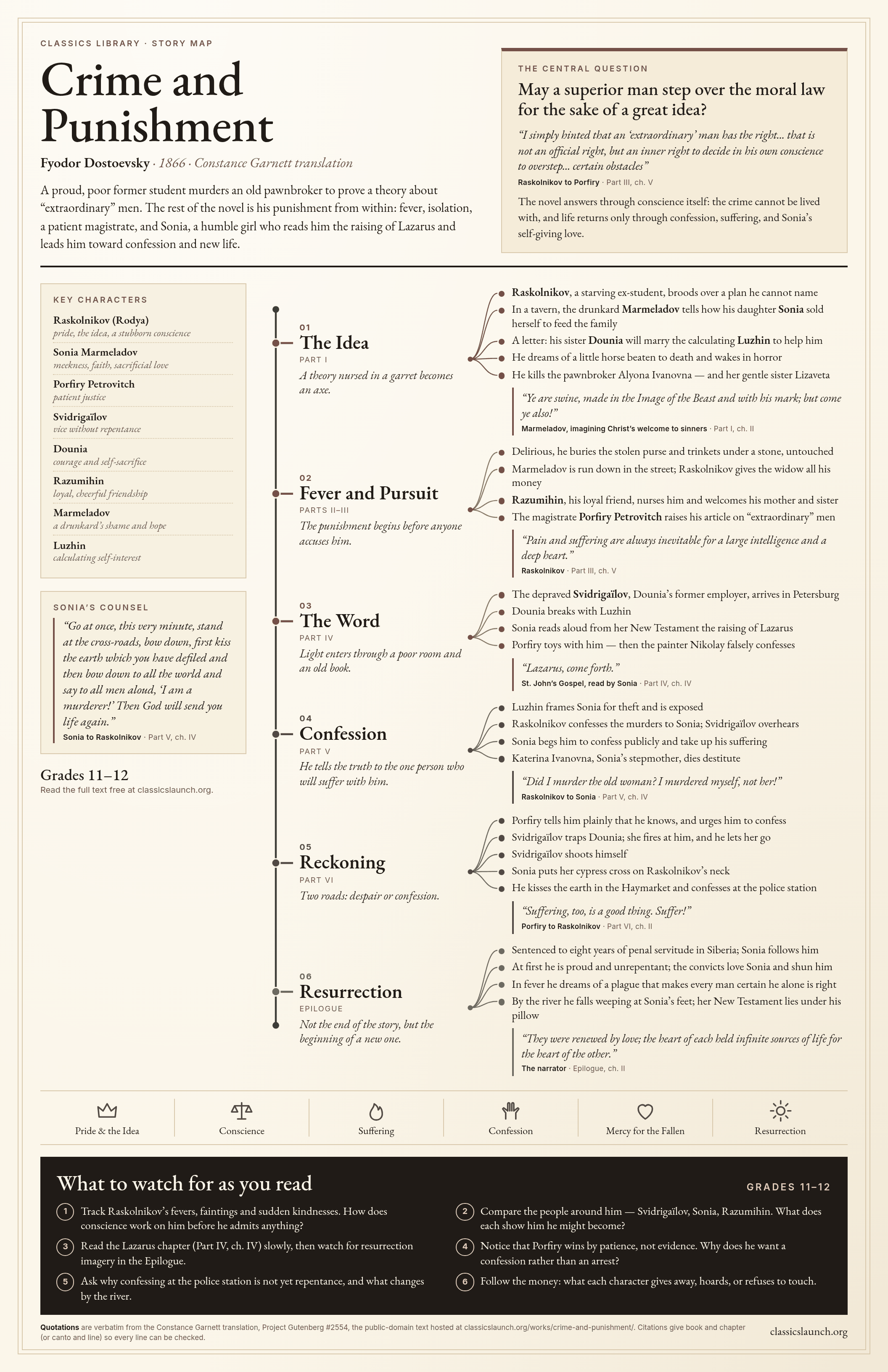
A proud, poor former student murders an old pawnbroker to prove a theory about “extraordinary” men. The rest of the novel is his punishment from within: fever, isolation, a patient magistrate, and Sonia, a humble girl who reads him the raising of Lazarus and leads him toward confession and new life.
The central question
May a superior man step over the moral law for the sake of a great idea?
“I simply hinted that an ‘extraordinary’ man has the right... that is not an official right, but an inner right to decide in his own conscience to overstep... certain obstacles”
The novel answers through conscience itself: the crime cannot be lived with, and life returns only through confession, suffering, and Sonia’s self-giving love.
- 01
The Idea
Part I
A theory nursed in a garret becomes an axe.
- Raskolnikov, a starving ex-student, broods over a plan he cannot name
- In a tavern, the drunkard Marmeladov tells how his daughter Sonia sold herself to feed the family
- A letter: his sister Dounia will marry the calculating Luzhin to help him
- He dreams of a little horse beaten to death and wakes in horror
- He kills the pawnbroker Alyona Ivanovna — and her gentle sister Lizaveta
“Ye are swine, made in the Image of the Beast and with his mark; but come ye also!”
- 02
Fever and Pursuit
Parts II–III
The punishment begins before anyone accuses him.
- Delirious, he buries the stolen purse and trinkets under a stone, untouched
- Marmeladov is run down in the street; Raskolnikov gives the widow all his money
- Razumihin, his loyal friend, nurses him and welcomes his mother and sister
- The magistrate Porfiry Petrovitch raises his article on “extraordinary” men
“Pain and suffering are always inevitable for a large intelligence and a deep heart.”
- 03
The Word
Part IV
Light enters through a poor room and an old book.
- The depraved Svidrigaïlov, Dounia’s former employer, arrives in Petersburg
- Dounia breaks with Luzhin
- Sonia reads aloud from her New Testament the raising of Lazarus
- Porfiry toys with him — then the painter Nikolay falsely confesses
“Lazarus, come forth.”
- 04
Confession
Part V
He tells the truth to the one person who will suffer with him.
- Luzhin frames Sonia for theft and is exposed
- Raskolnikov confesses the murders to Sonia; Svidrigaïlov overhears
- Sonia begs him to confess publicly and take up his suffering
- Katerina Ivanovna, Sonia’s stepmother, dies destitute
“Did I murder the old woman? I murdered myself, not her!”
- 05
Reckoning
Part VI
Two roads: despair or confession.
- Porfiry tells him plainly that he knows, and urges him to confess
- Svidrigaïlov traps Dounia; she fires at him, and he lets her go
- Svidrigaïlov shoots himself
- Sonia puts her cypress cross on Raskolnikov’s neck
- He kisses the earth in the Haymarket and confesses at the police station
“Suffering, too, is a good thing. Suffer!”
- 06
Resurrection
Epilogue
Not the end of the story, but the beginning of a new one.
- Sentenced to eight years of penal servitude in Siberia; Sonia follows him
- At first he is proud and unrepentant; the convicts love Sonia and shun him
- In fever he dreams of a plague that makes every man certain he alone is right
- By the river he falls weeping at Sonia’s feet; her New Testament lies under his pillow
“They were renewed by love; the heart of each held infinite sources of life for the heart of the other.”
- Pride & the Idea
- Conscience
- Suffering
- Confession
- Mercy for the Fallen
- Resurrection
What to watch for as you read
Grades 11–12- Track Raskolnikov’s fevers, faintings and sudden kindnesses. How does conscience work on him before he admits anything?
- Compare the people around him — Svidrigaïlov, Sonia, Razumihin. What does each show him he might become?
- Read the Lazarus chapter (Part IV, ch. IV) slowly, then watch for resurrection imagery in the Epilogue.
- Notice that Porfiry wins by patience, not evidence. Why does he want a confession rather than an arrest?
- Ask why confessing at the police station is not yet repentance, and what changes by the river.
- Follow the money: what each character gives away, hoards, or refuses to touch.
Every quotation is word for word from the Constance Garnett translation hosted in this library and is checked against that text each time the site is built. Citations give book and chapter (or canto and line).