Story maps · Grades 11–12
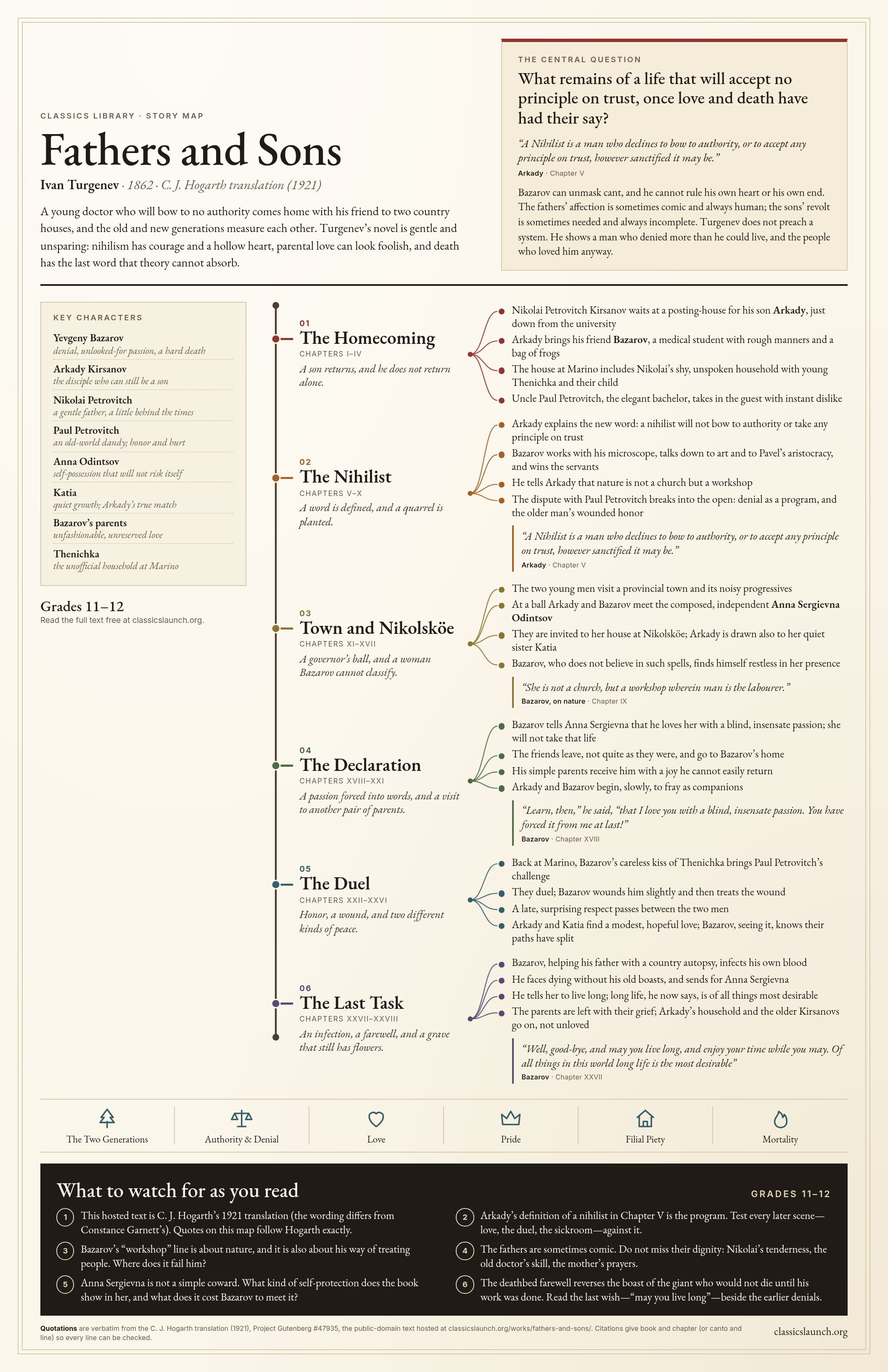
Fathers and Sons: A Story Map
The PDF is one tabloid page (11 × 17 in). On letter paper, choose “Fit to page.”
A young doctor who will bow to no authority comes home with his friend to two country houses, and the old and new generations measure each other. Turgenev’s novel is gentle and unsparing: nihilism has courage and a hollow heart, parental love can look foolish, and death has the last word that theory cannot absorb.
The central question
What remains of a life that will accept no principle on trust, once love and death have had their say?
“A Nihilist is a man who declines to bow to authority, or to accept any principle on trust, however sanctified it may be.”
Bazarov can unmask cant, and he cannot rule his own heart or his own end. The fathers’ affection is sometimes comic and always human; the sons’ revolt is sometimes needed and always incomplete. Turgenev does not preach a system. He shows a man who denied more than he could live, and the people who loved him anyway.
- 01
The Homecoming
Chapters I–IV
A son returns, and he does not return alone.
- Nikolai Petrovitch Kirsanov waits at a posting-house for his son Arkady, just down from the university
- Arkady brings his friend Bazarov, a medical student with rough manners and a bag of frogs
- The house at Marino includes Nikolai’s shy, unspoken household with young Thenichka and their child
- Uncle Paul Petrovitch, the elegant bachelor, takes in the guest with instant dislike
- 02
The Nihilist
Chapters V–X
A word is defined, and a quarrel is planted.
- Arkady explains the new word: a nihilist will not bow to authority or take any principle on trust
- Bazarov works with his microscope, talks down to art and to Pavel’s aristocracy, and wins the servants
- He tells Arkady that nature is not a church but a workshop
- The dispute with Paul Petrovitch breaks into the open: denial as a program, and the older man’s wounded honor
“A Nihilist is a man who declines to bow to authority, or to accept any principle on trust, however sanctified it may be.”
- 03
Town and Nikolsköe
Chapters XI–XVII
A governor’s ball, and a woman Bazarov cannot classify.
- The two young men visit a provincial town and its noisy progressives
- At a ball Arkady and Bazarov meet the composed, independent Anna Sergievna Odintsov
- They are invited to her house at Nikolsköe; Arkady is drawn also to her quiet sister Katia
- Bazarov, who does not believe in such spells, finds himself restless in her presence
“She is not a church, but a workshop wherein man is the labourer.”
- 04
The Declaration
Chapters XVIII–XXI
A passion forced into words, and a visit to another pair of parents.
- Bazarov tells Anna Sergievna that he loves her with a blind, insensate passion; she will not take that life
- The friends leave, not quite as they were, and go to Bazarov’s home
- His simple parents receive him with a joy he cannot easily return
- Arkady and Bazarov begin, slowly, to fray as companions
“Learn, then,” he said, “that I love you with a blind, insensate passion. You have forced it from me at last!”
- 05
The Duel
Chapters XXII–XXVI
Honor, a wound, and two different kinds of peace.
- Back at Marino, Bazarov’s careless kiss of Thenichka brings Paul Petrovitch’s challenge
- They duel; Bazarov wounds him slightly and then treats the wound
- A late, surprising respect passes between the two men
- Arkady and Katia find a modest, hopeful love; Bazarov, seeing it, knows their paths have split
- 06
The Last Task
Chapters XXVII–XXVIII
An infection, a farewell, and a grave that still has flowers.
- Bazarov, helping his father with a country autopsy, infects his own blood
- He faces dying without his old boasts, and sends for Anna Sergievna
- He tells her to live long; long life, he now says, is of all things most desirable
- The parents are left with their grief; Arkady’s household and the older Kirsanovs go on, not unloved
“Well, good-bye, and may you live long, and enjoy your time while you may. Of all things in this world long life is the most desirable”
- The Two Generations
- Authority & Denial
- Love
- Pride
- Filial Piety
- Mortality
What to watch for as you read
Grades 11–12- This hosted text is C. J. Hogarth’s 1921 translation (the wording differs from Constance Garnett’s). Quotes on this map follow Hogarth exactly.
- Arkady’s definition of a nihilist in Chapter V is the program. Test every later scene—love, the duel, the sickroom—against it.
- Bazarov’s “workshop” line is about nature, and it is also about his way of treating people. Where does it fail him?
- The fathers are sometimes comic. Do not miss their dignity: Nikolai’s tenderness, the old doctor’s skill, the mother’s prayers.
- Anna Sergievna is not a simple coward. What kind of self-protection does the book show in her, and what does it cost Bazarov to meet it?
- The deathbed farewell reverses the boast of the giant who would not die until his work was done. Read the last wish—“may you live long”—beside the earlier denials.
Every quotation is word for word from the C. J. Hogarth translation (1921) hosted in this library and is checked against that text each time the site is built. Citations give book and chapter (or canto and line).