Story maps · Grades 9–12
Frankenstein: A Story Map
The PDF is one tabloid page (11 × 17 in). On letter paper, choose “Fit to page.”
A Genevese student steals the fire of animation, then refuses the creature he has made, and a trail of deaths follows that refusal home. Shelley’s 1831 text is a warning about knowledge without love, about a maker’s duty, and about how misery, left unrelieved, can be schooled into revenge.
The central question
What does a maker owe the life he has called into the world?
“I ought to be thy Adam, but I am rather the fallen angel, whom thou drivest from joy for no misdeed.”
Victor wants the glory of discovery and cannot bear the face of his work. The creature begins with a hunger for kindness and is taught hatred by closed doors. The tragedy is not that man can learn too much, only that he may learn without reverence, responsibility or mercy.
- 01
Walton’s Frame
Letters I–IV
A polar voyager finds a man hunting something across the ice.
- Captain Robert Walton, hungry for unknown knowledge and for a friend, writes home from the north
- His ship is locked in ice; the crew sees a giant figure, then a wasted man on a sledge
- Taken aboard, Victor Frankenstein begins his history as a warning
- The letters make Walton a second student of ambition, listening in time
- 02
The Workshop
Chapters 1–5
Grief, study, and a night that will not stay in the laboratory.
- Victor’s happy Geneva childhood is marked by the gift of Elizabeth and the death of his mother
- At Ingolstadt he devours natural philosophy and conceives a way to bestow animation
- He warns Walton, from the far side of the experiment, how dangerous the acquirement of knowledge can be
- On a raw November night the creature opens its eyes; Victor flees in horror
“Learn from me, if not by my precepts, at least by my example, how dangerous is the acquirement of knowledge”
- 03
The First Graves
Chapters 6–10
The abandoned work comes home as death, and then as a voice.
- Victor’s young brother William is murdered; the servant Justine is condemned for the crime
- Victor knows the killer and says too little too late
- In the Alps the creature confronts him and claims the hearing due to a abandoned child
- He says he was born benevolent, and that misery has made him a fiend
“I was benevolent and good; misery made me a fiend. Make me happy, and I shall again be virtuous.”
- 04
A Creature’s Education
Chapters 11–16
Language, books, and a cottage door that will not open.
- The creature tells of the forest, of the De Lacey cottage, and of learning speech in secret
- From Plutarch, The Sorrows of Werter, and Paradise Lost he takes his first large ideas of man and of a maker
- He hopes for welcome from the blind old man; the family drives him out in terror
- Refused at every human door, he swears war on his creator’s happiness
- 05
The Bargained Mate
Chapters 17–23
A promise made in fear is broken in fear, and the wedding is paid for.
- The creature demands a companion as the price of exile and peace
- Victor consents, travels, and at last destroys the second body before it lives
- The creature’s vow is for the wedding night; friend Henry Clerval is already dead
- Victor marries Elizabeth; she is murdered, and his father dies of the grief
“Beware, for I am fearless and therefore powerful.”
- 06
The Ice
Chapter 24 and Walton’s closing letters
The chase ends where the story began, and a last pity is spoken.
- Victor pursues his creature into the Arctic and tells Walton to finish the work of destruction
- He dies on the ship, still naming his own motives mixed and his duty unmet
- The creature comes to the bier, grieves, and promises his own end on the pyre
- Walton, warned, turns the ship toward home
- Responsibility
- Forbidden Knowledge
- Abandonment
- Revenge
- Pity
- Ambition
What to watch for as you read
Grades 9–12- This hosted text is the 1831 revision (four letters and twenty-four chapters), not the three-volume 1818 form. Chapter numbers follow this edition.
- Victor’s warning about knowledge in Chapter 4 is not a ban on learning. What, exactly, does his example say we must not sever from knowledge?
- The creature’s “I ought to be thy Adam” is a claim of duty, not only of pain. Where does Victor still refuse to be a father?
- Justine’s trial is a test of courage in speech. Who knows the truth, and what do they owe her?
- Watch Walton beside Victor. The frame is there so that one ambitious man might choose differently.
- Do not flatten the creature into a mere monster or a mere victim. The book holds him responsible for murder, and it holds Victor responsible for the making and the flight.
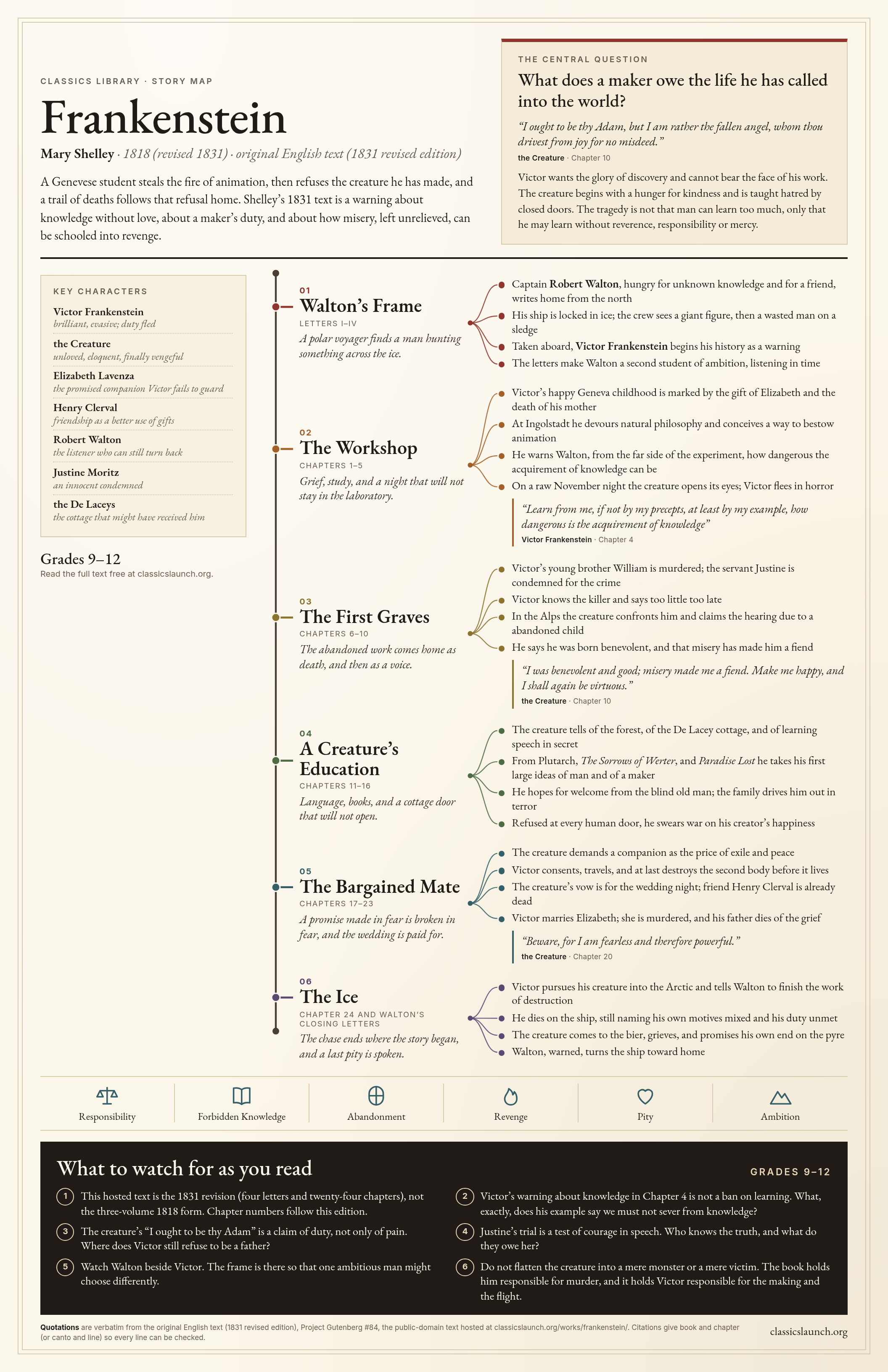
Every quotation is word for word from the original English text (1831 revised edition) hosted in this library and is checked against that text each time the site is built. Citations give book and chapter (or canto and line).