Story maps · Grades 11–12
Faust, Part One: A Story Map
The PDF is one tabloid page (11 × 17 in). On letter paper, choose “Fit to page.”
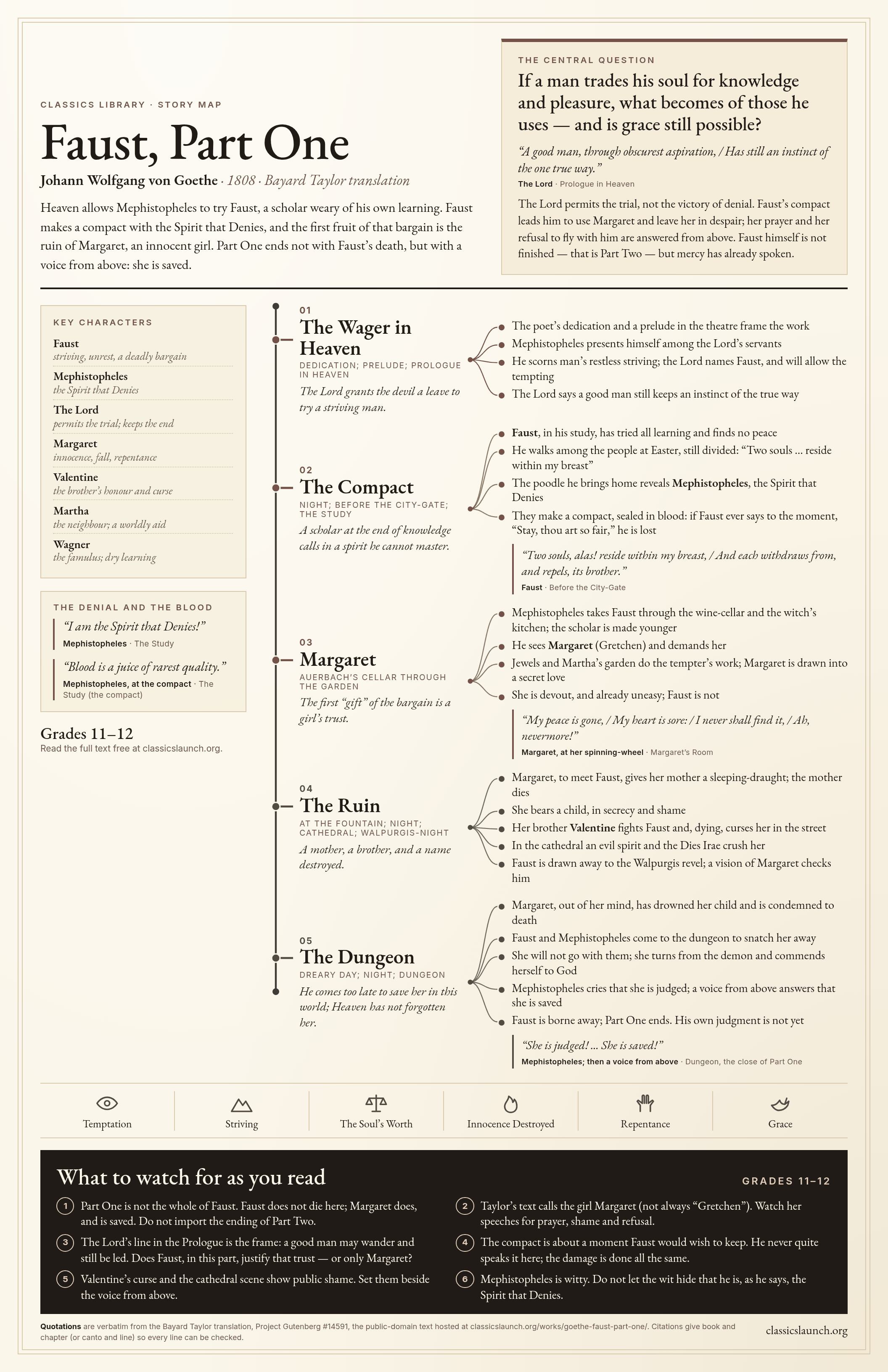
Heaven allows Mephistopheles to try Faust, a scholar weary of his own learning. Faust makes a compact with the Spirit that Denies, and the first fruit of that bargain is the ruin of Margaret, an innocent girl. Part One ends not with Faust’s death, but with a voice from above: she is saved.
The central question
If a man trades his soul for knowledge and pleasure, what becomes of those he uses — and is grace still possible?
“A good man, through obscurest aspiration, / Has still an instinct of the one true way.”
The Lord permits the trial, not the victory of denial. Faust’s compact leads him to use Margaret and leave her in despair; her prayer and her refusal to fly with him are answered from above. Faust himself is not finished — that is Part Two — but mercy has already spoken.
- 01
The Wager in Heaven
Dedication; Prelude; Prologue in Heaven
The Lord grants the devil a leave to try a striving man.
- The poet’s dedication and a prelude in the theatre frame the work
- Mephistopheles presents himself among the Lord’s servants
- He scorns man’s restless striving; the Lord names Faust, and will allow the tempting
- The Lord says a good man still keeps an instinct of the true way
- 02
The Compact
Night; Before the City-Gate; The Study
A scholar at the end of knowledge calls in a spirit he cannot master.
- Faust, in his study, has tried all learning and finds no peace
- He walks among the people at Easter, still divided: “Two souls … reside within my breast”
- The poodle he brings home reveals Mephistopheles, the Spirit that Denies
- They make a compact, sealed in blood: if Faust ever says to the moment, “Stay, thou art so fair,” he is lost
“Two souls, alas! reside within my breast, / And each withdraws from, and repels, its brother.”
- 03
Margaret
Auerbach’s Cellar through the Garden
The first “gift” of the bargain is a girl’s trust.
- Mephistopheles takes Faust through the wine-cellar and the witch’s kitchen; the scholar is made younger
- He sees Margaret (Gretchen) and demands her
- Jewels and Martha’s garden do the tempter’s work; Margaret is drawn into a secret love
- She is devout, and already uneasy; Faust is not
“My peace is gone, / My heart is sore: / I never shall find it, / Ah, nevermore!”
- 04
The Ruin
At the Fountain; Night; Cathedral; Walpurgis-Night
A mother, a brother, and a name destroyed.
- Margaret, to meet Faust, gives her mother a sleeping-draught; the mother dies
- She bears a child, in secrecy and shame
- Her brother Valentine fights Faust and, dying, curses her in the street
- In the cathedral an evil spirit and the Dies Irae crush her
- Faust is drawn away to the Walpurgis revel; a vision of Margaret checks him
- 05
The Dungeon
Dreary Day; Night; Dungeon
He comes too late to save her in this world; Heaven has not forgotten her.
- Margaret, out of her mind, has drowned her child and is condemned to death
- Faust and Mephistopheles come to the dungeon to snatch her away
- She will not go with them; she turns from the demon and commends herself to God
- Mephistopheles cries that she is judged; a voice from above answers that she is saved
- Faust is borne away; Part One ends. His own judgment is not yet
“She is judged! ... She is saved!”
- Temptation
- Striving
- The Soul’s Worth
- Innocence Destroyed
- Repentance
- Grace
What to watch for as you read
Grades 11–12- Part One is not the whole of Faust. Faust does not die here; Margaret does, and is saved. Do not import the ending of Part Two.
- Taylor’s text calls the girl Margaret (not always “Gretchen”). Watch her speeches for prayer, shame and refusal.
- The Lord’s line in the Prologue is the frame: a good man may wander and still be led. Does Faust, in this part, justify that trust — or only Margaret?
- The compact is about a moment Faust would wish to keep. He never quite speaks it here; the damage is done all the same.
- Valentine’s curse and the cathedral scene show public shame. Set them beside the voice from above.
- Mephistopheles is witty. Do not let the wit hide that he is, as he says, the Spirit that Denies.
Every quotation is word for word from the Bayard Taylor translation hosted in this library and is checked against that text each time the site is built. Citations give book and chapter (or canto and line).