Story maps · Grades 9–12
Les Misérables: A Story Map
The PDF is one tabloid page (11 × 17 in). On letter paper, choose “Fit to page.”
Released after nineteen years in the galleys, Jean Valjean is hardened against the world until a bishop answers his theft with mercy. He spends the rest of his life repaying that gift — protecting the orphan Cosette, saving his enemy Javert and the young Marius — while the law, in Javert’s person, pursues him to the end.
The central question
Can mercy remake a man whom the law has already condemned?
“the march from evil to good, from the unjust to the just, from night to day, from appetite to conscience, from rottenness to life, from hell to heaven, from nothingness to God.”
Valjean’s life says yes: one act of grace, accepted and repaid daily, turns a convict into a saint. Javert, who can see only the law, cannot bear that it is true.
- 01
The Bishop
Vol. I, Books I–II
A just man meets a hardened one.
- Bishop Myriel gives his palace to the sick and lives among the poor
- Jean Valjean, jailed for stealing a loaf of bread, is freed after nineteen years
- Turned away everywhere, he is welcomed at the bishop’s table
- He steals the bishop’s silver; caught, he is saved when the bishop adds the candlesticks
- He robs a boy, Little Gervais, of a coin — then weeps and repents
“Jean Valjean, my brother, you no longer belong to evil, but to good. It is your soul that I buy from you”
- 02
Fantine
Vol. I, Books III–VIII
A new name, a new life — and a test.
- Abandoned, Fantine leaves her daughter Cosette with the innkeepers Thénardier
- As “Father Madeleine,” Valjean becomes a factory owner and mayor
- Dismissed from his factory without his knowledge, Fantine sinks into misery
- Another man is about to be condemned as Jean Valjean
- After a night of struggle Valjean rides to the trial and names himself; Fantine dies
“He is not the man whom you are in search of; it is I: I am Jean Valjean.”
- 03
Cosette
Vol. II
A promise to the dead, kept.
- Valjean escapes the galleys and is believed drowned
- On Christmas Eve he finds Cosette drudging for the Thénardiers and buys her a doll
- He ransoms her and flees to Paris, with Javert close behind
- They find refuge in the convent of the Petit-Picpus, where he works as a gardener
- 04
Marius
Vols. III–IV
Youth, love and the cause of the poor.
- Marius breaks with his royalist grandfather over his dead father’s memory
- He lives in poverty and joins the student friends of Enjolras
- In the Luxembourg Garden he falls in love with Cosette
- He witnesses Thénardier’s ambush of Valjean in the Gorbeau tenement and alerts Javert
- Éponine, Thénardier’s daughter, loves Marius in silence
- 05
The Barricade
Vols. IV–V
June 1832: sacrifice in the street.
- The students raise a barricade; Éponine dies shielding Marius
- Little Gavroche is shot gathering cartridges
- Given Javert to execute, Valjean sets him free
- Enjolras and his friends fall
- Valjean carries the wounded Marius through the sewers of Paris
“up to that day he had never dreamed of that other superior, God.”
- 06
Light at the End
Vol. V, Books IV–IX
The law breaks; mercy endures.
- Javert cannot reconcile mercy with law and throws himself into the Seine
- Marius marries Cosette; Valjean confesses his past to Marius
- Marius coldly sends Valjean away, who wastes away alone
- Thénardier unwittingly reveals that Valjean saved Marius
- Valjean dies blessing Cosette and Marius by the bishop’s candlesticks
“Love each other well and always. There is nothing else but that in the world: love for each other.”
- Mercy & Law
- Conversion
- Conscience
- Sacrifice
- Fatherly Love
- The Poor
What to watch for as you read
Grades 9–12- Follow the bishop’s silver candlesticks from Volume I to Valjean’s deathbed.
- Compare Valjean and Javert. Both are honest; why can only one of them receive mercy?
- Read “A Tempest in a Skull” (Vol. I, Book VII, ch. III) closely. What does it cost Valjean to tell the truth?
- Notice the people who sacrifice themselves for others: Fantine, Éponine, Gavroche, Valjean. What do they give, and what are they given?
- Hugo stops the story for long essays (Waterloo, the convent, the sewers). Ask what each one adds to the moral picture.
- At the end, ask what Valjean has kept of the bishop’s gift, and what he has passed on.
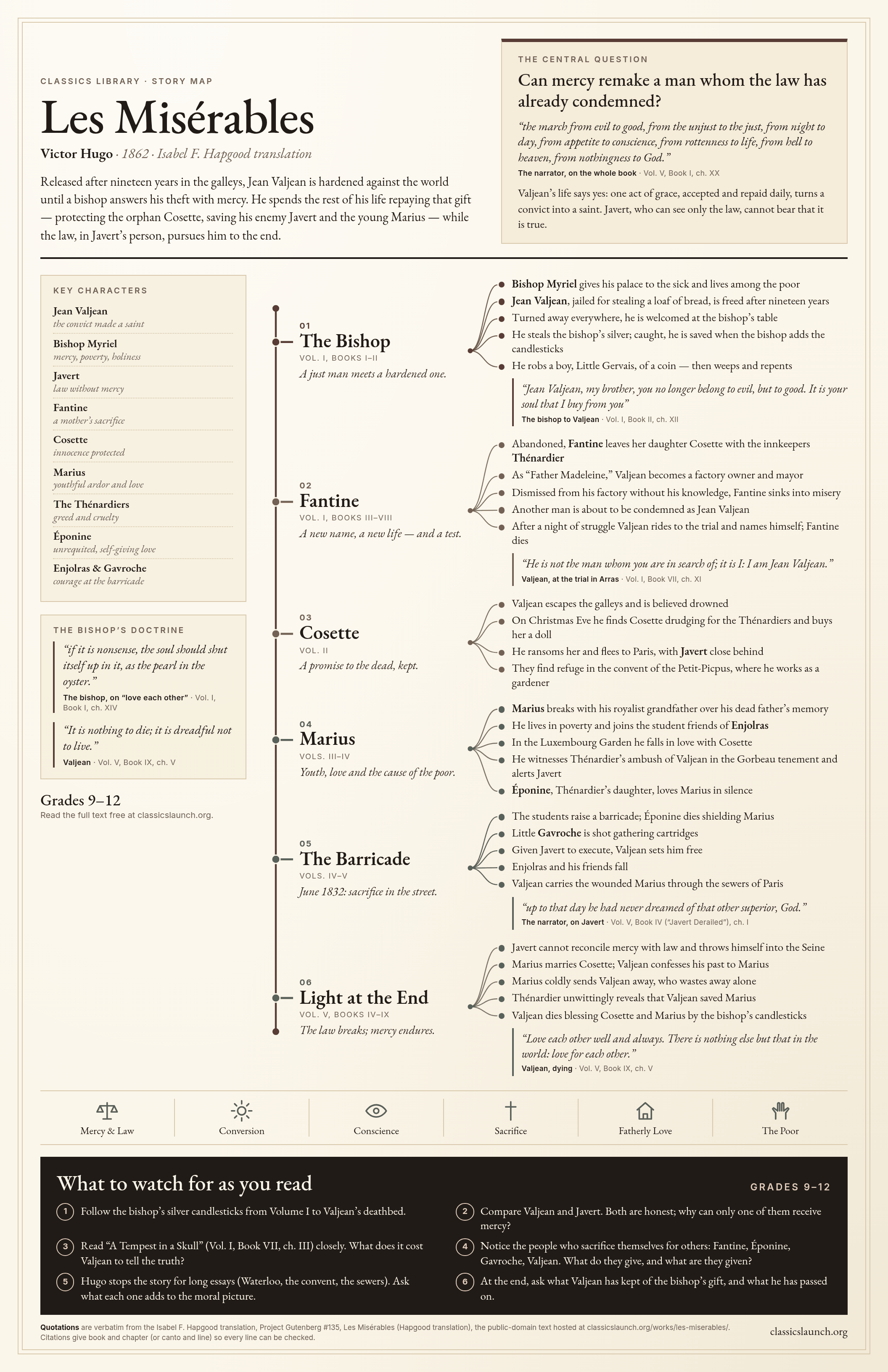
Every quotation is word for word from the Isabel F. Hapgood translation hosted in this library and is checked against that text each time the site is built. Citations give book and chapter (or canto and line).