Story maps · Grades 5–8
Little Women: A Story Map
The PDF is one tabloid page (11 × 17 in). On letter paper, choose “Fit to page.”
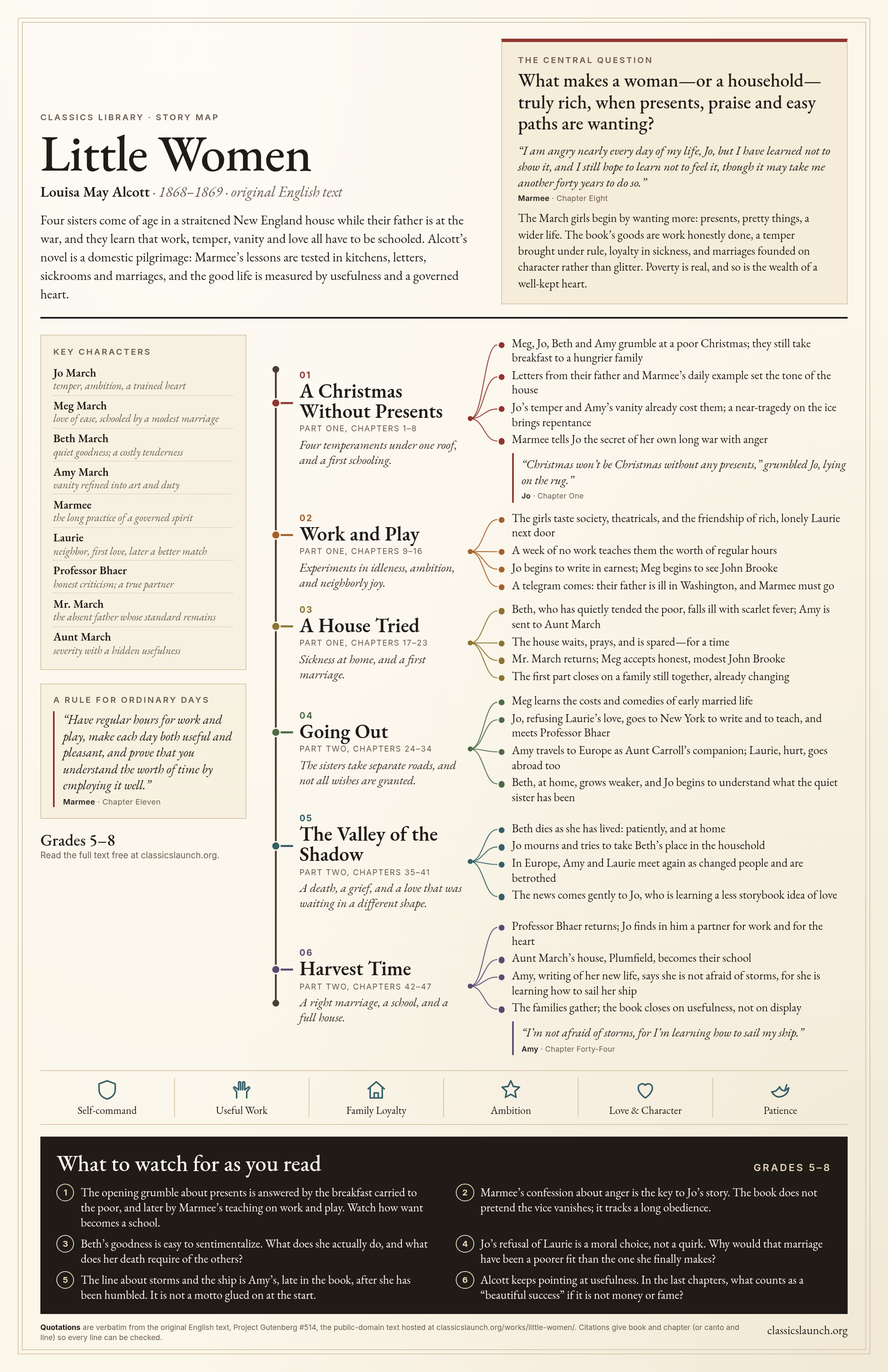
Four sisters come of age in a straitened New England house while their father is at the war, and they learn that work, temper, vanity and love all have to be schooled. Alcott’s novel is a domestic pilgrimage: Marmee’s lessons are tested in kitchens, letters, sickrooms and marriages, and the good life is measured by usefulness and a governed heart.
The central question
What makes a woman—or a household—truly rich, when presents, praise and easy paths are wanting?
“I am angry nearly every day of my life, Jo, but I have learned not to show it, and I still hope to learn not to feel it, though it may take me another forty years to do so.”
The March girls begin by wanting more: presents, pretty things, a wider life. The book’s goods are work honestly done, a temper brought under rule, loyalty in sickness, and marriages founded on character rather than glitter. Poverty is real, and so is the wealth of a well-kept heart.
- 01
A Christmas Without Presents
Part One, Chapters 1–8
Four temperaments under one roof, and a first schooling.
- Meg, Jo, Beth and Amy grumble at a poor Christmas; they still take breakfast to a hungrier family
- Letters from their father and Marmee’s daily example set the tone of the house
- Jo’s temper and Amy’s vanity already cost them; a near-tragedy on the ice brings repentance
- Marmee tells Jo the secret of her own long war with anger
“Christmas won’t be Christmas without any presents,” grumbled Jo, lying on the rug.”
- 02
Work and Play
Part One, Chapters 9–16
Experiments in idleness, ambition, and neighborly joy.
- The girls taste society, theatricals, and the friendship of rich, lonely Laurie next door
- A week of no work teaches them the worth of regular hours
- Jo begins to write in earnest; Meg begins to see John Brooke
- A telegram comes: their father is ill in Washington, and Marmee must go
- 03
A House Tried
Part One, Chapters 17–23
Sickness at home, and a first marriage.
- Beth, who has quietly tended the poor, falls ill with scarlet fever; Amy is sent to Aunt March
- The house waits, prays, and is spared—for a time
- Mr. March returns; Meg accepts honest, modest John Brooke
- The first part closes on a family still together, already changing
- 04
Going Out
Part Two, Chapters 24–34
The sisters take separate roads, and not all wishes are granted.
- Meg learns the costs and comedies of early married life
- Jo, refusing Laurie’s love, goes to New York to write and to teach, and meets Professor Bhaer
- Amy travels to Europe as Aunt Carroll’s companion; Laurie, hurt, goes abroad too
- Beth, at home, grows weaker, and Jo begins to understand what the quiet sister has been
- 05
The Valley of the Shadow
Part Two, Chapters 35–41
A death, a grief, and a love that was waiting in a different shape.
- Beth dies as she has lived: patiently, and at home
- Jo mourns and tries to take Beth’s place in the household
- In Europe, Amy and Laurie meet again as changed people and are betrothed
- The news comes gently to Jo, who is learning a less storybook idea of love
- 06
Harvest Time
Part Two, Chapters 42–47
A right marriage, a school, and a full house.
- Professor Bhaer returns; Jo finds in him a partner for work and for the heart
- Aunt March’s house, Plumfield, becomes their school
- Amy, writing of her new life, says she is not afraid of storms, for she is learning how to sail her ship
- The families gather; the book closes on usefulness, not on display
“I’m not afraid of storms, for I’m learning how to sail my ship.”
- Self-command
- Useful Work
- Family Loyalty
- Ambition
- Love & Character
- Patience
What to watch for as you read
Grades 5–8- The opening grumble about presents is answered by the breakfast carried to the poor, and later by Marmee’s teaching on work and play. Watch how want becomes a school.
- Marmee’s confession about anger is the key to Jo’s story. The book does not pretend the vice vanishes; it tracks a long obedience.
- Beth’s goodness is easy to sentimentalize. What does she actually do, and what does her death require of the others?
- Jo’s refusal of Laurie is a moral choice, not a quirk. Why would that marriage have been a poorer fit than the one she finally makes?
- The line about storms and the ship is Amy’s, late in the book, after she has been humbled. It is not a motto glued on at the start.
- Alcott keeps pointing at usefulness. In the last chapters, what counts as a “beautiful success” if it is not money or fame?
Every quotation is word for word from the original English text hosted in this library and is checked against that text each time the site is built. Citations give book and chapter (or canto and line).