Story maps · Grades 6–8
Oliver Twist: A Story Map
The PDF is one tabloid page (11 × 17 in). On letter paper, choose “Fit to page.”
A parish orphan is thrown from the workhouse into a network of thieves, and the question is whether a child can be claimed by kindness before crime finishes its work. Dickens sets mercy, truth and courage against hunger, calculation and fear, and he will not let the reader treat any of them as a joke.
The central question
Can mercy reach a child whom the law and the streets have already priced and used?
“Please, sir, I want some more.”
Oliver asks for more and is treated as a rebel. The book answers not with institutions but with costly kindness: Brownlow’s patience, Rose’s compassion, and Nancy’s warning given at the risk of her life. Crime has a long chain; love, late and dear, still breaks it.
- 01
The Parish Boy
Chapters I–VII
Hunger, a name, and a first escape.
- Oliver is born in a workhouse; his mother dies without giving her name
- He is farmed out, then returned to pick oakum among other starving boys
- Chosen by lot to ask for a second helping, he says the famous sentence and is advertised for sale
- Apprenticed to the undertaker Sowerberry, he is bullied by Noah Claypole and runs away toward London
“Please, sir, I want some more.”
- 02
Fagin’s School
Chapters VIII–XV
A door opens in London, and it is the wrong one.
- The Artful Dodger leads the footsore boy to Fagin, who trains children to pick pockets
- Oliver is taken out with the Dodger and Charley Bates; a theft is blamed on him
- Mr. Brownlow has him arrested, then, seeing his face, takes him home and tends him
- A portrait in the house seems to know the boy; Fagin’s people are already watching
- 03
Taken Back
Chapters XVI–XXII
Kindness is interrupted; the thieves want their tool.
- Sent on an errand with books and money, Oliver is recaptured by Nancy and Bill Sikes
- Nancy, already miserable in that life, first shows pity for him
- Fagin and the mysterious Monks have an interest in keeping the boy a thief
- Sikes forces Oliver into a housebreaking in the country; the boy is shot and left behind
- 04
The Maylie House
Chapters XXIII–XXXVI
A second home, and a plot against it.
- The wounded boy is taken in by Mrs. Maylie and her niece Rose
- He recovers in a country household that treats him as a child, not as a case
- Bumble and his wife sell what they know of Oliver’s birth to Monks
- Monks is revealed as a figure who wants the boy ruined, not merely used
- 05
Nancy’s Warning
Chapters XXXVII–XLVII
A girl still bound to her old life tells the truth anyway.
- Nancy overhears Monks and Fagin, and carries the warning to Rose on London Bridge
- She will not leave Sikes, though she loathes the life that holds her
- Noah Claypole spies on the meeting and reports it
- Sikes, told of the betrayal, murders Nancy
“I am chained to my old life. I loathe and hate it now, but I cannot leave it.”
- 06
The Account Settled
Chapters XLVIII–LIII
Crime falls; the hidden name is spoken; mercy remains.
- Sikes, hunted, dies in a terrible fall from a rooftop
- Monks is forced to confess: he is Oliver’s half-brother and has tried to destroy the boy’s inheritance and character
- Fagin is condemned; Oliver visits him in the condemned cell
- Oliver is claimed by Brownlow; Rose’s own hidden kinship is cleared; the boy is home at last
- Mercy
- Courage
- Hunger & Want
- Crime’s Chain
- True Home
- A Hidden Name
What to watch for as you read
Grades 6–8- Oliver asks for more in Chapter II. Watch who treats that sentence as rebellion, and who later treats the boy as a person.
- Nancy is not freed by her warning. What does it cost her to tell the truth while still “chained to her old life”?
- Brownlow is kind, but he also investigates. Mercy in this book is not the same thing as being easily fooled.
- Monks wants Oliver ruined as well as robbed. Why is a good name more dangerous to him than a lost will?
- Bumble’s joke about the law comes very late. Set it beside the workhouse, the courtroom, and the condemned cell.
- Dickens gives the thieves comedy and terror by turns. Do not let the jokes blunt what Nancy’s death is for.
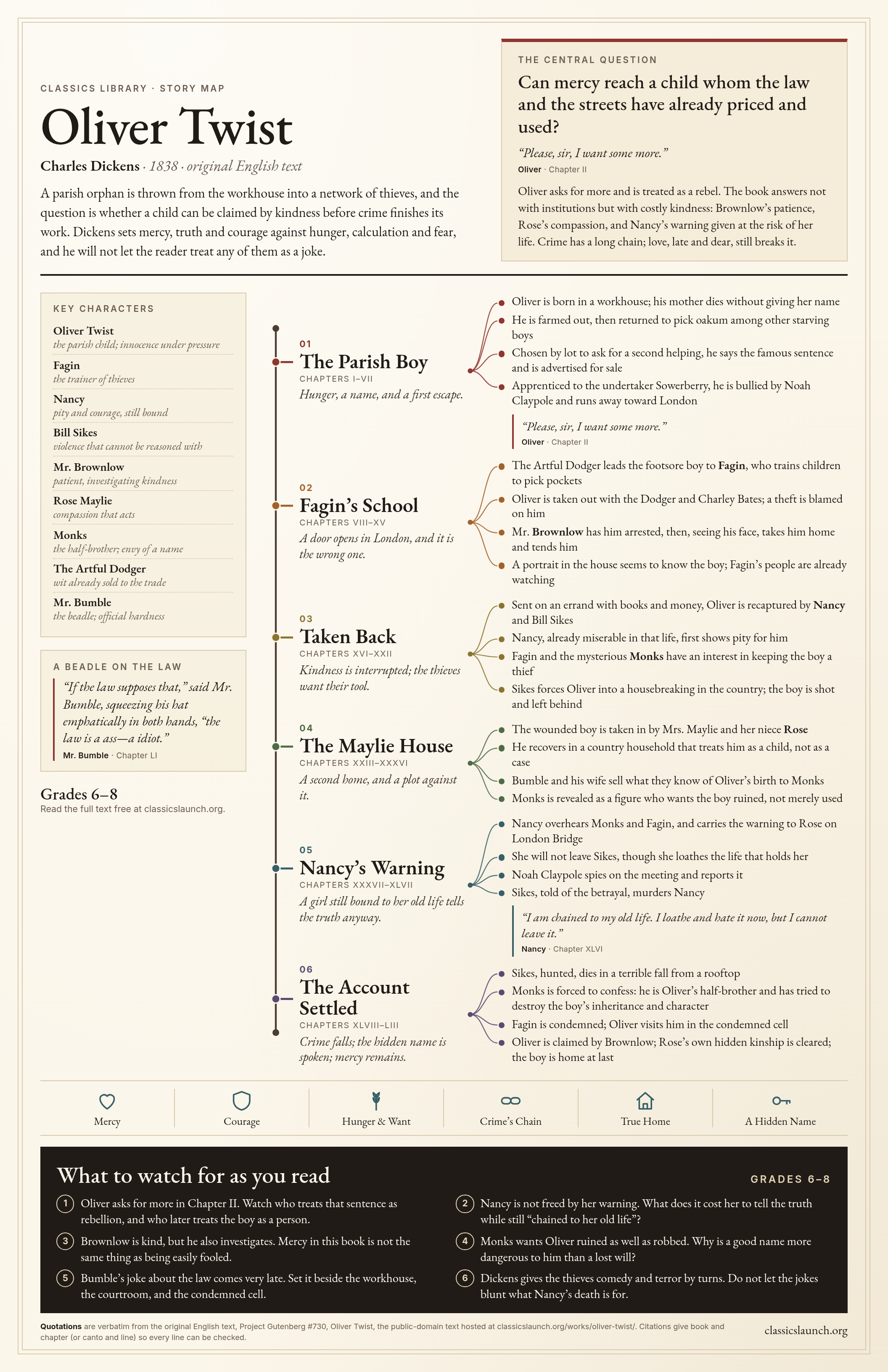
Every quotation is word for word from the original English text hosted in this library and is checked against that text each time the site is built. Citations give book and chapter (or canto and line).