Story maps · Grades 9–12
Pride and Prejudice: A Story Map
The PDF is one tabloid page (11 × 17 in). On letter paper, choose “Fit to page.”
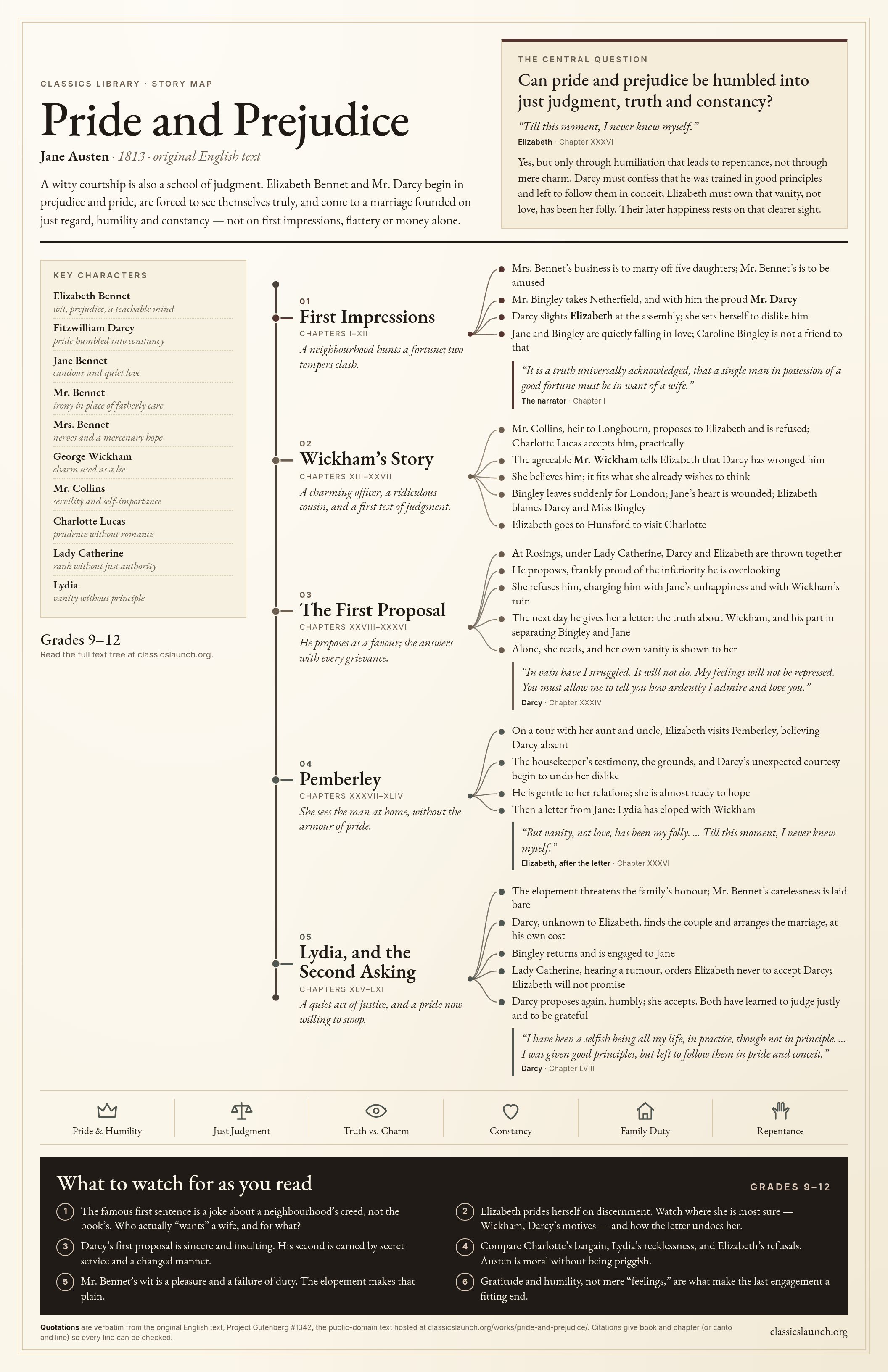
A witty courtship is also a school of judgment. Elizabeth Bennet and Mr. Darcy begin in prejudice and pride, are forced to see themselves truly, and come to a marriage founded on just regard, humility and constancy — not on first impressions, flattery or money alone.
The central question
Can pride and prejudice be humbled into just judgment, truth and constancy?
“Till this moment, I never knew myself.”
Yes, but only through humiliation that leads to repentance, not through mere charm. Darcy must confess that he was trained in good principles and left to follow them in conceit; Elizabeth must own that vanity, not love, has been her folly. Their later happiness rests on that clearer sight.
- 01
First Impressions
Chapters I–XII
A neighbourhood hunts a fortune; two tempers clash.
- Mrs. Bennet’s business is to marry off five daughters; Mr. Bennet’s is to be amused
- Mr. Bingley takes Netherfield, and with him the proud Mr. Darcy
- Darcy slights Elizabeth at the assembly; she sets herself to dislike him
- Jane and Bingley are quietly falling in love; Caroline Bingley is not a friend to that
“It is a truth universally acknowledged, that a single man in possession of a good fortune must be in want of a wife.”
- 02
Wickham’s Story
Chapters XIII–XXVII
A charming officer, a ridiculous cousin, and a first test of judgment.
- Mr. Collins, heir to Longbourn, proposes to Elizabeth and is refused; Charlotte Lucas accepts him, practically
- The agreeable Mr. Wickham tells Elizabeth that Darcy has wronged him
- She believes him; it fits what she already wishes to think
- Bingley leaves suddenly for London; Jane’s heart is wounded; Elizabeth blames Darcy and Miss Bingley
- Elizabeth goes to Hunsford to visit Charlotte
- 03
The First Proposal
Chapters XXVIII–XXXVI
He proposes as a favour; she answers with every grievance.
- At Rosings, under Lady Catherine, Darcy and Elizabeth are thrown together
- He proposes, frankly proud of the inferiority he is overlooking
- She refuses him, charging him with Jane’s unhappiness and with Wickham’s ruin
- The next day he gives her a letter: the truth about Wickham, and his part in separating Bingley and Jane
- Alone, she reads, and her own vanity is shown to her
“In vain have I struggled. It will not do. My feelings will not be repressed. You must allow me to tell you how ardently I admire and love you.”
- 04
Pemberley
Chapters XXXVII–XLIV
She sees the man at home, without the armour of pride.
- On a tour with her aunt and uncle, Elizabeth visits Pemberley, believing Darcy absent
- The housekeeper’s testimony, the grounds, and Darcy’s unexpected courtesy begin to undo her dislike
- He is gentle to her relations; she is almost ready to hope
- Then a letter from Jane: Lydia has eloped with Wickham
“But vanity, not love, has been my folly. ... Till this moment, I never knew myself.”
- 05
Lydia, and the Second Asking
Chapters XLV–LXI
A quiet act of justice, and a pride now willing to stoop.
- The elopement threatens the family’s honour; Mr. Bennet’s carelessness is laid bare
- Darcy, unknown to Elizabeth, finds the couple and arranges the marriage, at his own cost
- Bingley returns and is engaged to Jane
- Lady Catherine, hearing a rumour, orders Elizabeth never to accept Darcy; Elizabeth will not promise
- Darcy proposes again, humbly; she accepts. Both have learned to judge justly and to be grateful
“I have been a selfish being all my life, in practice, though not in principle. ... I was given good principles, but left to follow them in pride and conceit.”
- Pride & Humility
- Just Judgment
- Truth vs. Charm
- Constancy
- Family Duty
- Repentance
What to watch for as you read
Grades 9–12- The famous first sentence is a joke about a neighbourhood’s creed, not the book’s. Who actually “wants” a wife, and for what?
- Elizabeth prides herself on discernment. Watch where she is most sure — Wickham, Darcy’s motives — and how the letter undoes her.
- Darcy’s first proposal is sincere and insulting. His second is earned by secret service and a changed manner.
- Compare Charlotte’s bargain, Lydia’s recklessness, and Elizabeth’s refusals. Austen is moral without being priggish.
- Mr. Bennet’s wit is a pleasure and a failure of duty. The elopement makes that plain.
- Gratitude and humility, not mere “feelings,” are what make the last engagement a fitting end.
Every quotation is word for word from the original English text hosted in this library and is checked against that text each time the site is built. Citations give book and chapter (or canto and line).