Story maps · Grades 9–12
Sense and Sensibility: A Story Map
The PDF is one tabloid page (11 × 17 in). On letter paper, choose “Fit to page.”
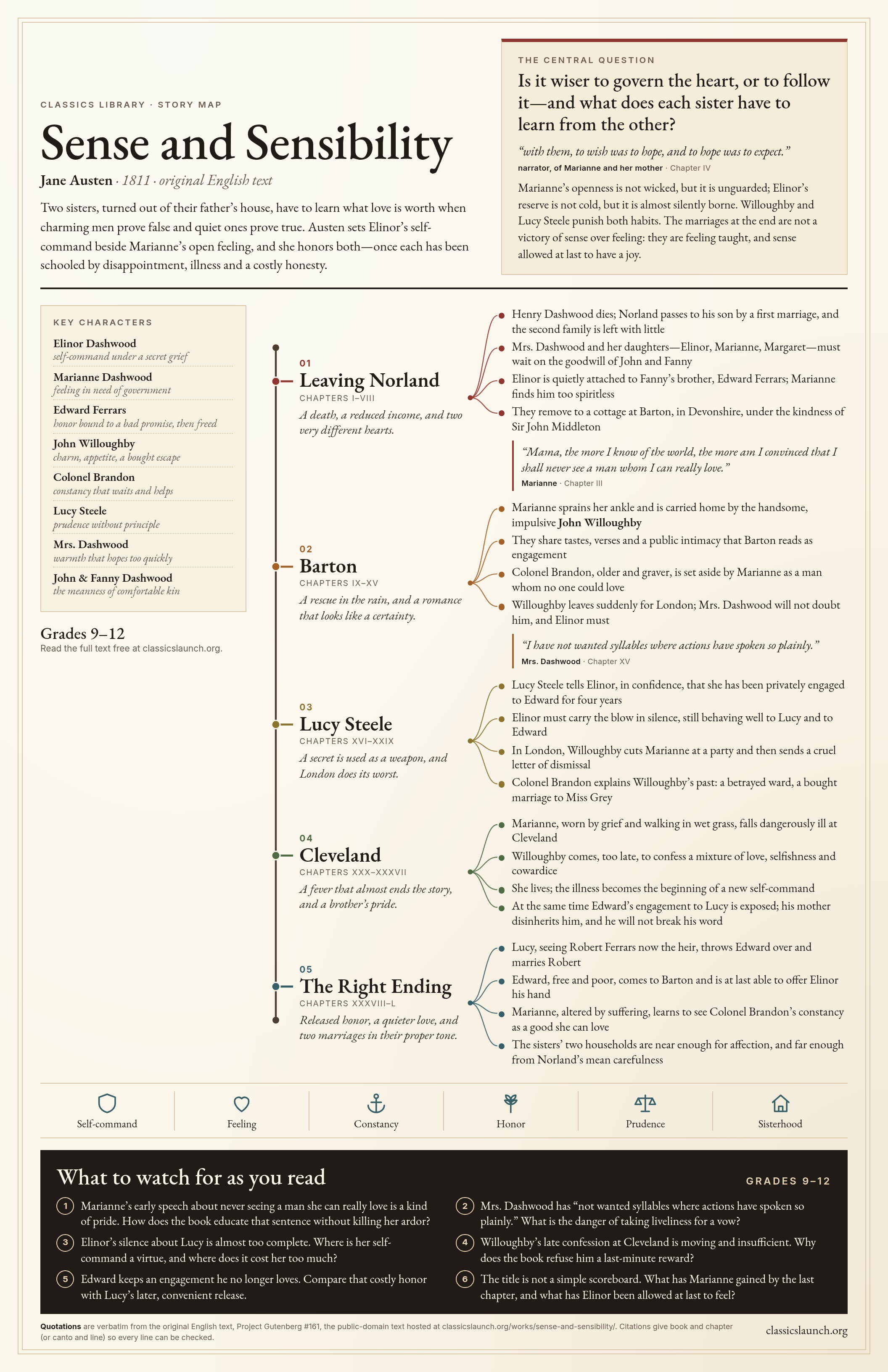
Two sisters, turned out of their father’s house, have to learn what love is worth when charming men prove false and quiet ones prove true. Austen sets Elinor’s self-command beside Marianne’s open feeling, and she honors both—once each has been schooled by disappointment, illness and a costly honesty.
The central question
Is it wiser to govern the heart, or to follow it—and what does each sister have to learn from the other?
“with them, to wish was to hope, and to hope was to expect.”
Marianne’s openness is not wicked, but it is unguarded; Elinor’s reserve is not cold, but it is almost silently borne. Willoughby and Lucy Steele punish both habits. The marriages at the end are not a victory of sense over feeling: they are feeling taught, and sense allowed at last to have a joy.
- 01
Leaving Norland
Chapters I–VIII
A death, a reduced income, and two very different hearts.
- Henry Dashwood dies; Norland passes to his son by a first marriage, and the second family is left with little
- Mrs. Dashwood and her daughters—Elinor, Marianne, Margaret—must wait on the goodwill of John and Fanny
- Elinor is quietly attached to Fanny’s brother, Edward Ferrars; Marianne finds him too spiritless
- They remove to a cottage at Barton, in Devonshire, under the kindness of Sir John Middleton
“Mama, the more I know of the world, the more am I convinced that I shall never see a man whom I can really love.”
- 02
Barton
Chapters IX–XV
A rescue in the rain, and a romance that looks like a certainty.
- Marianne sprains her ankle and is carried home by the handsome, impulsive John Willoughby
- They share tastes, verses and a public intimacy that Barton reads as engagement
- Colonel Brandon, older and graver, is set aside by Marianne as a man whom no one could love
- Willoughby leaves suddenly for London; Mrs. Dashwood will not doubt him, and Elinor must
“I have not wanted syllables where actions have spoken so plainly.”
- 03
Lucy Steele
Chapters XVI–XXIX
A secret is used as a weapon, and London does its worst.
- Lucy Steele tells Elinor, in confidence, that she has been privately engaged to Edward for four years
- Elinor must carry the blow in silence, still behaving well to Lucy and to Edward
- In London, Willoughby cuts Marianne at a party and then sends a cruel letter of dismissal
- Colonel Brandon explains Willoughby’s past: a betrayed ward, a bought marriage to Miss Grey
- 04
Cleveland
Chapters XXX–XXXVII
A fever that almost ends the story, and a brother’s pride.
- Marianne, worn by grief and walking in wet grass, falls dangerously ill at Cleveland
- Willoughby comes, too late, to confess a mixture of love, selfishness and cowardice
- She lives; the illness becomes the beginning of a new self-command
- At the same time Edward’s engagement to Lucy is exposed; his mother disinherits him, and he will not break his word
- 05
The Right Ending
Chapters XXXVIII–L
Released honor, a quieter love, and two marriages in their proper tone.
- Lucy, seeing Robert Ferrars now the heir, throws Edward over and marries Robert
- Edward, free and poor, comes to Barton and is at last able to offer Elinor his hand
- Marianne, altered by suffering, learns to see Colonel Brandon’s constancy as a good she can love
- The sisters’ two households are near enough for affection, and far enough from Norland’s mean carefulness
- Self-command
- Feeling
- Constancy
- Honor
- Prudence
- Sisterhood
What to watch for as you read
Grades 9–12- Marianne’s early speech about never seeing a man she can really love is a kind of pride. How does the book educate that sentence without killing her ardor?
- Mrs. Dashwood has “not wanted syllables where actions have spoken so plainly.” What is the danger of taking liveliness for a vow?
- Elinor’s silence about Lucy is almost too complete. Where is her self-command a virtue, and where does it cost her too much?
- Willoughby’s late confession at Cleveland is moving and insufficient. Why does the book refuse him a last-minute reward?
- Edward keeps an engagement he no longer loves. Compare that costly honor with Lucy’s later, convenient release.
- The title is not a simple scoreboard. What has Marianne gained by the last chapter, and what has Elinor been allowed at last to feel?
Every quotation is word for word from the original English text hosted in this library and is checked against that text each time the site is built. Citations give book and chapter (or canto and line).