Story maps · Grades 11–12
The Divine Comedy: A Story Map
The PDF is one tabloid page (11 × 17 in). On letter paper, choose “Fit to page.”
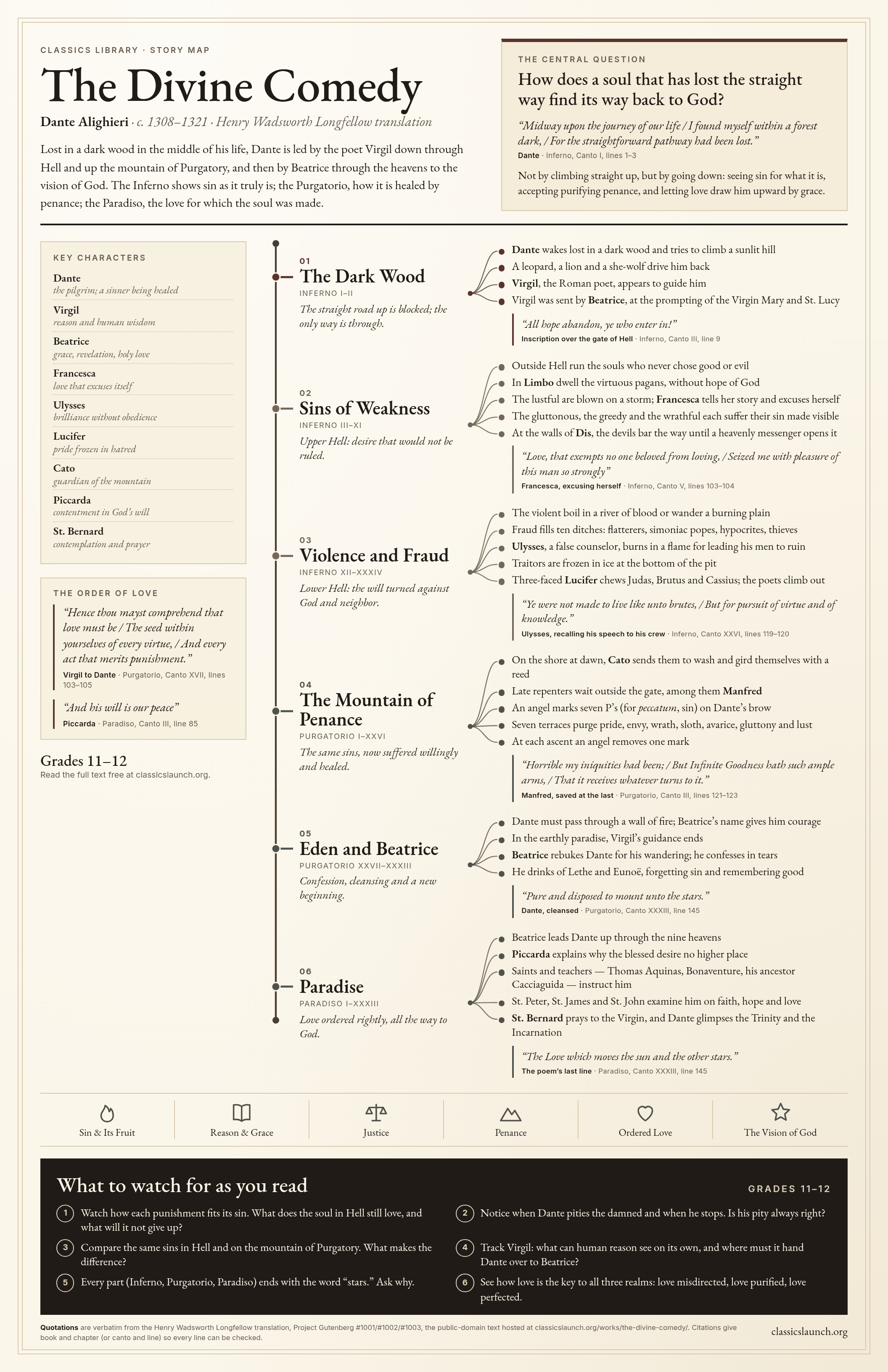
Lost in a dark wood in the middle of his life, Dante is led by the poet Virgil down through Hell and up the mountain of Purgatory, and then by Beatrice through the heavens to the vision of God. The Inferno shows sin as it truly is; the Purgatorio, how it is healed by penance; the Paradiso, the love for which the soul was made.
The central question
How does a soul that has lost the straight way find its way back to God?
“Midway upon the journey of our life / I found myself within a forest dark, / For the straightforward pathway had been lost.”
Not by climbing straight up, but by going down: seeing sin for what it is, accepting purifying penance, and letting love draw him upward by grace.
- 01
The Dark Wood
Inferno I–II
The straight road up is blocked; the only way is through.
- Dante wakes lost in a dark wood and tries to climb a sunlit hill
- A leopard, a lion and a she-wolf drive him back
- Virgil, the Roman poet, appears to guide him
- Virgil was sent by Beatrice, at the prompting of the Virgin Mary and St. Lucy
“All hope abandon, ye who enter in!”
- 02
Sins of Weakness
Inferno III–XI
Upper Hell: desire that would not be ruled.
- Outside Hell run the souls who never chose good or evil
- In Limbo dwell the virtuous pagans, without hope of God
- The lustful are blown on a storm; Francesca tells her story and excuses herself
- The gluttonous, the greedy and the wrathful each suffer their sin made visible
- At the walls of Dis, the devils bar the way until a heavenly messenger opens it
“Love, that exempts no one beloved from loving, / Seized me with pleasure of this man so strongly”
- 03
Violence and Fraud
Inferno XII–XXXIV
Lower Hell: the will turned against God and neighbor.
- The violent boil in a river of blood or wander a burning plain
- Fraud fills ten ditches: flatterers, simoniac popes, hypocrites, thieves
- Ulysses, a false counselor, burns in a flame for leading his men to ruin
- Traitors are frozen in ice at the bottom of the pit
- Three-faced Lucifer chews Judas, Brutus and Cassius; the poets climb out
“Ye were not made to live like unto brutes, / But for pursuit of virtue and of knowledge.”
- 04
The Mountain of Penance
Purgatorio I–XXVI
The same sins, now suffered willingly and healed.
- On the shore at dawn, Cato sends them to wash and gird themselves with a reed
- Late repenters wait outside the gate, among them Manfred
- An angel marks seven P’s (for peccatum, sin) on Dante’s brow
- Seven terraces purge pride, envy, wrath, sloth, avarice, gluttony and lust
- At each ascent an angel removes one mark
“Horrible my iniquities had been; / But Infinite Goodness hath such ample arms, / That it receives whatever turns to it.”
- 05
Eden and Beatrice
Purgatorio XXVII–XXXIII
Confession, cleansing and a new beginning.
- Dante must pass through a wall of fire; Beatrice’s name gives him courage
- In the earthly paradise, Virgil’s guidance ends
- Beatrice rebukes Dante for his wandering; he confesses in tears
- He drinks of Lethe and Eunoë, forgetting sin and remembering good
“Pure and disposed to mount unto the stars.”
- 06
Paradise
Paradiso I–XXXIII
Love ordered rightly, all the way to God.
- Beatrice leads Dante up through the nine heavens
- Piccarda explains why the blessed desire no higher place
- Saints and teachers — Thomas Aquinas, Bonaventure, his ancestor Cacciaguida — instruct him
- St. Peter, St. James and St. John examine him on faith, hope and love
- St. Bernard prays to the Virgin, and Dante glimpses the Trinity and the Incarnation
“The Love which moves the sun and the other stars.”
- Sin & Its Fruit
- Reason & Grace
- Justice
- Penance
- Ordered Love
- The Vision of God
What to watch for as you read
Grades 11–12- Watch how each punishment fits its sin. What does the soul in Hell still love, and what will it not give up?
- Notice when Dante pities the damned and when he stops. Is his pity always right?
- Compare the same sins in Hell and on the mountain of Purgatory. What makes the difference?
- Track Virgil: what can human reason see on its own, and where must it hand Dante over to Beatrice?
- Every part (Inferno, Purgatorio, Paradiso) ends with the word “stars.” Ask why.
- See how love is the key to all three realms: love misdirected, love purified, love perfected.
Every quotation is word for word from the Henry Wadsworth Longfellow translation hosted in this library and is checked against that text each time the site is built. Citations give book and chapter (or canto and line).