Story maps · Grades 10–12
The Hunchback of Notre-Dame: A Story Map
The PDF is one tabloid page (11 × 17 in). On letter paper, choose “Fit to page.”
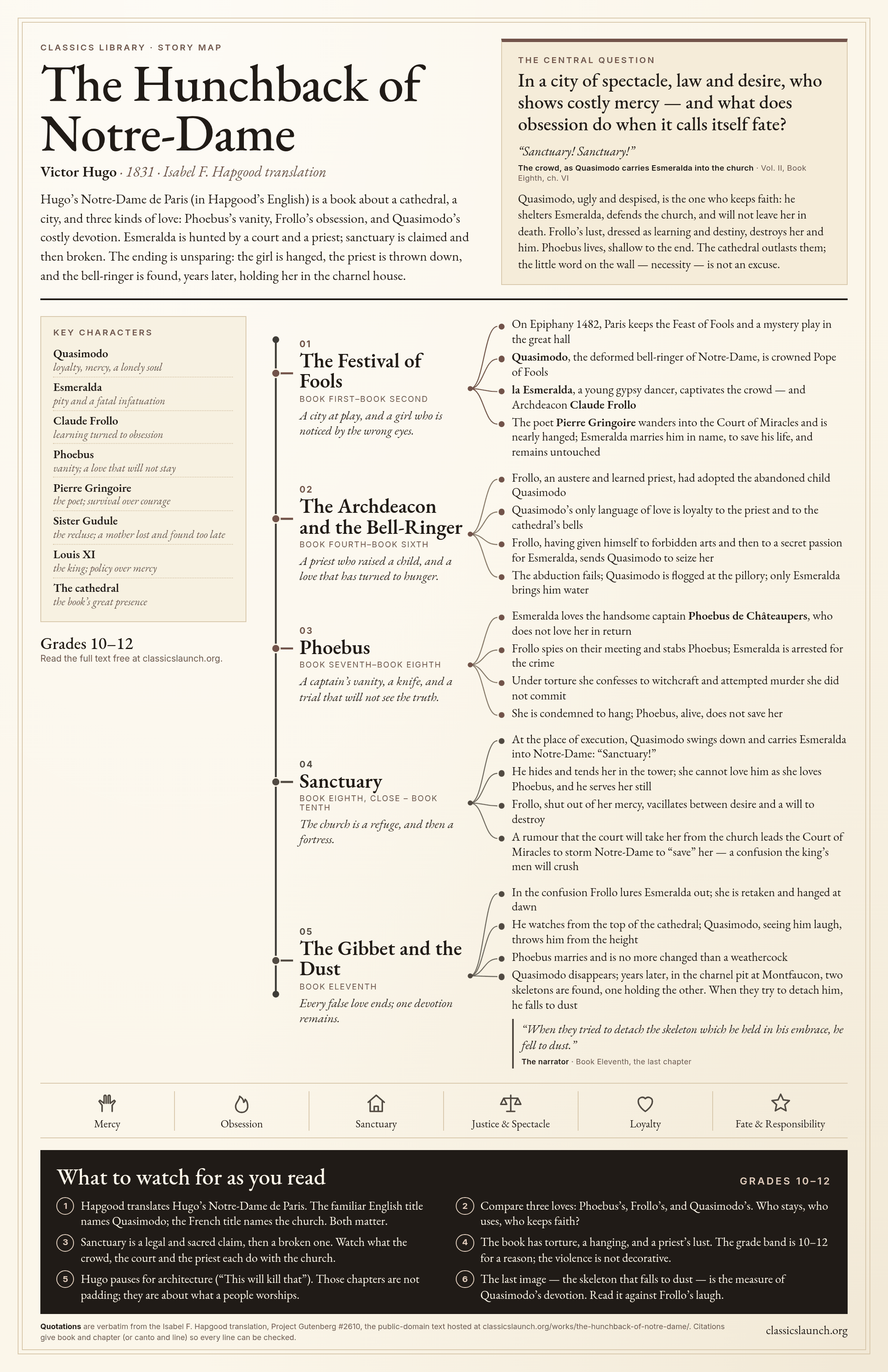
Hugo’s Notre-Dame de Paris (in Hapgood’s English) is a book about a cathedral, a city, and three kinds of love: Phoebus’s vanity, Frollo’s obsession, and Quasimodo’s costly devotion. Esmeralda is hunted by a court and a priest; sanctuary is claimed and then broken. The ending is unsparing: the girl is hanged, the priest is thrown down, and the bell-ringer is found, years later, holding her in the charnel house.
The central question
In a city of spectacle, law and desire, who shows costly mercy — and what does obsession do when it calls itself fate?
“Sanctuary! Sanctuary!”
Quasimodo, ugly and despised, is the one who keeps faith: he shelters Esmeralda, defends the church, and will not leave her in death. Frollo’s lust, dressed as learning and destiny, destroys her and him. Phoebus lives, shallow to the end. The cathedral outlasts them; the little word on the wall — necessity — is not an excuse.
- 01
The Festival of Fools
Book First–Book Second
A city at play, and a girl who is noticed by the wrong eyes.
- On Epiphany 1482, Paris keeps the Feast of Fools and a mystery play in the great hall
- Quasimodo, the deformed bell-ringer of Notre-Dame, is crowned Pope of Fools
- la Esmeralda, a young gypsy dancer, captivates the crowd — and Archdeacon Claude Frollo
- The poet Pierre Gringoire wanders into the Court of Miracles and is nearly hanged; Esmeralda marries him in name, to save his life, and remains untouched
- 02
The Archdeacon and the Bell-Ringer
Book Fourth–Book Sixth
A priest who raised a child, and a love that has turned to hunger.
- Frollo, an austere and learned priest, had adopted the abandoned child Quasimodo
- Quasimodo’s only language of love is loyalty to the priest and to the cathedral’s bells
- Frollo, having given himself to forbidden arts and then to a secret passion for Esmeralda, sends Quasimodo to seize her
- The abduction fails; Quasimodo is flogged at the pillory; only Esmeralda brings him water
- 03
Phoebus
Book Seventh–Book Eighth
A captain’s vanity, a knife, and a trial that will not see the truth.
- Esmeralda loves the handsome captain Phoebus de Châteaupers, who does not love her in return
- Frollo spies on their meeting and stabs Phoebus; Esmeralda is arrested for the crime
- Under torture she confesses to witchcraft and attempted murder she did not commit
- She is condemned to hang; Phoebus, alive, does not save her
- 04
Sanctuary
Book Eighth, close – Book Tenth
The church is a refuge, and then a fortress.
- At the place of execution, Quasimodo swings down and carries Esmeralda into Notre-Dame: “Sanctuary!”
- He hides and tends her in the tower; she cannot love him as she loves Phoebus, and he serves her still
- Frollo, shut out of her mercy, vacillates between desire and a will to destroy
- A rumour that the court will take her from the church leads the Court of Miracles to storm Notre-Dame to “save” her — a confusion the king’s men will crush
- 05
The Gibbet and the Dust
Book Eleventh
Every false love ends; one devotion remains.
- In the confusion Frollo lures Esmeralda out; she is retaken and hanged at dawn
- He watches from the top of the cathedral; Quasimodo, seeing him laugh, throws him from the height
- Phoebus marries and is no more changed than a weathercock
- Quasimodo disappears; years later, in the charnel pit at Montfaucon, two skeletons are found, one holding the other. When they try to detach him, he falls to dust
“When they tried to detach the skeleton which he held in his embrace, he fell to dust.”
- Mercy
- Obsession
- Sanctuary
- Justice & Spectacle
- Loyalty
- Fate & Responsibility
What to watch for as you read
Grades 10–12- Hapgood translates Hugo’s Notre-Dame de Paris. The familiar English title names Quasimodo; the French title names the church. Both matter.
- Compare three loves: Phoebus’s, Frollo’s, and Quasimodo’s. Who stays, who uses, who keeps faith?
- Sanctuary is a legal and sacred claim, then a broken one. Watch what the crowd, the court and the priest each do with the church.
- The book has torture, a hanging, and a priest’s lust. The grade band is 10–12 for a reason; the violence is not decorative.
- Hugo pauses for architecture (“This will kill that”). Those chapters are not padding; they are about what a people worships.
- The last image — the skeleton that falls to dust — is the measure of Quasimodo’s devotion. Read it against Frollo’s laugh.
Every quotation is word for word from the Isabel F. Hapgood translation hosted in this library and is checked against that text each time the site is built. Citations give book and chapter (or canto and line).