Story maps · Grades 11–12
The Idiot: A Story Map
The PDF is one tabloid page (11 × 17 in). On letter paper, choose “Fit to page.”
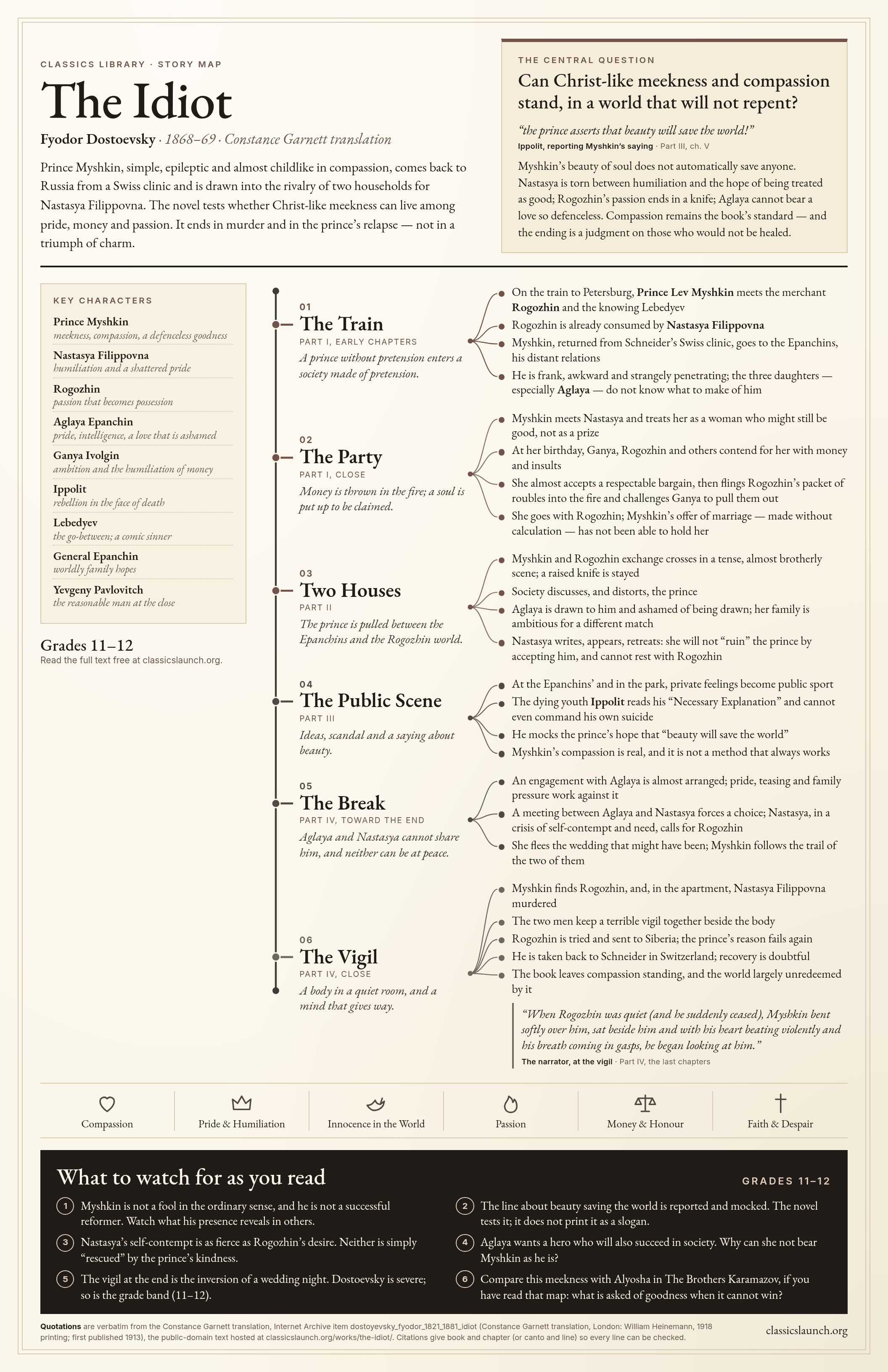
Prince Myshkin, simple, epileptic and almost childlike in compassion, comes back to Russia from a Swiss clinic and is drawn into the rivalry of two households for Nastasya Filippovna. The novel tests whether Christ-like meekness can live among pride, money and passion. It ends in murder and in the prince’s relapse — not in a triumph of charm.
The central question
Can Christ-like meekness and compassion stand, in a world that will not repent?
“the prince asserts that beauty will save the world!”
Myshkin’s beauty of soul does not automatically save anyone. Nastasya is torn between humiliation and the hope of being treated as good; Rogozhin’s passion ends in a knife; Aglaya cannot bear a love so defenceless. Compassion remains the book’s standard — and the ending is a judgment on those who would not be healed.
- 01
The Train
Part I, early chapters
A prince without pretension enters a society made of pretension.
- On the train to Petersburg, Prince Lev Myshkin meets the merchant Rogozhin and the knowing Lebedyev
- Rogozhin is already consumed by Nastasya Filippovna
- Myshkin, returned from Schneider’s Swiss clinic, goes to the Epanchins, his distant relations
- He is frank, awkward and strangely penetrating; the three daughters — especially Aglaya — do not know what to make of him
- 02
The Party
Part I, close
Money is thrown in the fire; a soul is put up to be claimed.
- Myshkin meets Nastasya and treats her as a woman who might still be good, not as a prize
- At her birthday, Ganya, Rogozhin and others contend for her with money and insults
- She almost accepts a respectable bargain, then flings Rogozhin’s packet of roubles into the fire and challenges Ganya to pull them out
- She goes with Rogozhin; Myshkin’s offer of marriage — made without calculation — has not been able to hold her
- 03
Two Houses
Part II
The prince is pulled between the Epanchins and the Rogozhin world.
- Myshkin and Rogozhin exchange crosses in a tense, almost brotherly scene; a raised knife is stayed
- Society discusses, and distorts, the prince
- Aglaya is drawn to him and ashamed of being drawn; her family is ambitious for a different match
- Nastasya writes, appears, retreats: she will not “ruin” the prince by accepting him, and cannot rest with Rogozhin
- 04
The Public Scene
Part III
Ideas, scandal and a saying about beauty.
- At the Epanchins’ and in the park, private feelings become public sport
- The dying youth Ippolit reads his “Necessary Explanation” and cannot even command his own suicide
- He mocks the prince’s hope that “beauty will save the world”
- Myshkin’s compassion is real, and it is not a method that always works
- 05
The Break
Part IV, toward the end
Aglaya and Nastasya cannot share him, and neither can be at peace.
- An engagement with Aglaya is almost arranged; pride, teasing and family pressure work against it
- A meeting between Aglaya and Nastasya forces a choice; Nastasya, in a crisis of self-contempt and need, calls for Rogozhin
- She flees the wedding that might have been; Myshkin follows the trail of the two of them
- 06
The Vigil
Part IV, close
A body in a quiet room, and a mind that gives way.
- Myshkin finds Rogozhin, and, in the apartment, Nastasya Filippovna murdered
- The two men keep a terrible vigil together beside the body
- Rogozhin is tried and sent to Siberia; the prince’s reason fails again
- He is taken back to Schneider in Switzerland; recovery is doubtful
- The book leaves compassion standing, and the world largely unredeemed by it
“When Rogozhin was quiet (and he suddenly ceased), Myshkin bent softly over him, sat beside him and with his heart beating violently and his breath coming in gasps, he began looking at him.”
- Compassion
- Pride & Humiliation
- Innocence in the World
- Passion
- Money & Honour
- Faith & Despair
What to watch for as you read
Grades 11–12- Myshkin is not a fool in the ordinary sense, and he is not a successful reformer. Watch what his presence reveals in others.
- The line about beauty saving the world is reported and mocked. The novel tests it; it does not print it as a slogan.
- Nastasya’s self-contempt is as fierce as Rogozhin’s desire. Neither is simply “rescued” by the prince’s kindness.
- Aglaya wants a hero who will also succeed in society. Why can she not bear Myshkin as he is?
- The vigil at the end is the inversion of a wedding night. Dostoevsky is severe; so is the grade band (11–12).
- Compare this meekness with Alyosha in The Brothers Karamazov, if you have read that map: what is asked of goodness when it cannot win?
Every quotation is word for word from the Constance Garnett translation hosted in this library and is checked against that text each time the site is built. Citations give book and chapter (or canto and line).