Story maps · Grades 9–12
The Odyssey: A Story Map
The PDF is one tabloid page (11 × 17 in). On letter paper, choose “Fit to page.”
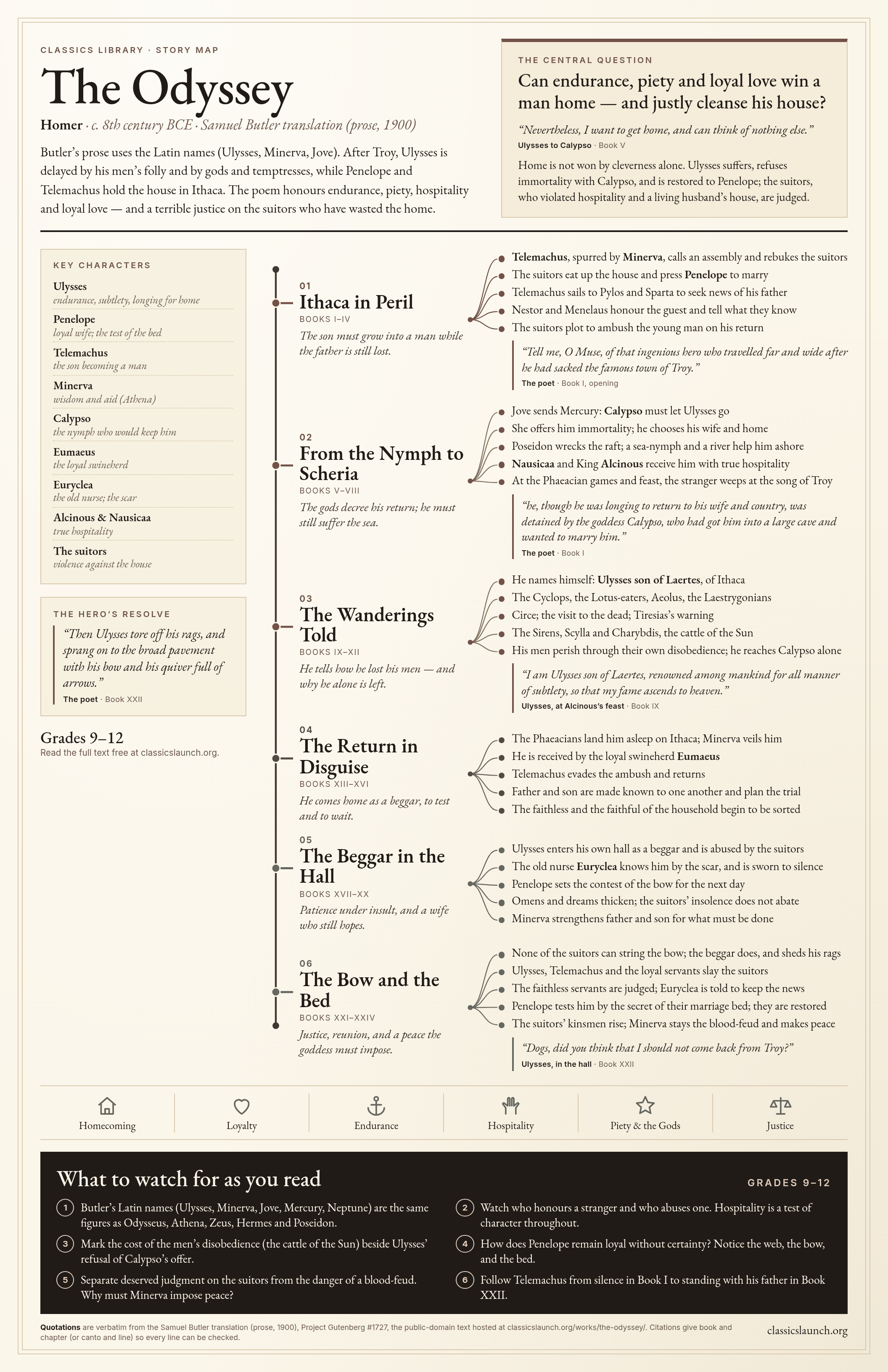
Butler’s prose uses the Latin names (Ulysses, Minerva, Jove). After Troy, Ulysses is delayed by his men’s folly and by gods and temptresses, while Penelope and Telemachus hold the house in Ithaca. The poem honours endurance, piety, hospitality and loyal love — and a terrible justice on the suitors who have wasted the home.
The central question
Can endurance, piety and loyal love win a man home — and justly cleanse his house?
“Nevertheless, I want to get home, and can think of nothing else.”
Home is not won by cleverness alone. Ulysses suffers, refuses immortality with Calypso, and is restored to Penelope; the suitors, who violated hospitality and a living husband’s house, are judged.
- 01
Ithaca in Peril
Books I–IV
The son must grow into a man while the father is still lost.
- Telemachus, spurred by Minerva, calls an assembly and rebukes the suitors
- The suitors eat up the house and press Penelope to marry
- Telemachus sails to Pylos and Sparta to seek news of his father
- Nestor and Menelaus honour the guest and tell what they know
- The suitors plot to ambush the young man on his return
“Tell me, O Muse, of that ingenious hero who travelled far and wide after he had sacked the famous town of Troy.”
- 02
From the Nymph to Scheria
Books V–VIII
The gods decree his return; he must still suffer the sea.
- Jove sends Mercury: Calypso must let Ulysses go
- She offers him immortality; he chooses his wife and home
- Poseidon wrecks the raft; a sea-nymph and a river help him ashore
- Nausicaa and King Alcinous receive him with true hospitality
- At the Phaeacian games and feast, the stranger weeps at the song of Troy
“he, though he was longing to return to his wife and country, was detained by the goddess Calypso, who had got him into a large cave and wanted to marry him.”
- 03
The Wanderings Told
Books IX–XII
He tells how he lost his men — and why he alone is left.
- He names himself: Ulysses son of Laertes, of Ithaca
- The Cyclops, the Lotus-eaters, Aeolus, the Laestrygonians
- Circe; the visit to the dead; Tiresias’s warning
- The Sirens, Scylla and Charybdis, the cattle of the Sun
- His men perish through their own disobedience; he reaches Calypso alone
“I am Ulysses son of Laertes, renowned among mankind for all manner of subtlety, so that my fame ascends to heaven.”
- 04
The Return in Disguise
Books XIII–XVI
He comes home as a beggar, to test and to wait.
- The Phaeacians land him asleep on Ithaca; Minerva veils him
- He is received by the loyal swineherd Eumaeus
- Telemachus evades the ambush and returns
- Father and son are made known to one another and plan the trial
- The faithless and the faithful of the household begin to be sorted
- 05
The Beggar in the Hall
Books XVII–XX
Patience under insult, and a wife who still hopes.
- Ulysses enters his own hall as a beggar and is abused by the suitors
- The old nurse Euryclea knows him by the scar, and is sworn to silence
- Penelope sets the contest of the bow for the next day
- Omens and dreams thicken; the suitors’ insolence does not abate
- Minerva strengthens father and son for what must be done
- 06
The Bow and the Bed
Books XXI–XXIV
Justice, reunion, and a peace the goddess must impose.
- None of the suitors can string the bow; the beggar does, and sheds his rags
- Ulysses, Telemachus and the loyal servants slay the suitors
- The faithless servants are judged; Euryclea is told to keep the news
- Penelope tests him by the secret of their marriage bed; they are restored
- The suitors’ kinsmen rise; Minerva stays the blood-feud and makes peace
“Dogs, did you think that I should not come back from Troy?”
- Homecoming
- Loyalty
- Endurance
- Hospitality
- Piety & the Gods
- Justice
What to watch for as you read
Grades 9–12- Butler’s Latin names (Ulysses, Minerva, Jove, Mercury, Neptune) are the same figures as Odysseus, Athena, Zeus, Hermes and Poseidon.
- Watch who honours a stranger and who abuses one. Hospitality is a test of character throughout.
- Mark the cost of the men’s disobedience (the cattle of the Sun) beside Ulysses’ refusal of Calypso’s offer.
- How does Penelope remain loyal without certainty? Notice the web, the bow, and the bed.
- Separate deserved judgment on the suitors from the danger of a blood-feud. Why must Minerva impose peace?
- Follow Telemachus from silence in Book I to standing with his father in Book XXII.
Every quotation is word for word from the Samuel Butler translation (prose, 1900) hosted in this library and is checked against that text each time the site is built. Citations give book and chapter (or canto and line).