Story maps · Grades 9–12
The Theban Plays: A Story Map
The PDF is one tabloid page (11 × 17 in). On letter paper, choose “Fit to page.”
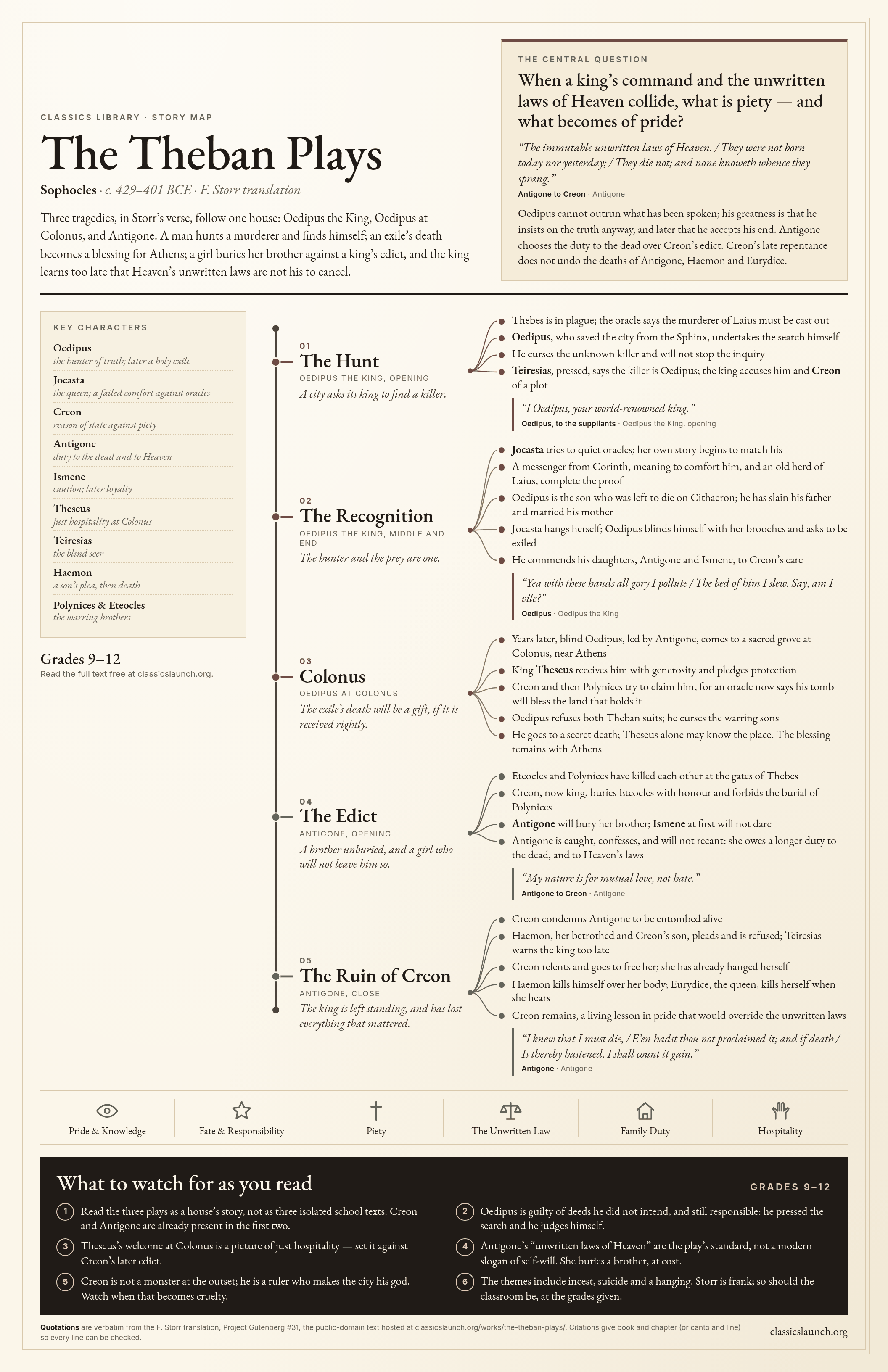
Three tragedies, in Storr’s verse, follow one house: Oedipus the King, Oedipus at Colonus, and Antigone. A man hunts a murderer and finds himself; an exile’s death becomes a blessing for Athens; a girl buries her brother against a king’s edict, and the king learns too late that Heaven’s unwritten laws are not his to cancel.
The central question
When a king’s command and the unwritten laws of Heaven collide, what is piety — and what becomes of pride?
“The immutable unwritten laws of Heaven. / They were not born today nor yesterday; / They die not; and none knoweth whence they sprang.”
Oedipus cannot outrun what has been spoken; his greatness is that he insists on the truth anyway, and later that he accepts his end. Antigone chooses the duty to the dead over Creon’s edict. Creon’s late repentance does not undo the deaths of Antigone, Haemon and Eurydice.
- 01
The Hunt
Oedipus the King, opening
A city asks its king to find a killer.
- Thebes is in plague; the oracle says the murderer of Laius must be cast out
- Oedipus, who saved the city from the Sphinx, undertakes the search himself
- He curses the unknown killer and will not stop the inquiry
- Teiresias, pressed, says the killer is Oedipus; the king accuses him and Creon of a plot
“I Oedipus, your world-renowned king.”
- 02
The Recognition
Oedipus the King, middle and end
The hunter and the prey are one.
- Jocasta tries to quiet oracles; her own story begins to match his
- A messenger from Corinth, meaning to comfort him, and an old herd of Laius, complete the proof
- Oedipus is the son who was left to die on Cithaeron; he has slain his father and married his mother
- Jocasta hangs herself; Oedipus blinds himself with her brooches and asks to be exiled
- He commends his daughters, Antigone and Ismene, to Creon’s care
“Yea with these hands all gory I pollute / The bed of him I slew. Say, am I vile?”
- 03
Colonus
Oedipus at Colonus
The exile’s death will be a gift, if it is received rightly.
- Years later, blind Oedipus, led by Antigone, comes to a sacred grove at Colonus, near Athens
- King Theseus receives him with generosity and pledges protection
- Creon and then Polynices try to claim him, for an oracle now says his tomb will bless the land that holds it
- Oedipus refuses both Theban suits; he curses the warring sons
- He goes to a secret death; Theseus alone may know the place. The blessing remains with Athens
- 04
The Edict
Antigone, opening
A brother unburied, and a girl who will not leave him so.
- Eteocles and Polynices have killed each other at the gates of Thebes
- Creon, now king, buries Eteocles with honour and forbids the burial of Polynices
- Antigone will bury her brother; Ismene at first will not dare
- Antigone is caught, confesses, and will not recant: she owes a longer duty to the dead, and to Heaven’s laws
“My nature is for mutual love, not hate.”
- 05
The Ruin of Creon
Antigone, close
The king is left standing, and has lost everything that mattered.
- Creon condemns Antigone to be entombed alive
- Haemon, her betrothed and Creon’s son, pleads and is refused; Teiresias warns the king too late
- Creon relents and goes to free her; she has already hanged herself
- Haemon kills himself over her body; Eurydice, the queen, kills herself when she hears
- Creon remains, a living lesson in pride that would override the unwritten laws
“I knew that I must die, / E’en hadst thou not proclaimed it; and if death / Is thereby hastened, I shall count it gain.”
- Pride & Knowledge
- Fate & Responsibility
- Piety
- The Unwritten Law
- Family Duty
- Hospitality
What to watch for as you read
Grades 9–12- Read the three plays as a house’s story, not as three isolated school texts. Creon and Antigone are already present in the first two.
- Oedipus is guilty of deeds he did not intend, and still responsible: he pressed the search and he judges himself.
- Theseus’s welcome at Colonus is a picture of just hospitality — set it against Creon’s later edict.
- Antigone’s “unwritten laws of Heaven” are the play’s standard, not a modern slogan of self-will. She buries a brother, at cost.
- Creon is not a monster at the outset; he is a ruler who makes the city his god. Watch when that becomes cruelty.
- The themes include incest, suicide and a hanging. Storr is frank; so should the classroom be, at the grades given.
Every quotation is word for word from the F. Storr translation hosted in this library and is checked against that text each time the site is built. Citations give book and chapter (or canto and line).