Story maps · Grades 7–12
The Three Musketeers: A Story Map
The PDF is one tabloid page (11 × 17 in). On letter paper, choose “Fit to page.”
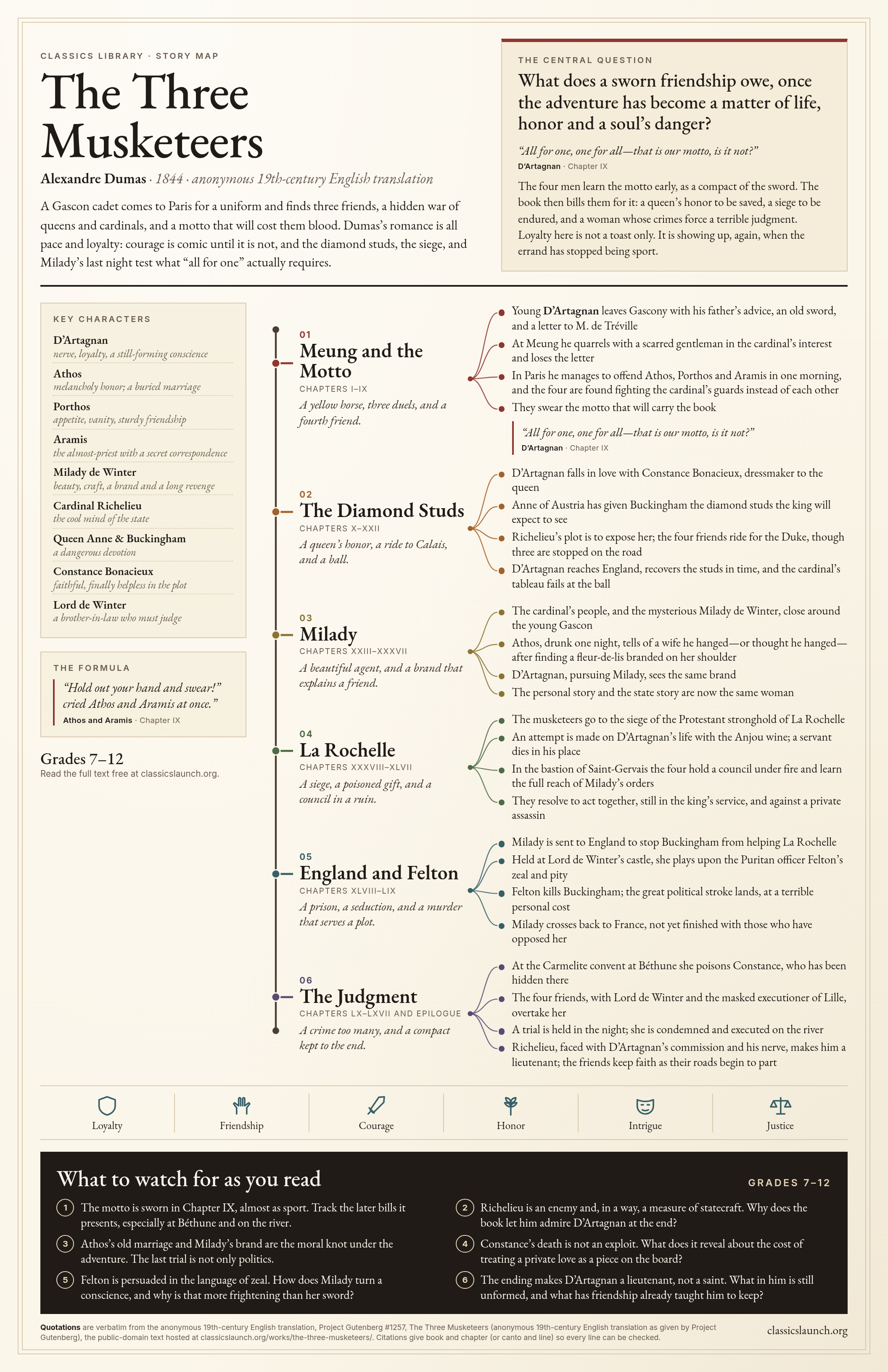
A Gascon cadet comes to Paris for a uniform and finds three friends, a hidden war of queens and cardinals, and a motto that will cost them blood. Dumas’s romance is all pace and loyalty: courage is comic until it is not, and the diamond studs, the siege, and Milady’s last night test what “all for one” actually requires.
The central question
What does a sworn friendship owe, once the adventure has become a matter of life, honor and a soul’s danger?
“All for one, one for all—that is our motto, is it not?”
The four men learn the motto early, as a compact of the sword. The book then bills them for it: a queen’s honor to be saved, a siege to be endured, and a woman whose crimes force a terrible judgment. Loyalty here is not a toast only. It is showing up, again, when the errand has stopped being sport.
- 01
Meung and the Motto
Chapters I–IX
A yellow horse, three duels, and a fourth friend.
- Young D’Artagnan leaves Gascony with his father’s advice, an old sword, and a letter to M. de Tréville
- At Meung he quarrels with a scarred gentleman in the cardinal’s interest and loses the letter
- In Paris he manages to offend Athos, Porthos and Aramis in one morning, and the four are found fighting the cardinal’s guards instead of each other
- They swear the motto that will carry the book
“All for one, one for all—that is our motto, is it not?”
- 02
The Diamond Studs
Chapters X–XXII
A queen’s honor, a ride to Calais, and a ball.
- D’Artagnan falls in love with Constance Bonacieux, dressmaker to the queen
- Anne of Austria has given Buckingham the diamond studs the king will expect to see
- Richelieu’s plot is to expose her; the four friends ride for the Duke, though three are stopped on the road
- D’Artagnan reaches England, recovers the studs in time, and the cardinal’s tableau fails at the ball
- 03
Milady
Chapters XXIII–XXXVII
A beautiful agent, and a brand that explains a friend.
- The cardinal’s people, and the mysterious Milady de Winter, close around the young Gascon
- Athos, drunk one night, tells of a wife he hanged—or thought he hanged—after finding a fleur-de-lis branded on her shoulder
- D’Artagnan, pursuing Milady, sees the same brand
- The personal story and the state story are now the same woman
- 04
La Rochelle
Chapters XXXVIII–XLVII
A siege, a poisoned gift, and a council in a ruin.
- The musketeers go to the siege of the Protestant stronghold of La Rochelle
- An attempt is made on D’Artagnan’s life with the Anjou wine; a servant dies in his place
- In the bastion of Saint-Gervais the four hold a council under fire and learn the full reach of Milady’s orders
- They resolve to act together, still in the king’s service, and against a private assassin
- 05
England and Felton
Chapters XLVIII–LIX
A prison, a seduction, and a murder that serves a plot.
- Milady is sent to England to stop Buckingham from helping La Rochelle
- Held at Lord de Winter’s castle, she plays upon the Puritan officer Felton’s zeal and pity
- Felton kills Buckingham; the great political stroke lands, at a terrible personal cost
- Milady crosses back to France, not yet finished with those who have opposed her
- 06
The Judgment
Chapters LX–LXVII and Epilogue
A crime too many, and a compact kept to the end.
- At the Carmelite convent at Béthune she poisons Constance, who has been hidden there
- The four friends, with Lord de Winter and the masked executioner of Lille, overtake her
- A trial is held in the night; she is condemned and executed on the river
- Richelieu, faced with D’Artagnan’s commission and his nerve, makes him a lieutenant; the friends keep faith as their roads begin to part
- Loyalty
- Friendship
- Courage
- Honor
- Intrigue
- Justice
What to watch for as you read
Grades 7–12- The motto is sworn in Chapter IX, almost as sport. Track the later bills it presents, especially at Béthune and on the river.
- Richelieu is an enemy and, in a way, a measure of statecraft. Why does the book let him admire D’Artagnan at the end?
- Athos’s old marriage and Milady’s brand are the moral knot under the adventure. The last trial is not only politics.
- Constance’s death is not an exploit. What does it reveal about the cost of treating a private love as a piece on the board?
- Felton is persuaded in the language of zeal. How does Milady turn a conscience, and why is that more frightening than her sword?
- The ending makes D’Artagnan a lieutenant, not a saint. What in him is still unformed, and what has friendship already taught him to keep?
Every quotation is word for word from the anonymous 19th-century English translation hosted in this library and is checked against that text each time the site is built. Citations give book and chapter (or canto and line).