Story maps · Grades 10–12
War and Peace: A Story Map
The PDF is one tabloid page (11 × 17 in). On letter paper, choose “Fit to page.”
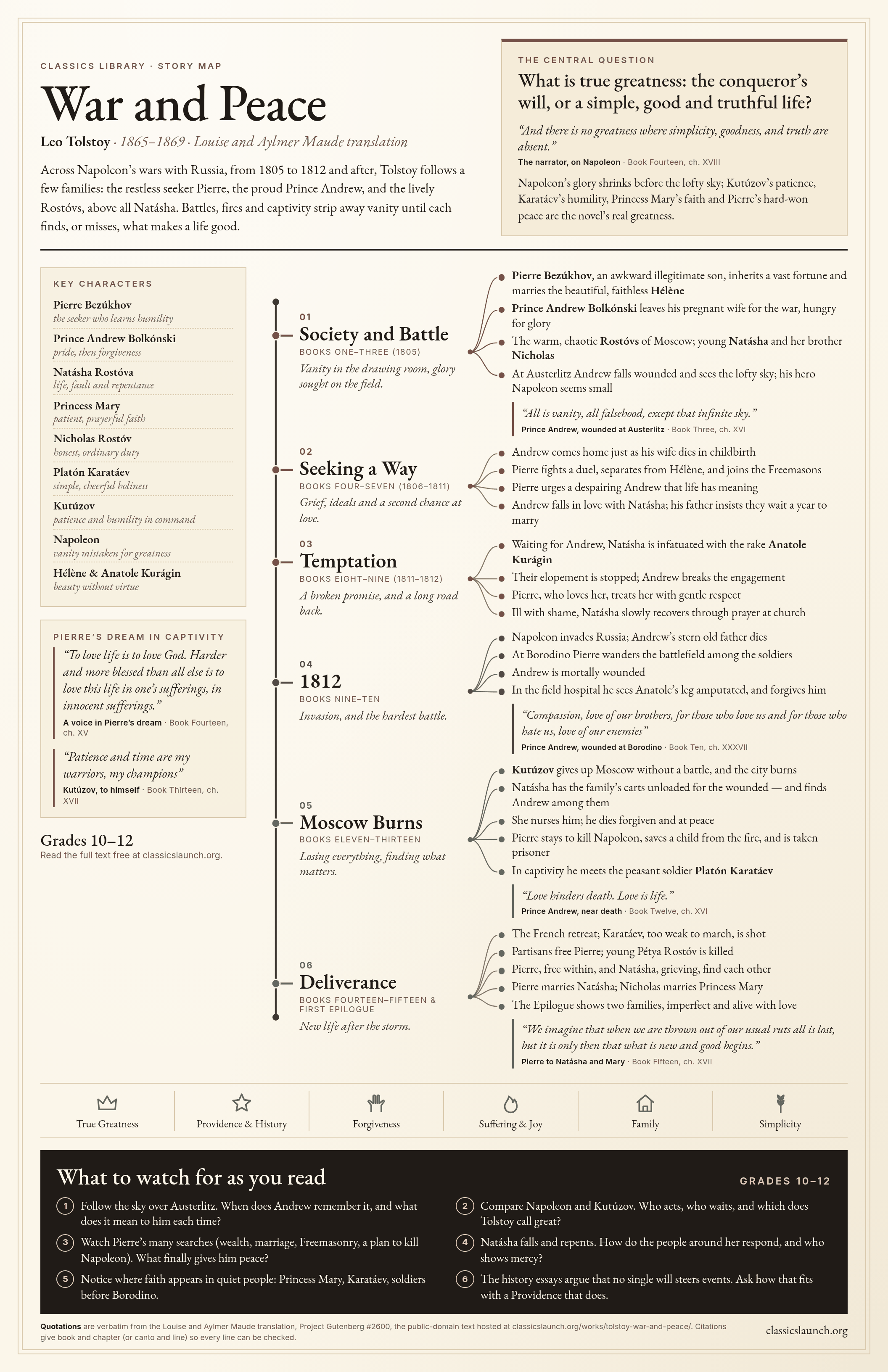
Across Napoleon’s wars with Russia, from 1805 to 1812 and after, Tolstoy follows a few families: the restless seeker Pierre, the proud Prince Andrew, and the lively Rostóvs, above all Natásha. Battles, fires and captivity strip away vanity until each finds, or misses, what makes a life good.
The central question
What is true greatness: the conqueror’s will, or a simple, good and truthful life?
“And there is no greatness where simplicity, goodness, and truth are absent.”
Napoleon’s glory shrinks before the lofty sky; Kutúzov’s patience, Karatáev’s humility, Princess Mary’s faith and Pierre’s hard-won peace are the novel’s real greatness.
- 01
Society and Battle
Books One–Three (1805)
Vanity in the drawing room, glory sought on the field.
- Pierre Bezúkhov, an awkward illegitimate son, inherits a vast fortune and marries the beautiful, faithless Hélène
- Prince Andrew Bolkónski leaves his pregnant wife for the war, hungry for glory
- The warm, chaotic Rostóvs of Moscow; young Natásha and her brother Nicholas
- At Austerlitz Andrew falls wounded and sees the lofty sky; his hero Napoleon seems small
“All is vanity, all falsehood, except that infinite sky.”
- 02
Seeking a Way
Books Four–Seven (1806–1811)
Grief, ideals and a second chance at love.
- Andrew comes home just as his wife dies in childbirth
- Pierre fights a duel, separates from Hélène, and joins the Freemasons
- Pierre urges a despairing Andrew that life has meaning
- Andrew falls in love with Natásha; his father insists they wait a year to marry
- 03
Temptation
Books Eight–Nine (1811–1812)
A broken promise, and a long road back.
- Waiting for Andrew, Natásha is infatuated with the rake Anatole Kurágin
- Their elopement is stopped; Andrew breaks the engagement
- Pierre, who loves her, treats her with gentle respect
- Ill with shame, Natásha slowly recovers through prayer at church
- 04
1812
Books Nine–Ten
Invasion, and the hardest battle.
- Napoleon invades Russia; Andrew’s stern old father dies
- At Borodino Pierre wanders the battlefield among the soldiers
- Andrew is mortally wounded
- In the field hospital he sees Anatole’s leg amputated, and forgives him
“Compassion, love of our brothers, for those who love us and for those who hate us, love of our enemies”
- 05
Moscow Burns
Books Eleven–Thirteen
Losing everything, finding what matters.
- Kutúzov gives up Moscow without a battle, and the city burns
- Natásha has the family’s carts unloaded for the wounded — and finds Andrew among them
- She nurses him; he dies forgiven and at peace
- Pierre stays to kill Napoleon, saves a child from the fire, and is taken prisoner
- In captivity he meets the peasant soldier Platón Karatáev
“Love hinders death. Love is life.”
- 06
Deliverance
Books Fourteen–Fifteen & First Epilogue
New life after the storm.
- The French retreat; Karatáev, too weak to march, is shot
- Partisans free Pierre; young Pétya Rostóv is killed
- Pierre, free within, and Natásha, grieving, find each other
- Pierre marries Natásha; Nicholas marries Princess Mary
- The Epilogue shows two families, imperfect and alive with love
“We imagine that when we are thrown out of our usual ruts all is lost, but it is only then that what is new and good begins.”
- True Greatness
- Providence & History
- Forgiveness
- Suffering & Joy
- Family
- Simplicity
What to watch for as you read
Grades 10–12- Follow the sky over Austerlitz. When does Andrew remember it, and what does it mean to him each time?
- Compare Napoleon and Kutúzov. Who acts, who waits, and which does Tolstoy call great?
- Watch Pierre’s many searches (wealth, marriage, Freemasonry, a plan to kill Napoleon). What finally gives him peace?
- Natásha falls and repents. How do the people around her respond, and who shows mercy?
- Notice where faith appears in quiet people: Princess Mary, Karatáev, soldiers before Borodino.
- The history essays argue that no single will steers events. Ask how that fits with a Providence that does.
Every quotation is word for word from the Louise and Aylmer Maude translation hosted in this library and is checked against that text each time the site is built. Citations give book and chapter (or canto and line).