Work record
Trustees of Dartmouth College v. Woodward
1819 · 19th Century · Court Decision · English
Abstract
Question Presented. New Hampshire lawmakers renamed a royally chartered school, enlarged its board with gubernatorial appointees, and placed state overseers above it. Did those statutes violate the federal prohibition on impairing contractual obligations?
Background. Eleazar Wheelock's mission school for Native American boys, financed by English gifts, received its royal grant in 1769. Decades later a feud between his son, then president, and the board, who dismissed him in 1815, drew in the newly elected Republican majority and Governor Plumer.
Arguments. The original board said private benefactors had given money in reliance on a grant fixing who would govern, so altering that grant broke faith with them. Woodward's lawyers said the institution existed for public instruction, its trustees owned nothing personally, the state had inherited royal and parliamentary authority over such bodies, and the federal clause protected bargains over property rather than grants of public trust.
Holding. Five justices sided with the trustees against one. Marshall classified the school as a privately endowed charity, described incorporation as creating a legal person with only the attributes its founding instrument confers, and found that transferring governance to the legislature's appointees impaired the bargain.
Significance. Charters for colleges, churches and businesses gained federal protection. Story's concurrence pointed toward reservation clauses, which state legislatures and constitutional conventions soon adopted, and the Taney Court confined implied grant terms in 1837.
Key figures
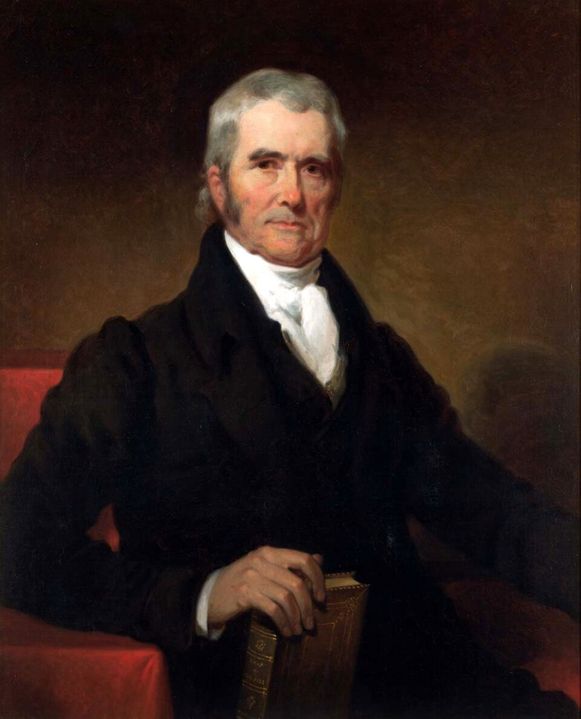
- John Marshall: Chief Justice announcing the judgment for the college trustees
- Gabriel Duvall: Sole dissenter, who gave no written reasons
- William H. Woodward: College officer holding seal and records for the new university
- Daniel Webster: Alumnus who argued his alma mater's cause

Summary
Dartmouth College began as the Reverend Eleazar Wheelock's charity school for teaching Indian youth to read and instructing them in the Christian faith. Funds raised in England, with the Earl of Dartmouth among the trustees of the English contributions, allowed Wheelock to seek a charter, and on 13 December 1769 the royal governor of New Hampshire, acting in the name of George III, incorporated twelve trustees with power to govern the college and fill their own vacancies. Wheelock's son John succeeded him as president. In 1815, after years of quarrels over religion, appointments and control, the trustees removed John Wheelock. The Republican legislature elected in 1816, with Governor William Plumer's support, then passed acts renaming the institution Dartmouth University, enlarging the board to twenty-one with the new members named by the governor, and adding a board of overseers largely appointed by the state. The original trustees refused to accept the change and sued William H. Woodward, the college's secretary and treasurer, who had sided with the university, for the records, seal and account books. The Superior Court of New Hampshire ruled for Woodward. At Washington in March 1818, Daniel Webster and Joseph Hopkinson argued for the trustees that the charter was a contract under which private donors had given property, that the college was a private charity rather than a branch of government, and that the 1816 acts took its management from the persons the founder had chosen. John Holmes and Attorney General William Wirt replied for Woodward that the college was a public corporation devoted to education, a concern of the whole community; that the trustees held no private beneficial interest; that New Hampshire had succeeded to the powers of the Crown and Parliament over such bodies; and that the Contract Clause was aimed at private agreements about property, not at charters granting public trusts. On 2 February 1819 the Court reversed the state court, 5-1, with Justice Gabriel Duvall dissenting without opinion. Chief Justice Marshall agreed that the Constitution does not restrain states in regulating their own civil institutions, but held that Dartmouth was a private eleemosynary corporation: its funds came from private donors, its trustees were not public officers, and its educational purpose did not make it part of the government. A corporation, he wrote, is an artificial being created by law, and the charter was a contract among the donors, the trustees and the Crown, whose obligations New Hampshire inherited. The 1816 acts transferred control of the college to the state and therefore impaired that contract. The library text contains Marshall's opinion only; the concurring opinions of Justices Washington and Story and the notes are not included. After the decision the college was restored to its trustees, and the state-created university ceased to operate. Story's suggestion that a state could reserve, in the charter itself, a power to amend was widely adopted in later state charters and constitutions, and the Court narrowed implied charter rights in the Charles River Bridge case in 1837.
Virtues in this work
- Justice: The Court holds New Hampshire to the terms on which donors gave their property, refusing to let the state take control of what private benefactors had entrusted to the founder's trustees.
- Charity: Marshall honours Wheelock's charity school and the voluntary gifts behind it, describing such institutions as filling a place government would otherwise leave vacant.
- Honor: The opinion treats the obligations of the 1769 charter as surviving the Revolution, so that the new state keeps the promises made in the Crown's name.
Plot or Argument
- The action of trover and the single question
Marshall describes the suit for the college's records and seal, the special verdict, and the judgment for Woodward, and states the sole issue: do the New Hampshire acts violate the Constitution? He acknowledges the respect due to the state court and the caution with which the Court treats such questions.
- Is the charter a contract?
An application for a charter, contributions conveyed on its faith, and a grant from the Crown contain every ingredient of a contract. The points to consider are whether the Constitution protects this contract and whether the acts impair it.
- The state's argument and the private character of the college
Marshall concedes that the Contract Clause was not meant to restrain states in regulating their civil institutions, and that a charter granting political power could be altered. Reviewing the founding of Wheelock's school and the charter's terms, he concludes that the college is a private eleemosynary institution whose funds are private and whose trustees are not public officers.
- The nature of a corporation
A corporation is an artificial being that possesses only the properties its charter confers, chiefly immortality and individuality, so that a succession of persons may act as one. Incorporation does not make a private charity a public body; the benefit to the public is the consideration for the grant.
- Within the letter and the spirit of the Constitution
Though the framers may not have had such cases particularly in view, a case within the words of a rule must be governed by it unless a plain reason for excluding it exists. Contracts for religion, charity and education are not too insignificant for the Constitution's protection, and the claim that the original trustees were appointed in a spirit hostile to republican government is answered from the history of the charter.
- Impairment and the judgment
The Revolution left contracts and property rights unchanged, and New Hampshire succeeded to the Crown's obligations. By placing the government of the college under the will of the state, the 1816 acts convert a private literary institution into a public one; they impair the contract, and the state court's judgment is reversed.
Characters
- John Marshall, Chief Justice; author of the opinion
Wrote the opinion holding the college charter a contract protected from state alteration.
- Gabriel Duvall, Associate Justice; dissent
Maryland justice who dissented but filed no opinion.
- Eleazar Wheelock, founder of the college
Connecticut minister who began a charity school for Indian youth and obtained the 1769 charter.
- John Wheelock, second president
The founder's son, removed by the trustees in 1815, whose cause the legislature took up.
- William H. Woodward, defendant in error
Secretary and treasurer of the college who held its records and seal for the state-created university.
- Daniel Webster, counsel for the trustees
Dartmouth graduate of 1801 whose argument for his college became famous in its own right.
- William Wirt, counsel for Woodward
Attorney General of the United States who, with John Holmes, defended the New Hampshire acts.
Lessons
Public body or private charity?
Both sides agreed that a state may reshape its own civil institutions. The whole case turned on whether Dartmouth was one of them. Marshall looked at where the money came from, who appointed the trustees and what they did, and concluded that teaching the young does not make a teacher a public officer.
- What tests does Marshall use to decide whether the college is public or private?
- Why does Marshall concede that a charter granting political power could be changed by the legislature?
- Should an institution that serves the whole community be controlled by the community's representatives?
The artificial person
Marshall's description of a corporation as an artificial being, invisible, intangible and existing only in law, explains how a group of changing individuals can hold property and act as one across generations. The charter gives it only the powers written there, and Marshall argues that the state cannot later add or remove them at will.
- Which two properties does Marshall say are most important to a corporation?
- Why would donors in 1769 want their gifts held by a corporation rather than by individuals?
- What are the advantages and risks of allowing artificial persons to hold rights under the Constitution?
When a rule reaches cases its authors did not foresee
Marshall admits that the framers probably were not thinking of college charters when they wrote the Contract Clause. He holds that a case within the words of a rule must still be governed by it unless there is a plain and strong reason to except it. Students can weigh this method of reading laws.
- What reason does Marshall give for applying the clause to a case the framers may not have contemplated?
- What would be the risks of allowing judges to create exceptions whenever the framers did not foresee a case?
Founders, donors and the dead hand
The trustees argued that donors gave their money trusting the charter to keep it under the government Wheelock designed. New Hampshire argued that a college serving the public should not remain forever in the hands of a self-perpetuating board named under a king. The case asks how long the wishes of founders should bind those who come after.
- How does Marshall answer the claim that trustees appointed by the Crown were hostile to republican government?
- Why might future donors to schools and churches have welcomed this decision?
- Should a founder's design ever give way to the wishes of later generations?
Context
The Dartmouth controversy combined a religious quarrel among New England Congregationalists, a personal dispute between the college president and his trustees, and the rivalry between New Hampshire's Federalists, who dominated the board, and the Republicans who won the state elections of 1816. Governor Plumer argued that a college chartered by a king should be brought under the control of a republican people. Across the country, legislatures were chartering banks, bridges, turnpikes and colleges, and the security of those charters was a matter of wide interest.
Composition
The Superior Court of New Hampshire, under Chief Justice William M. Richardson, decided for Woodward in November 1817. The case was argued at Washington on 10-12 March 1818 and decided on 2 February 1819; meanwhile friends of the college had prepared further suits to raise additional questions if needed. The library text, from Wikisource, reproduces Marshall's opinion for the Court.
Reception
The decision was welcomed by the college's supporters and by those who saw charters as security for private enterprise and charity; critics argued that it placed corporations beyond the reach of the people's representatives. Story's concurrence suggested that states could reserve a power of amendment when granting charters, and states increasingly did so in their statutes and constitutions. Webster's peroration, in which he was reported to have said that it was a small college and yet there were those who loved it, comes from a later recollection by Chauncey Goodrich and is not part of the official report.
Comparisons
- fletcher-v-peck
The Yazoo decision of 1810 first held that a state grant is a contract; Dartmouth extended that holding from a sale of land to a charter of incorporation.
- charles-river-bridge-v-warren-bridge
In 1837 the Taney Court declined to find an implied monopoly in a bridge charter, limiting the Dartmouth principle to the express terms of a grant; Story, who had concurred in Dartmouth, dissented.
- the-federalist-papers
Federalist No. 44 defends the ban on laws impairing contracts as a protection against sudden changes in legislation that affect personal rights, the concern Marshall applied to the college charter.
- the-founding-documents
Marshall's opinion rests on the clause of Article I, Section 10 that forbids any state to pass a law impairing the obligation of contracts.
- mcculloch-v-maryland
Decided in the same term, McCulloch treated the national government's corporation; Dartmouth treated a private one, and together they made corporate charters a central subject of constitutional law.
Quotes
Frequently cited
“A corporation is an artificial being, invisible, intangible, and existing only in contemplation of law.”
Frequently cited
“The opinion of the court, after mature deliberation, is, that this is a contract, the obligation of which cannot be impaired, without violating the constitution of the United States.”
“This is plainly a contract to which the donors, the trustees and the crown (to whose rights and obligations New Hampshire succeeds) were the original parties.”
“Taken in its broad, unlimited sense, the clause would be an unprofitable and vexatious interference with the internal concerns of a state”
“It is more than possible, that the preservation of rights of this description was not particularly in the view of the framers of the constitution, when the clause under consideration was introduced into that instrument.”
“These eleemosynary institutions do not fill the place, which would otherwise be occupied by government, but that which would otherwise remain vacant.”
For Students
A reading companion for classical Christian high school students. See the student guide.
Reading Guide
Watch for
- Marshall's concession that states may regulate their own civil institutions, and how he then limits it.
- The history of Eleazar Wheelock's charity school drawn from the charter itself.
- The definition of a corporation as an artificial being and the properties Marshall assigns to it.
- The admission that the framers may not have had college charters in view, and the rule Marshall applies anyway.
- The description of what the 1816 acts changed: the number of trustees, the overseers and appointment by the state.
Key terms and names
- Charter
- A formal grant from a sovereign creating a corporation and setting out its powers; Dartmouth's was granted in 1769.
- Eleemosynary
- Charitable; supported by gifts for purposes such as religion, charity or education.
- Corporation
- A body created by law that can hold property and act as a single person through a succession of members.
- Trover
- An old common-law action to recover the value of personal property wrongfully held by another; the trustees used it to claim the college's records and seal.
- Special verdict
- A jury finding of the facts that leaves the legal conclusion to the court.
- Self-perpetuating board
- A governing body that fills its own vacancies, as the charter allowed Dartmouth's trustees to do.
- Board of overseers
- The supervising body created by the 1816 acts, largely appointed by the governor and council of New Hampshire.
Seminar Questions
- Comprehension Who founded Dartmouth College, for what purpose, and how was it first funded?
- Comprehension What changes did the New Hampshire acts of 1816 make to the government of the college?
- Comprehension Why did the trustees sue William Woodward, and what did they ask to recover?
- Interpretation Why does Marshall think that educating the young does not make the trustees public officers?
- Interpretation Marshall says the parties differ less on principles than on applying them. What principle did both sides share?
- Interpretation How does Marshall respond to the argument that trustees named under a king were unsuited to a republic?
- Big Question What do the generations who inherit a school, church or charity owe to the intentions of its founders?
Faith Connections
- Psalm 78:4-7 (Scripture)
The psalmist resolves to show the generation to come the praises of the LORD, so that children not yet born may set their hope in God; Wheelock founded his school to teach the Christian faith to the young.
- Acts 5:1-4 (Scripture)
Peter tells Ananias that his property was his own before it was given and remained in his power, a passage often cited on the voluntary character of gifts, which is central to Marshall's account of a private charity.
- Proverbs 22:28 (Scripture)
Remove not the ancient landmark which thy fathers have set; the trustees argued that the bounds set by the founder and donors should not be moved by a later legislature.
Logic and Rhetoric
Central argument: Because Dartmouth's charter was granted on the faith of private gifts and created a private charitable corporation rather than an instrument of government, it is a contract within the letter and spirit of the Constitution, and New Hampshire's acts placing the college under state control impair that contract.
Rhetorical device: anaphora. Marshall repeats It is a contract three times in quick succession, made on a valuable consideration, for the security of property, and on the faith of which estate was conveyed, before concluding that the charter falls within the Constitution (quote 2 opens the same paragraph).
Debate: Resolved: that a state legislature should have the power to reorganize a privately founded college that serves the public.
Memory Work
A corporation is an artificial being, invisible, intangible, and existing only in contemplation of law.
These eleemosynary institutions do not fill the place, which would otherwise be occupied by government, but that which would otherwise remain vacant.
Writing Prompts
Essay: Explain how Marshall decides that Dartmouth is a private rather than a public corporation, and evaluate the strongest point the New Hampshire side made in response.
Comparison with Charles River Bridge v. Warren Bridge: Compare Marshall's protection of the Dartmouth charter with Chief Justice Taney's treatment of the Charles River Bridge charter in 1837. Do the two decisions conflict, or can both be reconciled?
Medical Lens
Marshall's opinion addresses a college charter, corporate personality and the Contract Clause; it has no medical subject matter.
Creative Prompts
- Classroom
Argue the case in moot court: one team presents Webster and Hopkinson's case that the charter is a private contract, the other presents Holmes and Wirt's case that Dartmouth is a public institution subject to the legislature, and a six-justice bench votes and writes short opinions.
- Essay
Write the dissent Justice Duvall never published, making the strongest case that New Hampshire could reorganize the college.
- Dialogue
Write a conversation in Hanover in 1817 between a student loyal to the college trustees and a student enrolled in the new Dartmouth University, as both institutions hold classes in the same village.
- Essay
Draft a charter for an imaginary private school today, deciding whether to include a clause reserving to the state a power of amendment, and explain your choice with reference to the case.
Further Reading
- Private Interest and Public Gain: The Dartmouth College Case, 1819, Francis N. Stites
Modern study of the college quarrel, the New Hampshire politics behind the 1816 acts and the litigation.
- The Dartmouth College Causes and the Supreme Court of the United States, John M. Shirley
Detailed nineteenth-century account by a New Hampshire lawyer, drawing on letters of the participants.
- Supreme Court Justice Joseph Story: Statesman of the Old Republic, R. Kent Newmyer
Biography of the justice whose concurrence shaped the later practice of reserving power to amend charters.
Verification notes
Grep confirmed all six quotations as exact strings in content/texts/dartmouth-college-v-woodward.txt. The 5-1 vote, Duvall's dissent without opinion and Todd's absence follow the U.S. Reports as generally described; web search was unavailable, so dates of argument and decision, the names of counsel and the Superior Court's November 1817 ruling come from standard accounts. Webster's famous small college peroration is reported only through Chauncey Goodrich's later recollection, and the record says so.
- Confirm the decision date of 2 February 1819 and the argument dates of 10-12 March 1818.
- Confirm that John Holmes and William Wirt argued for Woodward and Joseph Hopkinson with Webster for the trustees.
- Confirm that the state-created university ceased operating soon after the decision.