Work record
Relativity: The Special and General Theory
1916 · Early 20th Century · Essays · German
Abstract
Background. Having completed his theory of gravitation in late 1915, the Berlin physicist set out to explain it, together with his 1905 theory, to educated readers lacking advanced mathematics. A Sheffield physicist's English version appeared in 1920, after eclipse measurements of 1919 had confirmed that starlight bends near the sun; that version is the library's text.
Content. A train passing an embankment carries the first part: lightning flashes, clocks and measuring rods show that judgements of simultaneity, length and duration depend on the observer's frame, and that mass and energy are interchangeable. The second part imagines a windowless room hauled upward in empty space, equates its occupant's sensations with gravity, and arrives at curved space-time, deflected light and the orbit of Mercury. The third asks whether the cosmos could be closed without having an edge.
Key Concepts. Constancy of light's speed; frame-dependent time; Lorentz transformation; mass-energy equivalence; equivalence of inertia and gravitation; non-Euclidean continuum; Gaussian co-ordinates; a closed cosmos. Each is introduced through a concrete picture before any formula.
Significance. Few founders of a theory have explained it so plainly to the public. Its thought experiments became classroom staples, and its willingness to stake the general theory on the red shift was later held up by Popper as a model of testable science.
Key figures
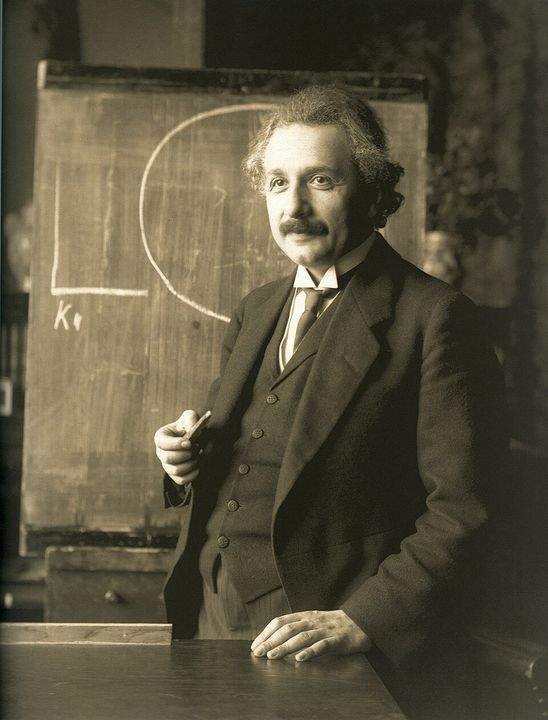
- Albert Einstein: Creator of both theories, writing for non-specialists
- Galileo and Newton: Founders of the classical mechanics that relativity revises and preserves
- H. A. Lorentz: Dutch theorist whose equations relate measurements in moving frames
- Hermann Minkowski: Geometer who joined space and time into one four-dimensional world
- Hippolyte Fizeau: French experimenter whose measurement of light in moving water supports the theory

Summary
Relativity: The Special and General Theory is Albert Einstein's own explanation of his two theories of relativity for readers who know no higher mathematics. He dated the preface December 1916, and the book appeared in German in 1917 as Über die spezielle und die allgemeine Relativitätstheorie (gemeinverständlich), published by Vieweg in Braunschweig. The library text is the authorised English translation by Robert W. Lawson, published in 1920, shortly after the eclipse observations of 1919 had made Einstein famous. In the preface he promises to repeat himself rather than seek elegance, following Boltzmann's advice that elegance belongs to the tailor and the cobbler. Part I, on the special theory, has seventeen short sections built on homely examples, above all a railway train running along an embankment. Einstein begins with what geometrical propositions mean physically, and with co-ordinates and time in classical mechanics. He states the principle of relativity, that the laws of nature are the same for bodies of reference in uniform motion, and shows its apparent conflict with the constant velocity of light. In Section VIII he asks what it means for two lightning strokes at points A and B on the line to be simultaneous, and in Section IX shows that strokes simultaneous for the embankment are not simultaneous for the train. Every body of reference has its own time. From this follow the Lorentz transformation, the contraction of moving rods and slowing of moving clocks, the relativistic addition of velocities confirmed by Fizeau's experiment, the equivalence of mass and energy, the evidence of the Michelson-Morley experiment, and Minkowski's four-dimensional space-time. Part II extends relativity to accelerated motion. Einstein imagines a man in a large chest far out in space, drawn upward by a rope at constant acceleration: the man would feel himself in a gravitational field, so that the equality of inertial and gravitational mass becomes the basis of a general principle of relativity. The theory predicts that light bends in a gravitational field and that clocks and rods on a rotating disc depart from Euclidean geometry. Einstein explains Gaussian co-ordinates and non-Euclidean continua, states the general principle, and shows how the theory accounts for the motion of Mercury's perihelion. Part III considers the universe as a whole, the difficulties of Newton's infinite universe, and the possibility of a space that is finite and yet unbounded. The appendices give a simple derivation of the Lorentz transformation, a note on Minkowski's world, the experimental tests of the general theory (perihelion of Mercury, deflection of light, red shift), and a later note on expanding space. The file notes that a fifth appendix, added to a much later printing, is omitted for copyright reasons.
Virtues in this work
- Humility: Einstein presents Newton's mechanics as surviving within his theory as a limiting case rather than as a discarded error.
- Charity: He repeats himself and uses everyday examples so that readers without mathematics can follow, hoping to give them a few happy hours of thought.
- Fortitude: In Appendix III he names an observation, the red shift, that would make his theory untenable if it failed.
Plot or Argument
- Preface
Einstein writes for readers interested in the theory from a general scientific and philosophical point of view but unacquainted with theoretical physics. He will present the main ideas in the order in which they arose, repeating himself where clarity requires, and hopes the book will give someone a few happy hours of thought.
- Part I, Sections I–VII: classical foundations and the conflict with light
Geometry is treated as a statement about practically rigid bodies. Positions are given relative to a body of reference, such as the railway embankment or a carriage. The Galilean principle of relativity holds for uniformly moving bodies of reference, but the classical addition of velocities conflicts with the law, supported by Maxwell's and Lorentz's electrodynamics, that light travels at a constant speed in a vacuum.
- Part I, Sections VIII–XII: time, simultaneity and the Lorentz transformation
To say that two lightning strokes are simultaneous requires a way of testing it: an observer midway between them must receive the light at the same moment. An observer on the moving train, by the same test, finds them not simultaneous. Time therefore depends on the body of reference, and so does distance. The Lorentz transformation replaces the Galilean one, and moving rods are shortened and moving clocks run slow as judged from the embankment.
- Part I, Sections XIII–XVII: confirmations and consequences
The relativistic addition of velocities agrees with Fizeau's measurement of light in moving water. The theory has heuristic value as a test of any proposed law, unites the conservation of mass with the conservation of energy, explains the null result of the Michelson-Morley experiment, and is expressed most simply in Minkowski's four-dimensional space-time.
- Part II, Sections XVIII–XXII: from special to general relativity
Why should the principle of relativity hold only for bodies of reference in uniform motion? Einstein shows that a man in a chest drawn upward with constant acceleration would interpret his experience as a gravitational field. Because inertial and gravitational mass are equal, acceleration and gravitation are equivalent. Consequences include the bending of light rays in gravitational fields, a prediction to be tested during solar eclipses.
- Part II, Sections XXIII–XXIX: non-Euclidean space-time and gravitation
Measuring-rods laid along the rim of a rotating disc show that Euclidean geometry does not hold for it. Einstein explains Gaussian co-ordinates on a curved surface, describes space-time in the general theory as a non-Euclidean continuum, formulates the general principle of relativity, and shows that the theory yields Newton's law as an approximation and accounts for the observed advance of Mercury's perihelion.
- Part III, Sections XXX–XXXII: the universe as a whole
Newton's theory seems to require either a universe with a centre of maximum density or one whose matter thins out to nothing. Einstein explains, with the analogy of two-dimensional beings on a sphere, how space might be finite and yet unbounded, and argues that the general theory makes such a closed universe possible.
- Appendices
Appendix I derives the Lorentz transformation simply; Appendix II discusses Minkowski's world; Appendix III reviews the experimental tests of the general theory and remarks on how theories are tested; Appendix IV, from a later printing, reports Friedmann's expanding solutions and Hubble's red shifts and withdraws the need for the cosmological term.
Characters
- Albert Einstein, author
Physicist in wartime Berlin explaining his theories to general readers.
- The observer on the embankment and the traveller on the train, thought-experiment figures
Two observers whose different judgements about the same lightning strokes show the relativity of simultaneity.
- The man in the chest, thought-experiment figure
An observer in an accelerated room in empty space who cannot tell his situation from rest in a gravitational field.
- Galileo Galilei and Isaac Newton, predecessors
Whose principle of relativity and mechanics the special theory preserves for slow motions and the general theory extends.
- H. A. Lorentz, predecessor
Dutch physicist whose electrodynamics and transformation equations underlie the special theory.
- Hermann Minkowski, interpreter
Mathematician who recast the special theory as the geometry of a four-dimensional world.
Lessons
A concept must be tied to a test
Einstein refuses to accept that simultaneity means anything until we say how it could be checked. By asking how an observer would actually decide whether two lightning strokes were simultaneous, he finds that the answer depends on the body of reference. Clear thinking often begins by asking what a word means in practice.
- What method does Einstein propose for deciding whether two distant events are simultaneous?
- Why do the observer on the train and the observer on the embankment disagree?
- Can you think of another everyday word whose meaning becomes unclear when you ask how it would be tested?
Old theories live on inside new ones
Einstein does not say Newton was simply wrong. Classical mechanics remains valid for velocities small compared with light, and Newton's law of gravitation follows from the general theory as an approximation. He calls it the fairest destiny of a theory to point the way to a more comprehensive one in which it survives as a limiting case.
- In what sense does Newton's mechanics survive within relativity?
- Why does Einstein regard this as a fair destiny rather than a defeat?
- How does this view of scientific progress compare with the idea that new theories overthrow old ones?
Imagination disciplined by experiment
The book's arguments rest on thought experiments, the train and the chest, but Einstein insists that the theory must be compared with reality. He points to Fizeau's experiment, the Michelson-Morley experiment, Mercury's perihelion and the bending of starlight, and states that if the predicted red shift were not found the general theory would be untenable.
- What does the thought experiment of the man in the chest show, and what does it not prove?
- Which observations does Einstein offer as tests of his theories?
- Why is it a strength, not a weakness, that a theory could be shown false by an observation?
Writing hard ideas plainly
Einstein wrote for readers with a school education and a fair amount of patience. He uses trains, embankments, clocks and rods, repeats himself deliberately, and prefers clearness to elegance. The book shows that even the most difficult ideas can be made accessible without being falsified.
- Why does Einstein choose the railway train as his main example?
- What does Boltzmann's remark about tailors and cobblers mean, and do you agree with it?
- Choose a section and explain its argument to a younger student in a paragraph.
Context
By the end of the nineteenth century physics rested on Newton's mechanics and on Maxwell's electromagnetic theory, but the two were hard to reconcile: light seemed to travel at a fixed speed, yet experiments such as Michelson and Morley's found no trace of the earth's motion through a supposed ether. Lorentz and Poincaré had developed much of the mathematics; Einstein's 1905 paper reinterpreted it as a new account of space and time. Over the next decade he sought to include gravitation, completing the general theory in November 1915 in Berlin, in the middle of the First World War.
Composition
Einstein wrote the popular account in 1916, dating its preface December of that year, and Vieweg published it in Braunschweig in 1917 as a small book. It went through many German editions, with additions by Einstein. Robert W. Lawson, a physicist at the University of Sheffield, made the authorised English translation, published by Methuen in London and Henry Holt in New York in 1920 after the British eclipse expeditions of 1919 had reported the predicted bending of starlight. Later printings added Appendix IV on the expanding universe and a fifth appendix, which the library file omits.
Reception
The book became one of the most widely read introductions to modern physics and has never gone out of print. Its train and lightning examples became standard in teaching relativity. Philosophers of science, including Karl Popper, cited Einstein's willingness to name observations that would refute his theory, and the book's Part III placed cosmology on a new footing. Later developments, such as Friedmann's expanding solutions and Hubble's observations, led Einstein himself to revise his cosmological assumptions, as Appendix IV records.
Comparisons
- galileo-selected-writings
Galileo's principle that a uniformly moving ship cannot be distinguished by experiments inside it from one at rest is the starting point of Einstein's special theory, which extends it to the laws of light.
- poincare-science-and-hypothesis
Poincaré, writing in 1902, discussed the relativity of space, the conventional element in geometry and the possibility of non-Euclidean physics; Einstein's account of geometry as a statement about rigid bodies takes up the same questions.
- euclid-elements-book-i
Einstein opens with the question of what Euclid's propositions mean physically and later shows that space-time in the general theory is not Euclidean; Euclid supplies the geometry being reconsidered.
- popper-the-logic-of-scientific-discovery
Popper took Einstein's readiness to name observations, such as the red shift, that would make his theory untenable as a model of falsifiable science.
- kuhn-the-structure-of-scientific-revolutions
Kuhn treated the passage from Newtonian to relativistic physics as a revolution in which basic concepts change meaning; Einstein's own account stresses instead that Newton's mechanics survives as a limiting case.
Quotes
“I adhered scrupulously to the precept of that brilliant theoretical physicist L. Boltzmann, according to whom matters of elegance ought to be left to the tailor and to the cobbler.”
“we entirely shun the vague word “space,” of which, we must honestly acknowledge, we cannot form the slightest conception”
“Every reference-body (co-ordinate system) has its own particular time; unless we are told the reference-body to which the statement of time refers, there is no meaning in a statement of the time of an event.”
“the inertial mass of a body is not a constant but varies according to the change in the energy of the body.”
“No fairer destiny could be allotted to any physical theory, than that it should of itself point out the way to the introduction of a more comprehensive theory, in which it lives on as a limiting case.”
“If the displacement of spectral lines towards the red by the gravitational potential does not exist, then the general theory of relativity will be untenable.”
“May the book bring some one a few happy hours of suggestive thought!”
For Students
A reading companion for classical Christian high school students. See the student guide.
Reading Guide
Watch for
- How Einstein uses the railway train and embankment throughout Part I.
- The test for simultaneity in Section VIII and its consequences in Section IX.
- Places where Einstein shows that Newton's mechanics remains true as an approximation.
- The man in the chest in Section XX and the equality of inertial and gravitational mass.
- Every observation Einstein offers as a test of the theory, especially in Section XXII and Appendix III.
Key terms and names
- Body of reference
- A practically rigid body, such as the embankment or a train, relative to which positions and times are measured.
- Principle of relativity
- The principle that the laws of nature take the same form for all bodies of reference in uniform motion (special) or for all bodies of reference whatever (general).
- Relativity of simultaneity
- The result that events simultaneous with respect to one body of reference need not be simultaneous with respect to another moving relative to it.
- Lorentz transformation
- The equations relating positions and times measured in two bodies of reference in uniform relative motion, consistent with a constant velocity of light.
- Equivalence principle
- The idea, based on the equality of inertial and gravitational mass, that a uniformly accelerated frame cannot be distinguished locally from a gravitational field.
- Finite but unbounded
- Describing a space, like the surface of a sphere for two-dimensional beings, that has a finite size but no edge.
Seminar Questions
- Comprehension Why do the observer on the embankment and the passenger on the train disagree about whether the lightning strokes at A and B were simultaneous?
- Comprehension What does the man in the chest experience, and what does Einstein conclude from it?
- Comprehension What three tests of the general theory does Einstein describe in Appendix III?
- Interpretation Why does Einstein insist that a statement about time has no meaning unless the body of reference is given?
- Interpretation How does Einstein's account of Newton as a limiting case shape the way he presents his own theory?
- Interpretation Why does Einstein begin a book about physics with the question of what geometrical propositions mean?
- Big Question If measurements of time and space depend on the observer, is anything in nature absolute? What does Einstein's own theory hold fixed?
Faith Connections
- Psalm 19:1-4 (Scripture)
'The heavens declare the glory of God' fits a book that ends by asking about the structure of the whole universe; the psalm praises the order that Einstein's laws describe.
- Psalm 90:2-4 (Scripture)
The psalmist contrasts God, who is from everlasting, with human measures of time; students may compare the psalm's distinction between eternity and time with Einstein's claim that each body of reference has its own time, without treating the one as a statement of the other.
- Augustine, Confessions XI (Church Fathers)
Augustine's famous inquiry, 'What then is time?', asks how time is measured and argues that God created time with the world; it is a classic companion for reading Sections VIII and IX.
- Isaac Newton, Principia, Scholium to the Definitions (Great Conversation)
Newton's definitions of absolute time and absolute space are the views Einstein revises; reading them side by side clarifies what changed.
Logic and Rhetoric
Central argument: The laws of nature, including the constant velocity of light, should be the same for all bodies of reference in uniform motion. Taken together, these require that simultaneity, length and time depend on the body of reference, as the Lorentz transformation describes. Because inertial and gravitational mass are equal, acceleration and gravitation are equivalent, so the principle of relativity can be extended to all motion. Therefore gravitation is described by a non-Euclidean space-time, a theory that contains Newton's as a limiting case and makes testable predictions about light, Mercury and the red shift.
Rhetorical device: thought experiment. In Sections VIII and IX Einstein places an observer midway between two lightning strokes on the embankment and another on a passing train, letting the reader see for himself why the two disagree about simultaneity.
Debate: Resolved: That a scientific concept has meaning only if we can say how it would be measured.
Memory Work
Every reference-body (co-ordinate system) has its own particular time; unless we are told the reference-body to which the statement of time refers, there is no meaning in a statement of the time of an event.
No fairer destiny could be allotted to any physical theory, than that it should of itself point out the way to the introduction of a more comprehensive theory, in which it lives on as a limiting case.
Writing Prompts
Essay: Using Sections VIII and IX, explain the relativity of simultaneity to a reader who has never studied physics, and then explain why we do not notice it in everyday life.
Comparison with Galileo: The Starry Messenger, Letter to the Grand Duchess Christina, and Two New Sciences (First Day): Compare Galileo's ship and Einstein's train. What does each thought experiment show about motion, and what does Einstein add that Galileo could not?
Medical Lens
A work of physics with no medical content.
Creative Prompts
- Classroom
Act out Section IX with a long hallway, two flashlights and two observers, one standing still and one walking. Discuss what the demonstration captures and what it cannot, given how slowly people move compared with light.
- Fiction
Write a short story told by the man in the chest, who wakes in a windowless room and must decide whether he is resting on a planet or being pulled through empty space.
- Essay
Einstein says a theory's fairest destiny is to live on as a limiting case of a more comprehensive one. Explain this claim using Newton's mechanics and argue whether it describes scientific progress well.
- Dialogue
Write a conversation between Galileo, on a ship in the harbour of Venice, and Einstein, on a train in Berlin, about what a traveller can learn about his own motion without looking out.
Further Reading
- The Meaning of Relativity, Albert Einstein
Einstein's 1921 Princeton lectures, a more mathematical account.
- Einstein: His Life and Universe, Walter Isaacson
- Subtle is the Lord: The Science and the Life of Albert Einstein, Abraham Pais
A scientific biography by a physicist who knew Einstein.
- Space, Time and Gravitation, A. S. Eddington
Eddington's 1920 popular account, written by the leader of an eclipse expedition.
Verification notes
Structure, section titles and quotations are taken from the stored Lawson translation. Publication facts (preface December 1916; Vieweg, Braunschweig, 1917; Lawson's translation, Methuen and Holt, 1920) and biographical facts follow standard accounts. The stored file's Appendix IV discusses Friedmann and Hubble and so comes from a later printing than 1920, and one footnote refers to observations of 1924; the file states that Appendix V is omitted for copyright reasons. No quotation is drawn from Appendix IV.
- The date and edition in which Appendix IV first appeared.
- Lawson's institutional affiliation at the time of translation.