Work record
The Epic of Gilgamesh
c. 2100-1200 BC · Ancient · Epic · Akkadian
Abstract
Background. Stories of a Sumerian ruler of Uruk were sung and copied for more than a millennium before scribes fixed a standard Akkadian telling; the best-preserved tablets come from Ashurbanipal's seventh-century library. The library stores no English text because the public-domain renderings are partial reconstructions overtaken by later finds.
Narrative. A restless tyrant meets his equal in a wild man fashioned by the gods. The pair slay a forest monster and a divine bull, and the gods condemn the wild man to sickness and death. Desolate, the king crosses the world to question the deathless flood-survivor, hears the deluge story, fails a test of wakefulness, and loses a rejuvenating plant to a snake.
Structure. A prologue and closing lines about Uruk's walls frame the whole, dreams punctuate each stage, and an inset narrative of the flood fills the eleventh tablet. Gaps where the clay is broken remain in every modern version.
Themes. Companionship, grief, the boundary between gods and mortals, the hunger for fame and for endless life, and the consolation of works that outlast their maker.
Significance. Often called the oldest surviving great work of literature, it astonished Victorian readers in 1872 with a flood narrative parallel to Genesis and remains central to the study of the ancient Near East.
Main characters
- Gilgamesh: king of Uruk, two-thirds god, seeker of life
- Enkidu: wild man made from clay, the king's friend
- Shamhat: temple woman who brings Enkidu among people
- Humbaba: guardian of the Cedar Forest
- Ishtar: goddess who sends the Bull of Heaven
- Siduri: ale-wife at the edge of the world
- Utnapishtim: immortal survivor of the great flood

Summary
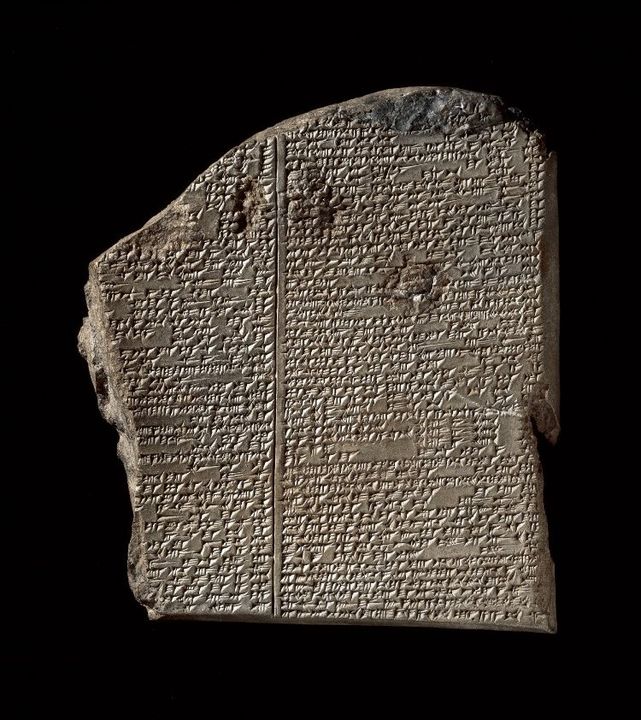
The Epic of Gilgamesh is the great poem of ancient Mesopotamia, known in its fullest form from the standard Babylonian version on clay tablets, many of them from the library of the Assyrian king Ashurbanipal at Nineveh. The library holds no text of it: the public-domain English versions, by Stephen Langdon (1917), Morris Jastrow and Albert T. Clay (1920) and R. Campbell Thompson (1928), are fragmentary scholarly editions of a poem still being recovered, so this record describes the epic without quoting it. Gilgamesh, king of Uruk, two-thirds god and one-third man, oppresses his city with his restless strength, and the people cry to the gods. The goddess Aruru forms Enkidu from clay in the wilderness, where he runs with the gazelles until a trapper brings the woman Shamhat to him; after a week with her the animals flee him, and she leads him to the shepherds' camp, where he learns to eat bread and drink beer. Enkidu challenges Gilgamesh, they wrestle, and they become friends. Together they journey to the Cedar Forest and kill its guardian Humbaba, despite his pleas. Back in Uruk, Gilgamesh rejects the goddess Ishtar's offer of marriage by listing the fates of her former lovers; she sends the Bull of Heaven against the city, and the friends kill it. The gods decree that Enkidu must die. He falls ill, curses and then blesses Shamhat, dreams of the house of dust, and dies after twelve days. Gilgamesh mourns him for seven days and nights and will not give him up to burial until decay begins. Terrified of death, Gilgamesh wanders to find Utnapishtim, the one man granted eternal life. He passes the scorpion-people at the mountains of Mashu, walks through the darkness of the sun's road, meets the ale-wife Siduri by the sea, and crosses the waters of death with the boatman Urshanabi. On Tablet XI Utnapishtim tells how the god Ea warned him of the flood the gods had decreed, how he built a great boat, rode out the storm, landed on Mount Nimush and sent out a dove, a swallow and a raven. Utnapishtim challenges Gilgamesh to stay awake for a week, and he fails at once. Told of a plant on the sea-bed that renews youth, Gilgamesh dives for it, but a snake steals it while he bathes. He returns to Uruk and shows Urshanabi the city's walls, the lasting work of a mortal king. A twelfth tablet, a translation of a separate Sumerian poem, tells of Enkidu's descent to the underworld. The British Museum scholar George Smith announced his discovery of the flood story among the Nineveh tablets in December 1872.
Virtues in this work
- Friendship: Gilgamesh and Enkidu, after wrestling at the doorway, become companions who face Humbaba and the Bull of Heaven together, and Gilgamesh mourns his friend for seven days and nights.
- Humility: Failing Utnapishtim's test of sleep and losing the plant of youth to a snake, Gilgamesh returns to Uruk and points not to himself but to the walls he built.
- Piety: Ninsun purifies herself and offers incense to Shamash, praying for her son's safety before the journey to the Cedar Forest.
Plot or Argument
- Tablet I: Gilgamesh and the making of Enkidu
A prologue invites the reader to walk the walls of Uruk and find the tablet-box holding Gilgamesh's story; the people's complaints against their overbearing king lead the gods to create Enkidu, who is drawn from the wild by Shamhat; Gilgamesh dreams of a meteor and an axe that his mother Ninsun interprets as a coming friend.
- Tablet II: The meeting of the friends
Enkidu learns the ways of the shepherds, comes to Uruk, blocks Gilgamesh at a doorway and wrestles him; the fight ends in friendship, and Gilgamesh proposes the expedition against Humbaba.
- Tablets III-V: The Cedar Forest
The elders and Ninsun send them off with counsel and prayers to Shamash; Gilgamesh's ominous dreams on the road are read as good omens by Enkidu; with the help of Shamash's winds they overcome Humbaba, who begs for his life, and they kill him and cut the cedars.
- Tablet VI: Ishtar and the Bull of Heaven
Gilgamesh scorns Ishtar's proposal, recounting how she ruined her lovers; she obtains the Bull of Heaven from her father Anu; the friends kill it, and Enkidu insults the goddess.
- Tablets VII-VIII: The death of Enkidu
Enkidu dreams that the gods have condemned him; he sickens, curses the trapper and Shamhat and then blesses her at Shamash's rebuke, sees the house of dust in a dream, and dies; Gilgamesh laments him and raises a funeral statue.
- Tablets IX-X: The road to Utnapishtim
Gilgamesh roams the wild in skins, passes the scorpion-man and his mate at Mashu, travels twelve double-hours of darkness to a garden of jewelled trees, meets Siduri, who counsels him to enjoy the days given to him, and crosses the waters of death with Urshanabi.
- Tablet XI: The flood and the plant of youth
Utnapishtim tells of the flood decreed by the gods, Ea's warning through a reed wall, the boat, the seven-day storm, the birds sent out and the sacrifice; he sets Gilgamesh the test of sleep, sends him home washed and clothed, and reveals the plant of rejuvenation, which a snake carries off.
- Tablet XII: Enkidu in the underworld
An appended Akkadian rendering of a Sumerian poem in which Enkidu goes down to retrieve objects Gilgamesh has dropped into the netherworld, is held there, and returns as a spirit to describe the condition of the dead.
Characters
- Gilgamesh, king of Uruk
Son of the goddess Ninsun and King Lugalbanda, two-thirds divine, who seeks fame and then escape from death.
- Enkidu, wild man, Gilgamesh's friend
Formed from clay to be the king's equal, drawn into human life, and doomed by the gods for the killing of Humbaba and the Bull.
- Shamhat, woman of the temple of Ishtar
Brings Enkidu out of the wilderness and teaches him to live among people.
- Ninsun, goddess, Gilgamesh's mother
Interprets her son's dreams and prays to Shamash for his safety.
- Humbaba, guardian of the Cedar Forest
Monstrous warden appointed by Enlil, who pleads for mercy before he is killed.
- Ishtar, goddess of love and war
Offers herself to Gilgamesh and, refused, sends the Bull of Heaven.
- Shamash, sun god
Patron of Gilgamesh who aids the friends against Humbaba.
- Siduri, ale-wife at the edge of the sea
Counsels Gilgamesh in the Old Babylonian version to enjoy food, clothing, wife and child.
- Urshanabi, boatman of Utnapishtim
Ferries Gilgamesh across the waters of death and returns with him to Uruk.
- Utnapishtim, survivor of the flood
The one man granted eternal life with his wife, who tells Gilgamesh the story of the deluge.
Lessons
Friendship that changes a king
Gilgamesh begins as a tyrant whose energy has no rival; Enkidu is created as his match, and their friendship turns his strength outward to shared quests. When Enkidu dies, the king's grief becomes the engine of the second half. The epic is among the oldest literary portraits of a friendship that changes both friends.
- Why do the gods answer the people's complaint by creating a companion rather than by punishing Gilgamesh?
- How does the wrestling match turn into friendship?
- What does Gilgamesh lose when Enkidu dies, beyond a companion in adventure?
The search for a way past death
After Enkidu's death Gilgamesh abandons his city to find Utnapishtim and learn the secret of eternal life. Every stage of the journey refuses him: Siduri urges him to accept mortal joys, Utnapishtim shows that the gods granted life to him alone, the test of sleep proves Gilgamesh cannot master even rest, and the snake takes the plant of youth. The poem treats the longing to escape death with sympathy while showing its limits.
- Why is a test of staying awake a fitting trial for a man who wants to defeat death?
- What does the snake gain from the plant, and what does Gilgamesh learn by losing it?
- Is Gilgamesh's quest a failure? What does he bring back to Uruk?
Walls that outlast the king
The epic opens and closes with the walls of Uruk, inviting the reader to climb them and examine their brickwork. Gilgamesh's lasting achievement is not personal immortality but the city he built and the story inscribed in the tablet-box. The frame suggests that a mortal's work and memory are what endure.
- Why does Gilgamesh show Urshanabi the walls at the very end?
- How does the prologue's invitation to read the tablet change the way the story is received?
- Is a great work or a good name a real answer to death, or a consolation?
Mercy and its refusal: Humbaba
When Humbaba is overcome he pleads for his life and offers service; Gilgamesh hesitates, and Enkidu urges the killing. The gods later choose Enkidu to die partly for this deed and for the Bull of Heaven. The episode raises the question of whether glory won by violence carries a price.
- Who urges the killing of Humbaba, and why?
- Does the epic connect Enkidu's death with this choice? How?
- What does the cutting of the cedars suggest about what the heroes take from the forest?
Context
Gilgamesh belongs to the civilisation of Sumer and Babylonia in southern Mesopotamia, modern Iraq, where Uruk was one of the first great cities. The poem was copied in scribal schools across the Near East: fragments of versions have been found from Babylonia and Assyria to the Hittite capital in Anatolia and Megiddo in Canaan, and parts were translated into Hittite and Hurrian. Its world is one of many gods, temple service, divination by dreams, and a gloomy house of dust awaiting the dead.
Composition
Five separate Sumerian poems about Bilgames (Gilgamesh) survive, probably composed for the court of the Ur III kings around 2100 BC. An Akkadian epic was formed by the Old Babylonian period, about 1800-1600 BC; the Pennsylvania tablet published by Langdon in 1917 and the Yale tablet published by Jastrow and Clay in 1920 belong to this stage. The standard Babylonian version, attributed in ancient catalogues to Sin-leqi-unninni and dated roughly 1300-1000 BC, opens with the line He who saw the Deep and is best known from seventh-century BC copies from Nineveh. No English text is stored in this library because the public-domain versions are partial reconstructions from damaged tablets, and new fragments have continued to appear since they were made.
Reception
The epic was forgotten after the end of cuneiform writing and rediscovered among tablets excavated at Nineveh by Austen Henry Layard and Hormuzd Rassam in the mid-nineteenth century. On 3 December 1872 George Smith of the British Museum told the Society of Biblical Archaeology that he had found an account of the flood, and the Daily Telegraph funded his return to Nineveh, where he found further fragments. The resemblance of Tablet XI to the flood of Genesis 6-9 has been discussed ever since: scholars note shared features such as the warning, the vessel, the birds and the sacrifice, and also deep differences, such as the Genesis flood as the moral judgment of one God set against the divided council of the Mesopotamian gods; they differ on whether the accounts reflect a common tradition, literary contact, or a shared memory of an event. The poem has since been widely translated and retold.
Comparisons
- the-bible
Genesis 6-9 and Tablet XI both tell of a flood survived by one righteous or favoured man in a great vessel who sends out birds and offers sacrifice; the accounts differ in their view of the divine, one God judging the corruption of the earth in Genesis and quarrelling gods in Gilgamesh, and scholars debate how they are related. Siduri's counsel to Gilgamesh is also often set beside Ecclesiastes 9:7-9.
- the-odyssey
Both are journeys to the ends of the earth by a hero who meets a divine woman by the sea, consults the dead or the deathless, refuses or loses immortality, and comes home to his own place and limits.
- the-iliad
Achilles' grief for Patroclus, his refusal to let the body go and his funeral rites are the closest classical parallel to Gilgamesh's mourning for Enkidu; in both, the friend's death turns the hero toward his own mortality.
- metamorphoses
Ovid's flood of Deucalion and Pyrrha in Book I is a later Mediterranean flood story in which a pious couple survive in a boat and repeople the earth, offering a third account to compare with Tablet XI and Genesis.
- hesiod-theogony-and-works-and-days
Hesiod's ages of mankind and his picture of gods who keep life hidden from men share the Gilgamesh poet's sense of a fixed gap between gods and mortals; the Theogony's divine generations also recall the Mesopotamian pantheon behind the epic.
- the-aeneid
Aeneas's descent to the underworld in Book VI, guided by the Sibyl and ferried by Charon, invites comparison with Gilgamesh's crossing of the waters of death with Urshanabi and with Enkidu's dream of the house of dust.
Quotes
For Students
A reading companion for classical Christian high school students. See the student guide.
Reading Guide
Watch for
- The walls of Uruk in the prologue and in the final lines of Tablet XI, and how the frame changes once you know the ending.
- Gilgamesh's dreams on the road to the Cedar Forest, and how Enkidu reads each one.
- The change in Gilgamesh's appearance and dress after Enkidu dies, and the questions every stranger asks him.
- The tests Gilgamesh fails on his quest: Siduri's counsel, the stone ones he smashes, the sleep test and the snake.
- How Utnapishtim's flood story is told within the epic as one man's memory of the gods' decision.
Key terms and names
- Uruk
- Gilgamesh's city in southern Mesopotamia, famed for its walls and its temple of Anu and Ishtar.
- Tablet
- A clay tablet incised with cuneiform script; the standard version fills eleven tablets, with a twelfth appended.
- Cuneiform
- The wedge-shaped script pressed into clay used for Akkadian and Sumerian, in which every surviving copy of the epic is written.
- Humbaba
- The guardian Enlil set over the Cedar Forest, whose killing begins the friends' fall from the gods' favour.
- Utnapishtim
- The Faraway, the survivor of the flood whom the gods made immortal with his wife, the goal of Gilgamesh's journey.
- Waters of death
- The sea Gilgamesh must cross with Urshanabi to reach Utnapishtim; touching them is fatal.
- House of dust
- The Mesopotamian underworld as Enkidu sees it in his dying dream, a dark place where the dead eat clay.
- Sin-leqi-unninni
- The scribe credited in ancient tradition with the standard version of the epic, which begins He who saw the Deep.
Seminar Questions
- Comprehension Why do the gods create Enkidu, and how does Shamhat bring him from the wild into human life?
- Comprehension Why does Gilgamesh refuse Ishtar, and what happens as a result?
- Comprehension What test does Utnapishtim set Gilgamesh, and how is his failure proved to him?
- Interpretation Is Enkidu's death a punishment, a fate, or both? Weigh the gods' council in Tablet VII against the deeds that preceded it.
- Interpretation Siduri tells Gilgamesh to enjoy food, clean clothes, his wife and his child. Is this wisdom or resignation, and why does Gilgamesh not take it?
- Interpretation Why does the poem end where it began, on the walls of Uruk? What has changed in the man who shows them?
- Big Question Gilgamesh seeks to escape death and is refused at every turn. What does a person need, if not endless life, to face mortality well?
- Big Question How should a reader compare two flood stories, from Mesopotamia and Genesis, without either dismissing their differences or ignoring their likeness?
Faith Connections
- Genesis 6-9 (Scripture)
The flood of Noah, with its warning, ark, birds and sacrifice, is the account most often compared with Tablet XI. Genesis presents one God who judges violence and corruption, saves Noah for his righteousness and makes a covenant never to destroy the earth by flood again; reading the two side by side brings out what each tradition believed about God and man.
- Ecclesiastes 9:7-10 (Scripture)
The Preacher's counsel to eat bread with joy, wear white garments and enjoy life with one's wife closely resembles Siduri's advice to Gilgamesh in the Old Babylonian version; Ecclesiastes sets it under the hand of God who has already approved one's works.
- 1 Corinthians 15:54-57 (Scripture)
Paul proclaims that death is swallowed up in victory through Christ. Gilgamesh loses the plant of life to a serpent; the Christian hope answers the king's longing not with a plant but with resurrection.
- Augustine, Confessions IV (Great Conversation)
Augustine describes his grief for a dead friend in Thagaste, how everything he looked at became death to him and how he wandered unable to rest, a Christian reflection on the same bereavement that drives Gilgamesh into the wild.
Logic and Rhetoric
Central argument: The epic's argument: all men die, even a king two-thirds divine; the gods granted endless life to Utnapishtim alone and will not repeat it; every attempt to seize life, by fame in the Cedar Forest, by conquering sleep or by the plant of youth, fails; therefore a mortal's lasting portion lies in the works he leaves, such as the walls of Uruk, and in the story that records them.
Rhetorical device: Ring composition (framing). The prologue of Tablet I invites the reader to climb the walls of Uruk and inspect their brickwork, and Gilgamesh repeats nearly the same invitation to Urshanabi at the end of Tablet XI, closing the story where it opened.
Debate: Resolved: Gilgamesh's quest for eternal life ends in wisdom rather than defeat.
Writing Prompts
Essay: Trace Gilgamesh from tyrant to mourner to wanderer to the man who shows Urshanabi the walls. What does he learn, and does the epic present that change as growth or as loss?
Comparison with The Iliad: Compare Gilgamesh's grief for Enkidu with Achilles' grief for Patroclus. How does each hero mourn, what does each refuse, and how does each come to accept his friend's death?
Medical Lens
The epic is one of the oldest literary records of grief and the fear of death. Gilgamesh's mourning for Enkidu, his refusal to surrender the body, his neglect of washing and clothing, and his roaming of the wild in animal skins form an early portrait of bereavement that later readers have compared with what is now called complicated grief; that is a modern reading, not a claim the poem makes. Enkidu's death comes through an illness sent by the gods that lasts twelve days, consistent with Mesopotamian belief that disease could be a divine judgment, a belief reflected in the medical practice of the period, which joined the asû, who used drugs and bandages, with the āšipu, an exorcist-healer; a Babylonian diagnostic handbook was compiled around the eleventh century BC. Dreams in the epic are omens to be interpreted, as by Ninsun and Enkidu. Utnapishtim's sleep test, in which bread loaves spoil day by day to prove how long Gilgamesh slept, ties sleep to mortality, and the plant that makes the old young again is an early image of the hope of reversing ageing. Enkidu's introduction to bread and beer marks him as human, an early literary association of drink with civilisation. Because the text is reconstructed from damaged tablets, any medical detail should be checked against a modern critical translation.
- Tablet II
Among the shepherds Enkidu is given bread and beer for the first time; he drinks seven jugs, becomes merry, and washes and anoints himself.
- Tablets VII-VIII
Enkidu dreams of the gods' council and of the house of dust, falls sick, lies ill for twelve days and dies; Gilgamesh laments him and will not yield the body until decay begins.
- Tablets IX-X
Gilgamesh wanders in skins with hollow cheeks and a face like one who has travelled far; each figure he meets asks why he looks so ravaged, and he tells of his grief and fear of death.
- Tablet XI
Utnapishtim challenges Gilgamesh to stay awake six days and seven nights; he falls asleep at once, and loaves set out each day, in stages of staleness and mould, prove how long he slept.
- Tablet XI, close
The plant from the bottom of the waters, whose name means that the old man becomes young, is carried off by a snake, which sheds its skin as it goes.
Creative Prompts
- Fiction
Write the scene in Tablet XI from the snake's point of view: what it sees as Gilgamesh bathes, why it takes the plant, and what happens when it sheds its skin.
- Dialogue
Write the conversation between Gilgamesh and Siduri at the edge of the sea, letting each make the strongest case for their view of how a mortal should live.
- Essay
Compare the flood of Tablet XI with Genesis 6-9, setting out the shared features and the differences in the reasons for the flood, the character of the divine, and what follows for the survivor.
- Classroom
Examine a photograph of the British Museum's flood tablet and discuss how scholars reconstruct a poem from broken clay, including why translations differ and why this library stores no text.
Further Reading
- The Epic of Gilgamesh: A New Translation, Andrew George
A scholarly translation of the standard version together with the Old Babylonian and Sumerian sources, marking gaps in the tablets.
- The Epic of Gilgamesh, trans. Benjamin R. Foster
A Norton Critical Edition translation with background texts and essays.
- The Buried Book: The Loss and Rediscovery of the Great Epic of Gilgamesh, David Damrosch
The story of the tablets, Layard, Rassam and George Smith.
- The Evolution of the Gilgamesh Epic, Jeffrey H. Tigay
A study of how the Sumerian poems became the Old Babylonian and standard epics.
- Gilgamesh the King, Ludmila Zeman
The first of an illustrated retelling for younger readers.
Verification notes
This record is abstract-only by design: no public-domain English text is stored, because the available public-domain versions (Langdon 1917, Jastrow and Clay 1920, Thompson 1928) are fragmentary scholarly editions or survive in poor scans, and the poem has been substantially enlarged by later finds. No quotations are given, following the manifest note. Tablet numbering and episode order follow the standard Babylonian version as usually presented in modern translations; Siduri's counsel on enjoying life is found in the Old Babylonian Sippar tablet rather than the standard version. Dates of the Sumerian poems, the Old Babylonian epic and Sin-leqi-unninni's version are approximate and debated. George Smith's announcement of 3 December 1872 is a well-documented date.
- Approximate dating of the standard version (c. 1300-1000 BC) and of Sin-leqi-unninni varies between scholars; check against a current critical edition before citing.
- Details of individual episodes (the number of jugs of beer, the length of Enkidu's illness, the loaves in the sleep test) should be checked against a modern translation, since tablet readings have been revised.