Work record
Discourses (selection) and Encheiridion
c. 108 CE · Ancient · Philosophy · Ancient Greek
Abstract
Background. Arrian, later a consul and historian, sat in Epictetus's classroom at Nicopolis and set down the master's informal Greek talks; he then distilled them into a pocket manual. Long's Victorian rendering, abridged here, prefaces both with a sketch of what little is known about the teacher's life.
Argument. Everything turns on one distinction. Judgments, impulses, desires and aversions belong to us; bodies, estates, offices and fame belong to others. Unhappiness follows whenever a person stakes his peace on the second class, and serenity follows from wanting only what lies in the first.
Structure. The lecture chapters move freely among providence, anger, tyranny, friendship, fever, nervousness, solitude and courage, answering imagined objectors. The Manual then reduces the program to numbered precepts on desire, roles, omens, speech, feasting and steady daily training.
Key Concepts. The student tests each impression, gives back what fortune lent, plays whatever part the divine dramatist assigns, and treats each hardship as a wrestling bout set by God.
Availability. The library stores Long's selection in full, including every chapter of the Manual; roughly seventy lecture chapters are drawn from all four surviving books, though many others are left out.
Significance. Marcus Aurelius absorbed this teaching, Simplicius annotated the Manual, monks adapted it, Pascal argued with it, and modern cognitive therapists cite it as precedent.
Key figures
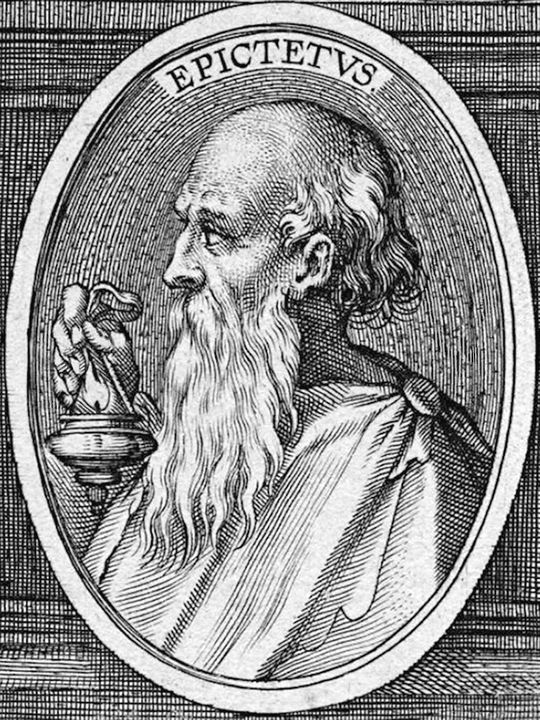
- Epictetus: Lame former slave turned Stoic teacher
- Arrian of Nicomedia: Pupil who transcribed the lectures and compiled the handbook
- Socrates: The philosopher Epictetus holds up as a pattern
- Diogenes of Sinope: Cynic praised for his freedom of speech
- Paconius Agrippinus: Banished senator who met his sentence calmly
- Cleanthes: Early Stoic whose prayer to Zeus closes the handbook

Summary
The Discourses and the Encheiridion preserve the teaching of Epictetus, a lame former slave who ran a school of Stoic philosophy at Nicopolis in western Greece in the early second century. Epictetus wrote nothing. His student Arrian of Nicomedia, later a Roman senator, consul and historian of Alexander, took down his lectures in plain conversational Greek, and also gathered their core into a short handbook, the Encheiridion (literally, something held in the hand). Of the eight books of Discourses known in antiquity, four survive. The library text is George Long's 1877 translation in a selected form: a biographical note by Long, about seventy chapters chosen from all four books of the Discourses, and the complete Encheiridion in fifty-two numbered chapters. The Discourses are lively and often combative. Epictetus questions an imagined pupil, mocks vanity, tells anecdotes and answers objections. The selection opens with the chapter on the things that are in our power and not in our power: of all our faculties only reason examines itself, and what belongs to us is our own judgment and will, while body, property, reputation and office belong to others. A man may chain the leg, Epictetus says, but not the will. Other chapters treat God as the father of men, progress in virtue, contentment, how to behave toward tyrants, how to struggle with circumstances, friendship, anxiety, the duties that can be read from names such as son, brother and citizen, how to bear sickness, solitude, freedom from fear, and attention. Socrates, Diogenes the Cynic and the senator Paconius Agrippinus, who went to dinner after learning he had been banished, are his recurring examples. The Encheiridion compresses this teaching into maxims. It begins by dividing all things into those in our power (opinion, impulse, desire, aversion) and those not in our power, and teaches that people are disturbed not by events but by their opinions about events. It counsels the student to call a broken jug a broken jug, to say of a lost child or possession that it has been given back, to wish for things to happen as they do happen, and to play well the part in the drama that the author of the play assigns. Later chapters give rules for speech, laughter, banquets, oaths, the reading of omens, the study of logic and the conduct of a beginner who is mocked for philosophizing. It closes with lines from the Stoic Cleanthes asking Zeus and Destiny to lead, and with Socrates' saying that Anytus and Meletus can kill him but cannot harm him. The Encheiridion was paraphrased for Christian monks in late antiquity, commented on by the Neoplatonist Simplicius, and read widely from the Renaissance onward.
Virtues in this work
- Fortitude: Agrippinus goes to exercise and then to dinner after the Senate condemns him, the model the opening discourse sets before students.
- Temperance: Encheiridion X names continence as the power to use when a fair face presents itself as an appearance.
- Prudence: The student is taught to test each appearance by asking whether it concerns what is or is not in his power.
- Humility: Epictetus says philosophy begins with awareness of one's own weakness and tells the improving student to accept being thought foolish.
- Piety: The Encheiridion ends with Cleanthes' prayer to be led by Zeus and Destiny, following willingly.
Plot or Argument
- Long's biographical note
Long gathers what little is known of Epictetus: birth at Hierapolis, slavery under Epaphroditus, lameness, study with Musonius Rufus, exile from Rome under Domitian, teaching at Nicopolis, and Arrian's role in recording the lectures.
- What is in our power
The opening discourse argues that the rational faculty alone examines itself and judges appearances. Since will and judgment are ours and all else is not, chains, exile and death cannot touch what matters; Agrippinus shows the attitude in practice.
- God, kinship and progress
Chapters on God as father of men, on progress, providence and contentment argue that a creature akin to the divine should think no mean thoughts of itself, that the world's order shows design, and that real progress lies in governing desire and aversion, not in reading books about it.
- Others, tyrants and circumstances
Discourses on not being angry with those who err, on tyrants, and on struggling with circumstances treat wrongdoing as error, deny that a tyrant controls anything that is truly one's own, and describe hardships as an opponent sent to train the athlete.
- Roles, names and the beginning of philosophy
Epictetus derives duties from the names a person bears (man, son, brother, councillor) and says that philosophy begins with an awareness of one's own weakness and the conflict of opinions about what is good.
- Sickness, anxiety, solitude and fear
Practical chapters apply the doctrine to fever, anxiety before an audience, being alone, poverty, and fear of tyrants, insisting that each condition is a test in which the ruling faculty can still act well.
- Encheiridion I-XV: the basic division
The handbook opens with things in and not in our power, then teaches the discipline of desire and aversion, the earthen jug, opinions as the source of disturbance, the voyage and the captain's call, and the habit of saying of losses that they have been restored.
- Encheiridion XVI-XXXIII: roles and conduct
The student is an actor in a play chosen by another; he should not fear omens, should take the station he is given, and should follow rules for speech, laughter, company, banquets and reputation.
- Encheiridion XXXIV-LII: the beginner's discipline
Closing chapters warn against pleasure and boasting, urge treating each day as an Olympic contest, rank the practice of a precept above the logic that proves it, and end with verses of Cleanthes and words of Socrates from Plato's Crito and Apology.
Characters
- Epictetus, teacher
Former slave and Stoic schoolmaster at Nicopolis whose spoken lectures make up the book.
- Arrian, recorder
Flavius Arrianus, pupil of Epictetus, who wrote down the Discourses and compiled the Encheiridion.
- Socrates, model philosopher
Held up throughout as the man who lived by reason and could not be harmed by his accusers.
- Diogenes of Sinope, model philosopher
The Cynic whose freedom and frankness Epictetus repeatedly praises.
- Paconius Agrippinus, Roman senator
Exiled under Nero; his calm on hearing his sentence illustrates the opening discourse.
- Cleanthes, Stoic poet
Second head of the Stoic school, whose prayer to Zeus and Destiny is quoted at the end of the Encheiridion.
Lessons
The great division
Epictetus sorts everything into what is in our power, our judgments, impulses, desires and aversions, and what is not, such as body, property, reputation and office. Trouble comes from treating the second kind as if it were the first. The division is meant to be practiced on every harsh appearance, not merely believed.
- Why does Epictetus put the body on the list of things not in our power?
- What does he mean by telling a harsh appearance that it is only an appearance?
- Is there anything you care about that does not fit neatly on either side of his line?
Opinion and disturbance
Encheiridion V teaches that we are disturbed by our opinions about events, not by the events; death would have seemed terrible to Socrates if it were so. Epictetus traces three stages of moral education, from blaming others, to blaming oneself, to blaming no one.
- How does the example of Socrates support the claim about death?
- What would it look like for a student to move from the first to the third stage Epictetus describes?
- Are there griefs that the doctrine of opinion cannot fully explain?
Playing the part well
In Encheiridion XVII the student is an actor whose part, short or long, poor or powerful, is chosen by the author of the play. Duty lies in acting the part well, not in choosing it. The Discourses apply the same idea to the names of son, brother and citizen.
- Who is the author of the play in Epictetus's picture?
- How does Epictetus's own life as a lame former slave give weight to this teaching?
- Where does accepting one's part end and the duty to change one's circumstances begin?
Freedom under a tyrant
In the discourses on tyrants and on freedom from fear, the tyrant's guards and swords frighten only those who value what the tyrant can take. A man who has learned what is truly his own can approach the tyrant without fear, as Agrippinus went to dinner after his sentence.
- What exactly can the tyrant take, according to Epictetus, and what can he not?
- Why does Epictetus compare the unafraid man to children quarrelling over a game but not over the shells?
- Is inner freedom enough, or does Epictetus leave room for resisting injustice outwardly?
Context
Epictetus taught under the Flavian and early Antonine emperors, when Stoicism was the most widely held philosophy among educated Romans and a school of moral training as much as a body of doctrine. Domitian's expulsion of philosophers from Rome (traditionally dated to c. 89 or c. 93-95 CE) drove him to Nicopolis, a city founded by Augustus after Actium, where young men from across the empire came to study with him. His Stoicism draws on Zeno, Cleanthes and Chrysippus but presents itself above all as practice: the discipline of desire, of impulse, and of assent.
Composition
Arrian of Nicomedia (c. 86-c. 160 CE) attended the school as a young man, probably in the first decades of the second century, and wrote down the lectures in the plain Greek of everyday speech; the date c. 108 CE is a conventional estimate for his time there. Four books of Discourses survive of a larger collection. The Encheiridion is Arrian's digest of the teaching. George Long's English version of the complete works appeared in 1877; this text is a selection from it with the full Encheiridion.
Reception
Marcus Aurelius thanks his teacher Rusticus for lending him the memoirs of Epictetus, and the Meditations quote him often. Simplicius wrote a long commentary on the Encheiridion in the sixth century, and Christian monastic adaptations of it circulated in Greek, one attributed to Nilus of Ancyra. Renaissance humanists translated it widely; Pascal discussed Epictetus with Isaac Le Maistre de Sacy; and twentieth-century cognitive therapists named him among their forerunners.
Comparisons
- meditations
Marcus Aurelius, an emperor, writes privately in the tradition of Epictetus, a former slave, and quotes him; both use the division between what is in our power and what is not.
- letters-from-a-stoic
Seneca's letters, a generation earlier, give Stoic counsel to a single friend in polished literary Latin, where Epictetus speaks bluntly to a classroom in Greek.
- the-consolation-of-philosophy
Boethius in prison is taught by Lady Philosophy that fortune's gifts were never his own, a lesson close to the Encheiridion's advice to say of losses that they have been restored.
- pensees
Pascal admired Epictetus for knowing human duty and greatness but faulted him for presuming on human strength; the Pensees answer the Stoic with the Christian doctrine of grace.
- the-nicomachean-ethics
Aristotle counts external goods and fortune as parts of a flourishing life, while Epictetus places happiness wholly in the will; reading both sharpens the question of what a good life requires.
Quotes
Frequently cited
“Of things some are in our power, and others are not.”
Frequently cited
“Men are disturbed not by the things which happen, but by the opinions about the things”
Frequently cited
“Remember that thou art an actor in a play, of such a kind as the teacher (author) may choose”
“Seek not that the things which happen should happen as you wish; but wish the things which happen to be as they are, and you will have a tranquil flow of life.”
“Never say about anything, I have lost it, but say I have restored it.”
“You may fetter my leg, but my will not even Zeus himself can overpower.”
“The beginning of philosophy, to him at least who enters on it in the right way and by the door is a consciousness of his own weakness and inability about necessary things”
“Now is the time for the fever. Let it be borne well.”
For Students
A reading companion for classical Christian high school students. See the student guide.
Reading Guide
Watch for
- The tyrant's threats in the opening discourse and how Epictetus answers each one, ending with Agrippinus going to dinner.
- How often Socrates and Diogenes appear as living proof of the teaching.
- The images of the earthen jug, the ship's captain calling the passengers back, and the actor's part in the Encheiridion.
- The difference in tone between the argumentative Discourses and the compressed maxims of the Encheiridion.
- The closing chapter's prayer of Cleanthes and words of Socrates.
Key terms and names
- Prohairesis (will)
- Long's word will translates the faculty of moral choice, the one thing Epictetus says no one, not even Zeus, can overpower.
- Appearances
- The impressions that present things to the mind; the student must test each one before assenting to it.
- Things in our power
- Opinion, impulse, desire and aversion; everything else, including the body, belongs to the things not in our power.
- Encheiridion
- Greek for something kept at hand, Arrian's short digest of the master's teaching.
- Nicopolis
- City in Epirus founded by Augustus, where Epictetus kept his school after leaving Rome.
- Agrippinus
- Roman senator whose calm acceptance of exile Epictetus offers as a model in the opening discourse.
Seminar Questions
- Comprehension List the things Encheiridion I says are in our power and those it says are not. Where does the body fall?
- Comprehension In the opening discourse, what does the imagined tyrant threaten, and how does Epictetus answer each threat?
- Interpretation Why does Epictetus use Socrates to prove that death is not terrible in Encheiridion V? Is an example a proof?
- Interpretation What does the image of the actor in Encheiridion XVII assume about the author of the play?
- Interpretation How does the chapter on bearing sickness turn a fever into an athletic contest, and why does that image suit Epictetus?
- Big Question Can a person love a child or friend fully while practicing the discipline of Encheiridion III and XI?
- Big Question Is freedom chiefly an inner condition or an outward one?
Faith Connections
- Philippians 4:11-13 (Scripture)
Paul, writing in chains, says he has learned to be content in every state. His contentment rests on Christ who strengthens him, where Epictetus's rests on the will's own power, which makes a fruitful contrast.
- Acts 17:28 (Scripture)
At Athens Paul quotes a Greek poet, for we are also his offspring, the same Stoic conviction that underlies Epictetus's discourse on God as father of men.
- Augustine, City of God IX.4 (Church Fathers)
Augustine discusses the Stoic account of the passions, drawing on Aulus Gellius's story of a Stoic frightened in a storm and on a passage from Epictetus, and argues that the Christian does not abolish the passions but directs them rightly.
- Pascal, Conversation with M. de Sacy on Epictetus and Montaigne (Great Conversation)
Pascal praises Epictetus for seeing human duty clearly and faults him for thinking humans can fulfil it by their own strength, setting Stoic pride against Montaigne's skepticism before turning to grace.
Logic and Rhetoric
Central argument: Only what is in our power can be truly good or evil for us. Only our judgments, impulses, desires and aversions are in our power. Therefore externals such as health, property, reputation and life itself are neither good nor evil, and a person who judges rightly about them cannot be harmed, hindered or made unhappy by anyone.
Rhetorical device: hypophora (raising and answering questions). In the opening discourse Epictetus voices the tyrant's threats of chains, prison and beheading and answers each in turn, ending with the line about the fettered leg and the will Zeus cannot overpower.
Debate: Resolved: that people are disturbed not by events but by their opinions about events.
Memory Work
Men are disturbed not by the things which happen, but by the opinions about the things
Remember that thou art an actor in a play, of such a kind as the teacher (author) may choose
Writing Prompts
Essay: Using the opening discourse and Encheiridion I and V, explain Epictetus's division between what is and is not in our power, and evaluate whether it can guide a person through serious illness.
Comparison with Meditations: Epictetus was a lame former slave and Marcus Aurelius was emperor of Rome. Compare how each applies the same Stoic teaching to his own station in life.
Medical Lens
Ancient Stoics described philosophy as a therapy of the passions, and Epictetus repeatedly compares his school to a place of healing and his teaching to a physician's regimen. His claim that disturbance comes from opinions about events, not events themselves, is often cited as an ancient forerunner of cognitive therapy: Albert Ellis and Aaron Beck both named Stoic philosophy, and Epictetus in particular, among their influences. The resemblance is real but partial, since Epictetus's aim is virtue and agreement with a providential order, not symptom relief. The chapter on sickness gives a patient's ethic for fever, thirst and the physician's verdict; the chapter on anxiety analyzes stage fright as desire for what is not in one's power; and Epictetus's own lameness, which Long attributes to early infirmity rather than the later story of a master's cruelty, lies behind his remark that lameness hinders the leg but not the will. The Encheiridion's counsel on grief (saying a dead child has been restored) represents the Stoic ideal of freedom from passion and has been debated since antiquity; it is best read as a training discipline for the student, not a clinical recommendation.
- Discourses, "In What Manner We Ought to Bear Sickness" (III.10)
How a student should bear fever, thirst and hunger, and how he should regard the physician's good or bad report.
- Discourses, "On Anxiety (Solicitude)" (II.13)
Epictetus diagnoses the anxious man, pale before an audience, as wanting something not in his power.
- Encheiridion, ch. V
Disturbance arises from opinions about things; the stages of blaming others, oneself and no one.
- Encheiridion, chs. IX and XI
Disease and lameness as impediments to the body but not the will; the discipline of saying of the dead that they have been restored.
- Long's biographical note
Long weighs the story that Epictetus was lamed by his master against Simplicius's report that he was weak and lame from early life.
Creative Prompts
- Dialogue
Write a short exchange in Epictetus's question-and-answer style between the teacher and a student who has just failed an examination.
- Classroom
Keep a two-column log for three days, sorting each worry into what is and is not in your power, then discuss what the exercise revealed.
- Essay
Compare Epictetus's actor in a play with the Christian idea of vocation. Where do they agree, and where does the idea of a personal God change the picture?
Further Reading
- Meditations, Marcus Aurelius
- Epictetus: A Stoic and Socratic Guide to Life, A. A. Long
- The Inner Citadel: The Meditations of Marcus Aurelius, Pierre Hadot
Explains the three Stoic disciplines Marcus took from Epictetus.
- The Therapy of Desire, Martha C. Nussbaum
On Hellenistic philosophy as therapy of the passions.
Verification notes
Biographical facts follow Long's note and standard reference works; Epictetus's dates and the date of Arrian's attendance are approximate. The selected text gives Discourses chapters by title without book numbers; the book.chapter references in locators follow the standard numbering of the complete Discourses. The Encheiridion is numbered I-LII as in Long's translation, which differs slightly from the 53-chapter numbering of some editions. All quotations were found in the attached text.
- Confirm the book.chapter numbers given for the Discourses chapters (I.1, II.11, II.13, III.10) against a complete edition.
- Confirm the date of Domitian's expulsion of the philosophers used in historical context (c. 89 vs. c. 93-95 CE).