Work record
Kalevala
1835; enlarged 1849 · 19th Century · Epic · Finnish
Abstract
Background. A country doctor travelling through Karelia wrote down hundreds of runo-songs from peasant singers and wove them into one story, giving written Finnish its foundational poem.
Narrative. From a cosmos hatched out of a duck's eggs, the tale follows three heroes of Kaleva's land. They court the daughters of the North, whose queen claims a wonder-mill as bride-price; they lose and recover companions in the realm of death; and they finally raid the northern stronghold, shattering the mill at sea. Revenge, plague and a stolen sun follow before the old minstrel sails away.
Kullervo. Embedded in the cycle is the grim history of a slave boy from a feuding clan, whose rage destroys his masters, his kin and himself. Lönnrot gathered its episodes from several singers and joined them into a single tragedy.
Form. Every couplet doubles its thought, alliteration binds the lines, and long charms recite how iron, serpents and diseases began. Crawford kept this falling eight-syllable rhythm in English.
Themes. Song as mastery, wooing and rivalry, maternal devotion, the cost of vengeance, and the passing of a pagan age.
Significance. Its appearance fed Finland’s national awakening long before independence in 1917, lent Longfellow a meter, and inspired Sibelius, the painter Gallen-Kallela and the young Tolkien.
Main characters
- Väinämöinen: Ancient bard and enchanter, born old
- Ilmarinen: Smith who hammers out the Sampo
- Lemminkäinen: Rash, charming hero brought back from death
- Louhi: Cunning queen of the North
- Aino: Girl who chooses the sea over an old suitor
- Kullervo: Enslaved youth driven to ruin by a feud
- Marjatta: Virgin mother of the child-king

Summary
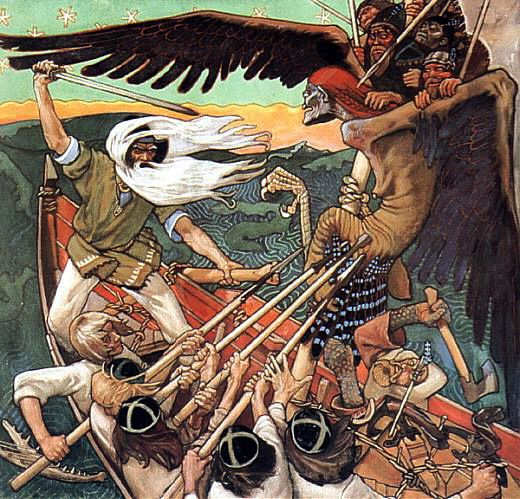
The Kalevala is the national epic of Finland, compiled by the physician and folklorist Elias Lönnrot from oral songs he and others gathered in Finnish and Russian Karelia. Its fifty runes, or cantos, follow the deeds of the people of Kalevala, chiefly the old singer and sage Väinämöinen, the smith Ilmarinen and the reckless Lemminkäinen, and their long rivalry with Louhi, mistress of the cold northern land of Pohjola. It begins with creation: the Daughter of the Air floats on the sea for centuries until a duck's eggs break on her knee and form the earth, sky, sun and moon, and Väinämöinen is born already old. He clears the land and sows barley, defeats the young Joukahainen in a singing contest and sinks him in a swamp, and is promised Joukahainen's sister Aino, who drowns herself rather than marry him. Drifting to Pohjola, Väinämöinen wins Louhi's help home by promising the Sampo, a magic mill that grinds flour, salt and money, which Ilmarinen forges; but Louhi's daughter refuses the smith. Lemminkäinen carries off the island maiden Kyllikki, goes to Pohjola to woo, and is killed on the river of Tuonela, the land of the dead; his mother rakes his body from the river, joins its pieces and revives him with balm a bee brings from heaven. Väinämöinen builds a boat with spells he must seek in the underworld and inside the giant Antero Vipunen, and after a contest of suitors Ilmarinen wins the Maiden of Pohjola through impossible tasks, followed by long wedding songs. The story of Kullervo, a child of a feuding family sold into servitude, is the epic's tragedy: wronged by Ilmarinen's wife, he takes revenge, unwittingly wrongs his own lost sister, destroys his enemies and dies on his sword. The heroes then sail to Pohjola, where Väinämöinen lulls the household to sleep with a harp made from a pike's jawbone, and they carry off the Sampo; Louhi pursues them, and in the battle the Sampo breaks and its fragments bring prosperity to the Finnish shore. Louhi sends nine diseases, which Väinämöinen heals with sauna, ointment and prayer, then hides the sun and moon until she is forced to free them. In the last rune the virgin Marjatta conceives by eating a lingonberry and bears a son who is baptized king of Karelia, and Väinämöinen departs in a copper boat, leaving his harp and songs to his people. Lönnrot published the Old Kalevala of 32 poems in 1835 and the 50-rune New Kalevala, nearly 23,000 lines, in 1849. John Martin Crawford's 1888 translation keeps the eight-syllable trochaic meter of the Finnish and uses older German-influenced spellings such as Wainamoinen and Pohyola.
Virtues in this work
- Charity: Lemminkäinen's mother wades into the river of death and rakes it again and again until she recovers her son.
- Prudence: Väinämöinen wins his contests by knowledge of origins and spells, as when he defeats Joukahainen with song rather than blows.
- Industry: Ilmarinen works his forge for days, breaking every flawed creation, until the Sampo rises from the fire.
- Temperance: Kullervo's unchecked anger after the stone in his bread leads to destruction on all sides and finally his own death.
Plot or Argument
- Proem and Runes I-II: creation and the first sowing
The singer invites a brother to sing the old songs. The Daughter of the Air, floating on the sea, shapes the world from a duck's broken eggs; Väinämöinen is born, clears the land with the help of Sampsa and a tiny hero who fells the great oak, and sows barley.
- Runes III-V: Joukahainen and Aino
Väinämöinen sings the boastful Joukahainen into a swamp, who promises his sister Aino to save himself. Aino, unwilling to marry an old man, drowns herself; her mother's tears become rivers, and Väinämöinen catches and loses her in the form of a fish.
- Runes VI-X: the journey to Pohjola and the forging of the Sampo
Joukahainen shoots Väinämöinen's horse from under him; he drifts to Pohjola, where Louhi helps him home in return for the promise of the Sampo. He wounds his knee with an axe and is healed by a charm on the origin of iron. Ilmarinen forges the Sampo, but Louhi's daughter does not go with him.
- Runes XI-XV: Lemminkäinen
Lemminkäinen carries off Kyllikki, who breaks her vow not to go dancing; he sets out for Pohjola, performs tasks for Louhi, and is killed by a herdsman beside the river of Tuonela. His mother rakes his body from the river and restores him.
- Runes XVI-XXV: the boat, the lost words and the wedding
Väinämöinen seeks the words to finish his boat in Tuonela and inside the giant Antero Vipunen. He and Ilmarinen compete as suitors; Ilmarinen wins the Maiden of Pohjola by ploughing a field of serpents, capturing Tuoni's bear and wolf, and catching a great pike. The wedding runes include the brewing of beer, the bride's farewell, advice to bride and groom, and Väinämöinen's songs.
- Runes XXVI-XXX: Lemminkäinen's revenge and exile
Uninvited to the wedding, Lemminkäinen goes to Pohjola, kills its master, and flees to an island of refuge; returning to find his home burned, he leads a failed war-voyage that ends in Pohjola's frost.
- Runes XXXI-XXXVI: Kullervo
After the feud between the brothers Untamo and Kalervo, Kullervo grows up a slave and is sold to Ilmarinen. When Ilmarinen's wife bakes a stone in his bread, he takes a terrible revenge on her. He finds his family, unknowingly wrongs his lost sister, who drowns herself, destroys Untamo's people and dies by his own sword.
- Runes XXXVII-XLIV: the golden bride, the theft of the Sampo and the harps
Ilmarinen, widowed, forges a bride of gold that gives no warmth. The three heroes sail to Pohjola; Väinämöinen makes a harp from a pike's jawbone and plays all creation to tears and Pohjola to sleep; they steal the Sampo, which breaks in the sea battle with Louhi. He makes a second harp of birchwood.
- Runes XLV-XLIX: diseases, the bear and the stolen sun
Louhi sends the nine diseases born of Loviatar, and Väinämöinen heals the people with sauna, ointments and prayer to Ukko. A bear-hunt and bear-feast follow. Louhi hides the sun and moon and steals fire; the fire is recovered from a fish, and Louhi at last releases the heavenly lights.
- Rune L and Epilogue: Marjatta and Väinämöinen's departure
The virgin Marjatta conceives from a lingonberry and bears a son in a stable; Väinämöinen judges against the child, who rebukes him, and the boy is baptized king of Karelia. Väinämöinen sails away in a copper boat, leaving his harp and songs behind. In the epilogue the singer ends his song.
Characters
- Väinämöinen (Wainamoinen), eternal singer and sage
Born old from the Daughter of the Air, a master of song and spells who leads the people of Kalevala and departs at the end.
- Ilmarinen, smith
Forger of the sky and of the Sampo, who wins the Maiden of Pohjola through hard tasks.
- Lemminkäinen (Lemminkainen), reckless adventurer
Handsome, boastful wooer who is killed in Tuonela and restored by his mother.
- Louhi, mistress of Pohjola
Powerful, shrewd ruler of the North who demands the Sampo, fights for it, and later sends sickness and steals the sun and moon.
- Aino, sister of Joukahainen
Young woman promised to Väinämöinen against her will, who drowns herself in the sea.
- Joukahainen (Youkahainen), young Lapland singer
Challenges Väinämöinen to a contest of song and loses.
- Kullervo, son of Kalervo
Mistreated child of a blood feud, whose strength and anger bring ruin on others and himself.
- Lemminkäinen's mother, mother
Searches the world for her son and brings him back from the river of death.
- The Maiden of Pohjola, Louhi's daughter
Sought by Väinämöinen and Ilmarinen; she marries Ilmarinen and is killed through Kullervo's revenge.
- Kyllikki, Lemminkäinen's wife
Island maiden carried off by Lemminkäinen, whose broken vow drives him back to Pohjola.
- Marjatta (Mariatta), virgin mother
Bears a wondrous son whose kingship ends Väinämöinen's age.
- Ukko, supreme god of sky and thunder
Invoked in prayers and charms throughout the poem.
Lessons
The power of the word
In the Kalevala, song is power: Väinämöinen sings Joukahainen into a swamp, needs three missing words to finish his boat, and heals wounds only when he knows the origin of the thing that caused them. Knowledge of beginnings, sung aright, is the hero's real strength, and the poem ends with the singer leaving his songs to his people.
- Why must Väinämöinen know the origin of iron before he can stop the bleeding of his knee?
- What makes Väinämöinen the victor in the contest with Joukahainen?
- Why does the poem end with a harp and songs left behind rather than with a battle won?
A mother's love
The most moving figures in the epic are often mothers. Aino's mother laments that she drove her daughter toward an unwanted marriage, and Lemminkäinen's mother searches land and river until she rakes her son's body from the stream of death and restores him with a balm from heaven.
- What does Aino's mother learn from her daughter's death, and whom does she warn?
- How does Lemminkäinen's mother succeed where the heroes would have failed?
- Why might a people's national epic give so much weight to the love of parents for children?
Nurture and the tragedy of Kullervo
Kullervo is the child of a feud who is never rocked, taught or loved; his great strength turns to destruction and finally to self-destruction. Väinämöinen's words at his death draw the lesson that a child badly nurtured will never gain discretion, however strong he grows.
- What wrongs are done to Kullervo, and which wrongs does he do in return?
- Is Kullervo more to blame for his deeds, or more to be pitied?
- What does Väinämöinen's comment on Kullervo's death say about education and the family?
Wealth, rivalry and the lost Sampo
The Sampo grinds grain, salt and money, and both Kalevala and Pohjola want it. The rivalry ends with the treasure shattered in the sea, yet even its fragments bring plenty to Finland, while the attempt to own it brings war, sickness and the theft of the sun.
- Why does Louhi want the Sampo, and why do the heroes decide to steal it back?
- What is lost and what is gained when the Sampo breaks?
- Is the Sampo best understood as a thing, a blessing, or a symbol of prosperity itself?
Context
Finland had been part of the Swedish realm for centuries before it became a Grand Duchy within the Russian Empire in 1809. Educated Finns spoke and wrote mostly Swedish, while the old Finnish song tradition of the eight-syllable runo survived chiefly among peasant singers in eastern Karelia. The Kalevala gave the Finnish language a literary monument, and it became central to the 19th-century Finnish national movement and to the country's sense of itself before independence in 1917.
Composition
Lönnrot made eleven collecting journeys between 1828 and 1844, building on the earlier work of collectors such as the physician Zacharias Topelius the Elder. He published the Old Kalevala in 1835 (its preface is dated 28 February, now celebrated as Kalevala Day) and, after much new material had been collected, the New Kalevala of 1849 in fifty runes. Scholars agree that Lönnrot combined variants from many singers and regions, ordered them into a continuous plot and wrote some connecting lines, so the work is both genuine oral poetry and a 19th-century composition; how to weigh those two sides is still discussed. Crawford's translation (New York, 1888) was the first complete English version made in the original meter.
Reception
Anton Schiefner's German translation of 1852 introduced the Kalevala to European readers, and Longfellow, who read it, adopted its trochaic meter for The Song of Hiawatha (1855). Jean Sibelius drew on the Kalevala for Kullervo (1892), the Lemminkäinen Suite and later tone poems, and the painter Akseli Gallen-Kallela's illustrations became the classic images of its heroes. J. R. R. Tolkien read it as a student, wrote his own Story of Kullervo, and acknowledged its influence on the tale of Túrin and on his Elvish languages.
Comparisons
- the-song-of-hiawatha
Longfellow borrowed the Kalevala's trochaic tetrameter and its repetitions for his epic of the Ojibwe hero, and Crawford's English sounds very like Hiawatha as a result.
- poetic-edda
Both are northern collections of mythic songs gathered from older oral tradition; the Edda's Völuspá, like Rune I, begins with the making of the world, and both feature smiths, magic and contests of wisdom.
- argonautica
The voyage to the cold North to win a treasure from a cunning ruler, with a royal daughter as prize, has often been compared with Jason's quest for the Golden Fleece; Crawford's preface draws the parallel.
- the-lord-of-the-rings
Tolkien was deeply influenced by the Kalevala, especially by Kullervo, and admired how it gave a small nation a body of myth; his own legendarium grew partly from that example.
- the-odyssey
Väinämöinen, like Odysseus, is an old, wily hero who wins by speech and craft more than by force, and both poems were shaped from long oral traditions of song.
- the-nibelungenlied
A national epic adopted by 19th-century nationalism, with a broken treasure and a cycle of revenge that destroys both families.
Quotes
Frequently cited
“Mastered by desire impulsive, By a mighty inward urging, I am ready now for singing, Ready to begin the chanting Of our nation’s ancient folk-song Handed down from by-gone ages.”
Frequently cited
“Forges skilfully the Sampo; On one side the flour is grinding, On another salt is making, On a third is money forging, And the lid is many-colored.”
Frequently cited
“But he left his harp of magic, Left his songs and wisdom-sayings, To the lasting joy of Suomi.”
“Listen, all ye mothers, listen, Learn from me a tale of wisdom: Never urge unwilling daughters From the dwellings of their fathers, To the bridegrooms that they love not,”
“Lemminkainen’s faithful mother Takes the rake of magic metals, Rakes the Tuoni river bottoms, Rakes the cataract and whirlpool,”
“If the child is not well nurtured, Is not rocked and led uprightly, Though he grow to years of manhood, Bear a strong and shapely body, He will never know discretion, Never eat the bread of honor, Never drink the cup of wisdom.”
“Wept the young, and wept the aged, Wept the mothers, wept the daughters Wept the warriors and heroes At the music of his playing,”
“Come, O Ukko, to my rescue, God of mercy, lend thy presence, Give these vapor-baths new virtues, Grant to them the powers of healing, And restore my dying people;”
For Students
A reading companion for classical Christian high school students. See the student guide.
Reading Guide
Watch for
- How each rune grows out of parallel lines, where the second line restates the first in new words.
- Every time a hero must know or sing the origin of a thing before he can master or heal it.
- The Sampo from its forging in Rune X to its breaking in Rune XLIII.
- The mothers: Aino's mother, Lemminkäinen's mother and Kullervo's mother.
- The last rune, in which Marjatta's son is baptized king and Väinämöinen departs.
Key terms and names
- Rune (runo)
- A Finnish song-poem; Lönnrot divided the epic into fifty runes, each a canto of the whole story.
- Sampo
- The magic mill that Ilmarinen forges for Louhi, grinding flour, salt and money; its meaning has been debated since the 19th century.
- Kalevala
- The land or kin of the hero Kaleva, home of Väinämöinen and his companions; Lönnrot took it as the title of the whole epic.
- Pohjola
- The dark, cold Northland ruled by Louhi, spelled Pohyola in Crawford's translation.
- Tuonela
- The land of the dead, ruled by Tuoni and reached across a black river.
- Kantele
- The Finnish plucked harp; Väinämöinen makes the first from a pike's jawbone and a second from birchwood.
- Trochaic tetrameter
- The Kalevala meter of eight syllables in falling stress, kept in Crawford's English and borrowed by Longfellow.
- Ukko
- The highest god of Finnish tradition, lord of sky and thunder, invoked in many of the poem's prayers.
Seminar Questions
- Comprehension How is the world made in Rune I, and how is Väinämöinen born?
- Comprehension Why does Louhi want the Sampo, and what must Ilmarinen do before he can marry her daughter?
- Comprehension How does Lemminkäinen's mother bring her son back from Tuonela?
- Interpretation Why does Aino choose the sea over marriage to Väinämöinen, and how does the poem judge the people who arranged the match?
- Interpretation What does Väinämöinen's victory over Joukahainen show about the kind of wisdom the poem values?
- Interpretation How should we understand the Marjatta rune, in which a new king displaces the ancient singer?
- Big Question Can a nation's songs and stories shape its identity as strongly as its laws or wars?
- Big Question Is Kullervo's ruin caused more by what was done to him or by what he chose?
Faith Connections
- Luke 2:1-20 (Scripture)
Marjatta's son, born in a stable and honoured as a king in Rune L, echoes the Nativity, which Finnish singers had absorbed into their oral songs over centuries of Christian presence; many readers take Väinämöinen's departure as the old ways giving place to Christianity.
- Proverbs 22:6 (Scripture)
Train up a child in the way he should go: Väinämöinen's words at Kullervo's death make the same claim about upbringing from the opposite side, describing the child who was never trained.
- John 1:1-3 (Scripture)
In the Kalevala, things are mastered by singing their origins; John speaks of the Word through whom all things were made, a fruitful contrast between a world shaped by spells and a world made by the Word of God.
- J. R. R. Tolkien, On Fairy-Stories (Great Conversation)
Tolkien, who loved the Kalevala, argues that human beings make secondary worlds because they are made in the image of a Maker; the essay helps students see Lönnrot's epic as such a sub-creation of a whole people.
Logic and Rhetoric
Central argument: Wisdom lies in knowing the origins of things and singing them rightly; force, rivalry and revenge, as in the struggle for the Sampo and the story of Kullervo, destroy what they seek; therefore what endures is the song left to the people, not the treasure fought over.
Rhetorical device: parallelism. In Rune XLI each line restates the last with a new subject, as in the lines on the young and aged, mothers and daughters, warriors and heroes all weeping at Väinämöinen's harp.
Debate: Resolved: that Lönnrot should be counted as the author of the Kalevala and not merely its editor.
Memory Work
Mastered by desire impulsive, By a mighty inward urging, I am ready now for singing, Ready to begin the chanting Of our nation’s ancient folk-song Handed down from by-gone ages.
But he left his harp of magic, Left his songs and wisdom-sayings, To the lasting joy of Suomi.
Writing Prompts
Essay: Explain the role of song and spoken spells in the Kalevala, using Väinämöinen's contest with Joukahainen, the healing of his knee, and the harp-playing in Pohjola.
Comparison with The Song of Hiawatha: Read the Kalevala's proem beside the opening of The Song of Hiawatha. How does Longfellow use the Finnish meter, and what does each poem claim about where its stories come from?
Medical Lens
The Kalevala matters to the history of medicine on two levels. Its compiler was a physician: Lönnrot served for two decades as district doctor at Kajaani during years of famine and epidemic, and his doctoral dissertation (1832) dealt with the magical medicine of the Finns, the charms that fill the epic. Inside the poem, healing is done by knowledge of origins: to stop the bleeding of Väinämöinen's axe wound in Runes VIII-IX, an old man must sing the origin of iron before applying a blood-stopping charm, ointment and bandages, and Rune XLV tells how the blind daughter of Tuonela, Loviatar, bears nine diseases that Väinämöinen drives out with the heated sauna, salves and prayer to Ukko. The sauna appears throughout as a place of cleansing, birth and healing. Lemminkäinen's restoration in Rune XV, in which his mother joins the parts of his body and anoints him with balm brought by a bee, combines charm, salve and prayer. These passages are folk-medical and religious, not clinical; their charms are best read as records of traditional belief that Lönnrot himself studied as a doctor. The Aino and Kullervo stories include two suicides and much grief, treated in the poem as tragedy and lament rather than as illness.
- Runes VIII-IX
Väinämöinen's axe slips and gashes his knee; an old man stops the bleeding by singing the origin of iron and then applies salve and bandages.
- Rune XV
Lemminkäinen's mother rakes his body from the river of Tuonela, joins it together and revives him with salves, the last fetched by a bee from heaven.
- Rune XLV
Loviatar bears the nine diseases, which Louhi sends upon Kalevala; Väinämöinen heals the people with the sauna, ointments and prayers.
- Runes IV and XXXV-XXXVI
Aino drowns herself and her mother laments; Kullervo's sister drowns herself and Kullervo falls on his sword.
Creative Prompts
- Poetry
Write twenty lines in the Kalevala meter, eight syllables a line with each line echoing the one before, telling the origin of some ordinary object you use every day.
- Essay
Compare Lemminkäinen's mother and Aino's mother. What does each mother do, and what does each learn?
- Dialogue
Stage the singing contest between Väinämöinen and Joukahainen as an exchange of boasts and replies.
- Classroom
Make a map of the epic's world, marking Kalevala, Pohjola, Tuonela, the sea where the Sampo broke, and the journeys between them.
Further Reading
- The Kalevala, Elias Lönnrot, trans. Keith Bosley
Modern verse translation with introduction (Oxford World's Classics, 1989).
- The Kalevala, or Poems of the Kaleva District, Elias Lönnrot, trans. Francis Peabody Magoun Jr.
Prose translation with full notes and an appendix on Lönnrot's sources (Harvard University Press, 1963).
- The Story of Kullervo, J. R. R. Tolkien, ed. Verlyn Flieger
Tolkien's unfinished student retelling, published in 2015 with his essays on the Kalevala.
- The Song of Hiawatha, Henry Wadsworth Longfellow
The American epic that took the Kalevala's meter.
Verification notes
Plot and structure are secure and follow Lönnrot's 1849 text as Crawford renders it in fifty runes plus proem and epilogue. All eight quotations were checked verbatim against the stored Gutenberg file, including its curly apostrophes; locators are by rune, since the file has no line numbers. Crawford uses older spellings (Wainamoinen, Lemminkainen, Youkahainen, Pohyola, Mariatta); the record gives standard modern Finnish forms with Crawford's in parentheses where helpful. Crawford's own preface contains some statements that later scholarship does not support, for example that Finland did not then belong to Russia when Topelius was collecting (it had been a Grand Duchy of the Russian Empire since 1809); the record does not rely on them. Lönnrot's life dates, Kajaani post and professorship follow standard reference accounts.
- Biographical details for the translator John Martin Crawford (dates, profession) were not confirmed and are deliberately left out.
- The number of lines in the 1849 edition is given variously (22,793 in Crawford's preface; 22,795 in some modern references); the record says nearly 23,000.
- Lönnrot's 1832 dissertation title and exact subject (Finnish magical medicine) should be checked against a Lönnrot bibliography before citing.