Work record
The Song of Hiawatha
1855 · 19th Century · Epic · English
Abstract
Background. Seeking native matter for an American epic, Longfellow reworked Ojibway tales of Manabozho collected by Henry Rowe Schoolcraft and his family, borrowing the hero's name from Iroquois tradition and the measure of the Finnish Kalevala.
Narrative. Raised beside Lake Superior by his grandmother, the hero confronts the father who abandoned his mother, fasts until maize is given, subdues a giant fish and a plague-sending sorcerer, and marries a girl from an enemy nation. Friends are lost to spirits and pygmies; a hungry winter carries off his wife. Foreseeing the coming of bearded strangers, he welcomes a missionary and paddles toward the setting sun.
Structure. A framing prologue claims the songs came from a singer in a quiet valley; episodic cantos follow the hero from cradle to departure, interrupted by inset tales such as the story of Osseo. Doubled lines and native words glossed in apposition give the verse its chant-like texture.
Themes. Peace after vengeance, service to one's people, the preservation of memory, mourning and its proper bounds, and a meeting of old and new faiths.
Significance. A best-seller that drew critics and parodists alike, it fixed images of Great Lakes peoples in popular imagination for a century and inspired works by Dvořák and Coleridge-Taylor.
Main characters
- Hiawatha: Prophet, hunter and bringer of corn, healing and writing
- Nokomis: His grandmother, Daughter of the Moon
- Minnehaha: Laughing Water, his Dacotah wife, who dies in famine
- Mudjekeewis: The West Wind, Hiawatha's father
- Chibiabos: Musician friend, drowned and made lord of the dead
- Kwasind: Friend of enormous strength
- Pau-Puk-Keewis: Dancing, gambling trickster
- Iagoo: Boastful storyteller who reports the winged canoe
- The Black-Robe chief: Missionary priest welcomed in the final canto
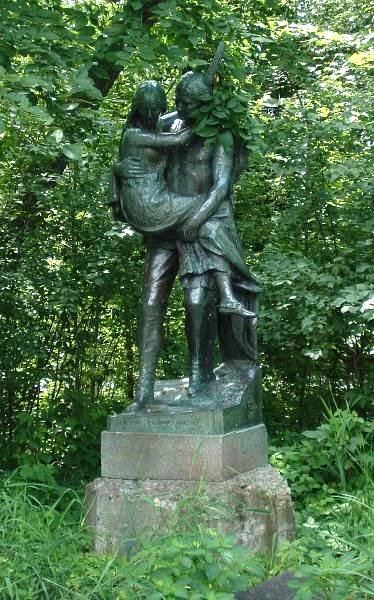

Summary
The Song of Hiawatha is a book-length poem in twenty-two cantos with an Introduction, retelling legends of the Ojibway and neighbouring peoples around a single hero on the south shore of Lake Superior, which the poem calls Gitche Gumee, the shining Big-Sea-Water. The Introduction presents the songs as gathered by the singer Nawadaha from the forest, the birds and the rivers, and addresses readers who believe every human heart is human. In the first canto Gitche Manito, the Master of Life, calls the warring nations together, bids them wash off their war-paint and smoke the peace-pipe, and promises a Prophet who will guide them. Canto II tells how Mudjekeewis became the West Wind and how his sons became the other winds. Hiawatha is born to Wenonah, who dies after Mudjekeewis deserts her, and is raised by his grandmother Nokomis, who teaches him the stars, the birds and the beasts; he kills his first deer with a bow made by the boaster Iagoo. Grown, he travels west and fights his immortal father, who sends him home to clear the land of monsters. He fasts seven days for the good of his people and wrestles the youth Mondamin, whose buried body becomes the first corn. He wins two friends, the musician Chibiabos and the strong man Kwasind, builds a birch-bark canoe, is swallowed by the giant sturgeon Mishe-Nahma and kills it from within, and slays the magician Pearl-Feather, Megissogwon, who sends fever from the marshes. He woos Minnehaha, daughter of an old Dacotah arrow-maker, and the wedding feast includes the dancing of Pau-Puk-Keewis, the songs of Chibiabos and Iagoo's tale of the Son of the Evening Star. Minnehaha blesses the cornfields, and Hiawatha invents picture-writing so that the wisdom of the old men will not be forgotten. Evil spirits drown Chibiabos under the ice; Hiawatha mourns until the Medas cure his grief, and Chibiabos becomes ruler of the land of the dead. Pau-Puk-Keewis wrecks Hiawatha's lodge, flees through many shapes and is killed; the Puk-Wudjies kill Kwasind with a pine-cone. Two ghosts visit to warn against excessive mourning. In a terrible winter Famine and Fever enter the wigwam, and Minnehaha dies while Hiawatha searches the forest for food. Iagoo returns with stories of a winged canoe and bearded white men, and Hiawatha tells of his vision of the future. In the last canto a Black-Robe priest arrives by canoe; Hiawatha welcomes him, tells his people to listen to his message, and sails westward into the sunset. Longfellow wrote the poem between June 1854 and March 1855, drawing mainly on Henry Rowe Schoolcraft's collections, and Ticknor and Fields published it on 10 November 1855.
Virtues in this work
- Piety: Hiawatha fasts seven days and prays to the Master of Life not for himself but for the good of his people.
- Fortitude: In the famine he goes alone into the frozen forest to seek food for the dying Minnehaha.
- Friendship: He mourns Chibiabos for seven weeks with a lament that names him the sweetest of all singers.
- Magnanimity: He welcomes the Black-Robe and his companions as guests and commands his people to protect them.
- Industry: He builds the canoe, invents picture-writing and teaches the art of healing for the use of all.
Plot or Argument
- Introduction and Canto I: The Peace-Pipe
The poet names his sources and his readers; Gitche Manito gathers the nations at the red pipestone quarry, makes peace among them and promises a Prophet.
- Cantos II-IV: The winds, childhood and the father
Mudjekeewis takes the West Wind; Hiawatha is raised by Nokomis by Gitche Gumee, learns the speech of birds and beasts, kills his first deer, and fights his father in the west before receiving his mission.
- Cantos V-VI: Fasting and friends
Hiawatha fasts seven days for his people and wrestles Mondamin, who becomes the maize; he befriends Chibiabos the singer and Kwasind the strong man.
- Cantos VII-IX: Canoe, sturgeon and Pearl-Feather
He builds a birch canoe from the gifts of the forest, kills Mishe-Nahma from inside the fish, and slays the fever-sending magician Megissogwon with the woodpecker's help.
- Cantos X-XII: Wooing and wedding
Against Nokomis's advice he goes to the land of the Dacotahs for Minnehaha; at the wedding feast Pau-Puk-Keewis dances, Chibiabos sings and Iagoo tells of Osseo, the Son of the Evening Star.
- Cantos XIII-XIV: Cornfields and picture-writing
Minnehaha walks round the fields at night to bless them; the crows are trapped; Hiawatha devises painted signs so that memory and messages can outlast speech.
- Cantos XV-XVIII: Lament and losses
Chibiabos drowns; Hiawatha's grief is healed by the Medas and he teaches the art of healing; Pau-Puk-Keewis wrecks the lodge, is hunted through many forms and slain; the pygmies kill Kwasind.
- Cantos XIX-XX: The Ghosts and the Famine
Two silent guests prove to be ghosts who ask the living to mourn more lightly; in the hungry winter Famine and Fever come, and Minnehaha dies.
- Cantos XXI-XXII: The White Man's Foot and Hiawatha's Departure
Iagoo describes the winged canoe; Hiawatha foretells the settlers' coming; the Black-Robe arrives with the Christian message, and Hiawatha departs westward to the Islands of the Blessed.
Characters
- Hiawatha, hero
Son of the West Wind and Wenonah, a prophet, hunter and teacher who labours for the good of his people.
- Nokomis, grandmother
Daughter of the Moon, who raises Hiawatha and teaches him the lore of the sky and the forest.
- Minnehaha, wife
Laughing Water, daughter of the Dacotah arrow-maker, who blesses the cornfields and dies in the famine.
- Mudjekeewis, father
The West Wind, who deserted Wenonah and wrestles his son for days before sending him on his mission.
- Wenonah, mother
Daughter of Nokomis, who dies grieving after Hiawatha's birth.
- Chibiabos, friend
The sweetest singer, drowned by evil spirits and made ruler in the land of the dead.
- Kwasind, friend
The very strong man, killed by the Puk-Wudjies with a pine-cone.
- Iagoo, storyteller
The great boaster and traveller, who makes Hiawatha's first bow and later describes the white men's ship.
- Pau-Puk-Keewis, trickster
A handsome dancer and gambler who wrecks Hiawatha's lodge and is changed after death into the war-eagle.
- Megissogwon (Pearl-Feather), antagonist
The magician who killed Nokomis's father and sends fever and pestilence from the fens.
- Gitche Manito, Great Spirit
The Master of Life, who gives the peace-pipe and promises a Prophet.
- The Black-Robe chief, missionary
A priest who arrives by canoe in the last canto with the message of Christ and Mary.
Lessons
Strength used for others
Hiawatha fasts not for glory in war but for profit of the people, and his deeds give them corn, the canoe, healing and writing. The poem measures a hero by what he brings to his people rather than by the enemies he defeats.
- What does Hiawatha pray for during his seven days of fasting?
- Which of his gifts to the people do you think matters most, and why?
- How is Hiawatha different from a warrior hero such as Achilles?
Peace among quarrelling nations
The poem opens with Gitche Manito telling the tribes that their strength is in union and their danger in discord, and closes with Hiawatha welcoming strangers in peace. Discord, by contrast, is what his vision says will scatter his people.
- What does Gitche Manito tell the warriors to do with their war-clubs?
- Where else in the poem does the peace-pipe appear?
Grief and its limits
Hiawatha mourns Chibiabos for seven weeks, and the ghosts later warn that too much lamentation burdens the dead. When Minnehaha dies, he grieves deeply yet goes on to finish his task. The poem honours mourning while showing a way through it.
- How do the Medas help Hiawatha after Chibiabos dies?
- What do the two ghosts ask the living to do?
- Why do you think the ghosts' visit comes just before the famine?
Keeping memory alive
In Canto XIV Hiawatha sees that great men die and their wisdom perishes unless it is written. He invents signs that can be painted on grave-posts and birch-bark. The poem itself claims to preserve songs that might otherwise be lost.
- What problem does Hiawatha solve with picture-writing?
- How does the Introduction say these stories reached the poet?
- What stories in your own family would you want to write down?
Context
Longfellow wrote at a time when Americans were seeking a national literature built on native material, and when the Native nations of the Great Lakes were being pressed westward by treaties and settlement. He set the poem among the Ojibway on the south shore of Lake Superior, near the Pictured Rocks, and drew chiefly on the work of Henry Rowe Schoolcraft, the Indian agent at Sault Ste. Marie, whose Algic Researches (1839) recorded tales of the trickster-hero Manabozho, many gathered with the help of his Ojibway-Irish wife Jane Johnston Schoolcraft and her family. Longfellow gave his hero the name Hiawatha, which properly belongs to an Iroquois figure linked with the founding of the League of the Iroquois in New York, and made him a peacemaker and culture-bringer.
Composition
According to the introductory note in the library text, Longfellow began the poem on 25 June 1854 and finished it on 29 March 1855; Ticknor and Fields published it on 10 November 1855. He chose unrhymed trochaic tetrameter, the measure of the Finnish epic the Kalevala, which he had read, and he credited Schoolcraft as his source in his notes. The library text is Project Gutenberg #19, which includes a brief introductory note by Woodrow W. Morris (1991) and Longfellow's vocabulary of native words but not his longer notes.
Reception
The poem sold very widely, with tens of thousands of copies in its first years, while some reviewers attacked its meter and accused it of borrowing from the Kalevala. Its rhythm invited parody, including Lewis Carroll's Hiawatha's Photographing (1857). Antonín Dvořák said that the poem influenced his Symphony No. 9, From the New World (1893), and Samuel Coleridge-Taylor's cantata trilogy, beginning with Hiawatha's Wedding Feast (1898), was performed for decades in Britain. Place names such as Minnehaha Falls in Minneapolis owe their fame to the poem.
Comparisons
- paul-reveres-ride
Longfellow's other great American legend in verse: both turn local tradition into national myth, one from New England's Revolution, one from the Great Lakes, and both rely on a strong, insistent rhythm meant to be read aloud.
- the-last-of-the-mohicans
Cooper's 1826 novel and Longfellow's poem are the two most influential nineteenth-century American portrayals of Native heroes, and both close with an ending and a westward passing.
- Kalevala (Elias Lönnrot, comp.)
Longfellow borrowed the trochaic measure, the parallel repetitions and the shape of a folk-epic assembled from many songs from the Finnish epic, whose hero Väinämöinen also departs over the water at the end.
- the-aeneid
Both national epics end with a vision of a future people; Virgil's hero founds Rome, while Hiawatha foresees the coming of the settlers and hands his people over to new teachers.
- beowulf
Both heroes clear the land of monsters, from Grendel to the great sturgeon and Pearl-Feather, and both poems are steeped in grief for lost companions.
- the-sign-of-the-beaver
A twentieth-century children's novel set among the Penobscot in Maine that, like Hiawatha, turns on hospitality and teaching across the line between Native and settler peoples.
Quotes
Frequently cited
“By the shores of Gitche Gumee, By the shining Big-Sea-Water, Stood the wigwam of Nokomis, Daughter of the Moon, Nokomis.”
Frequently cited
“As unto the bow the cord is, So unto the man is woman; Though she bends him, she obeys him, Though she draws him, yet she follows; Useless each without the other!”
Frequently cited
“Westward, westward Hiawatha Sailed into the fiery sunset, Sailed into the purple vapors, Sailed into the dusk of evening:”
“Who believe that in all ages Every human heart is human,”
“All your strength is in your union, All your danger is in discord; Therefore be at peace henceforward, And as brothers live together.”
“Wah-wah-taysee, little fire-fly, Little, flitting, white-fire insect, Little, dancing, white-fire creature, Light me with your little candle, Ere upon my bed I lay me, Ere in sleep I close my eyelids!”
“Straightway from his brain departed All his moody melancholy;”
“Farewell, O my Laughing Water! All my heart is buried with you, All my thoughts go onward with you!”
For Students
A reading companion for classical Christian high school students. See the student guide.
Reading Guide
Watch for
- The repeated questions and answers of the Introduction, and the four kinds of readers it addresses.
- Each day of Hiawatha's fast in Canto V and the refrain he cries on the first three.
- Canto XIV, where Hiawatha worries that wisdom will be forgotten.
- The two silent guests in Canto XIX and the two silent guests in Canto XX.
- How the last canto echoes the first: the peace-pipe, the promised Prophet and the welcome of strangers.
Key terms and names
- Gitche Gumee
- The Big-Sea-Water, Lake Superior, on whose south shore Hiawatha grows up.
- Gitche Manito
- The Great Spirit or Master of Life, who makes peace among the nations in Canto I.
- Mondamin
- The youth Hiawatha wrestles during his fast; buried, he rises as the first maize.
- Calumet
- The peace-pipe, carved from red stone, smoked to seal peace and to welcome guests.
- Medas
- The medicine-men who heal Hiawatha's grief in Canto XV.
- Ponemah
- The Land of the Hereafter, reached by the Islands of the Blessed, where the dead travel.
- Trochaic tetrameter
- A line of four strong-weak beats, as in By the shores of Gitche Gumee, used throughout the poem.
Seminar Questions
- Comprehension What does Gitche Manito ask the warring nations to do in Canto I, and what does he promise them?
- Comprehension How does Hiawatha defeat Mishe-Nahma, the King of Fishes?
- Comprehension Who are the two guests that come to Minnehaha's bedside in Canto XX?
- Interpretation Why does Hiawatha fast for the profit of the people rather than for his own glory, and what does his wrestling with Mondamin teach about work and reward?
- Interpretation Nokomis tells Hiawatha to marry a neighbour's daughter; he prefers the starlight of a stranger. What does the comparison of firelight and starlight say about home and longing?
- Interpretation Why does Longfellow end the poem with Hiawatha telling his people to listen to the Black-Robe and then leaving them?
- Big Question The Introduction speaks of feeble hands groping in darkness that touch God's right hand. Can people who have never heard the Gospel still long for the good and find some of it?
Faith Connections
- Acts 17:26-27 (Scripture)
Paul tells the Athenians that God made all nations to seek him, if haply they might feel after him and find him. The Introduction's picture of hands groping in darkness and touching God's hand echoes this passage.
- Romans 2:14-15 (Scripture)
Paul speaks of Gentiles who show the work of the law written in their hearts. Hiawatha's fasting for his people and his peacemaking are shown as longings for a good he does not yet fully know.
- Romans 10:14-15 (Scripture)
How shall they hear without a preacher? In Canto XXII Hiawatha greets the Black-Robe, who has come so far to see them, and tells his people to listen to his words.
- Justin Martyr, Second Apology 13 (Church Fathers)
Justin taught that seeds of the Word were sown among the pagans, so that whatever they said rightly belongs to Christians. Longfellow's poem treats native legend in a similar spirit, as a preparation for the message brought in the last canto.
Logic and Rhetoric
Central argument: Every human heart longs for the good. Hiawatha's people receive peace, food, healing and memory through a hero who labours and suffers for them, yet they still face famine, death and discord. Therefore the poem ends by presenting the Christian message as the fulfilment of the Prophet promised in Canto I, which Hiawatha himself welcomes.
Rhetorical device: anaphora and parallelism. Gitche Manito's speech in Canto I repeats I have given you at the start of line after line, and the repetitions of Canto III (By the shores of Gitche Gumee, By the shining Big-Sea-Water) build each image twice.
Debate: Resolved: that Hiawatha is better described as a teacher than as a warrior.
Memory Work
By the shores of Gitche Gumee, By the shining Big-Sea-Water, Stood the wigwam of Nokomis, Daughter of the Moon, Nokomis.
All your strength is in your union, All your danger is in discord; Therefore be at peace henceforward, And as brothers live together.
Writing Prompts
Essay: Trace the theme of peace from the peace-pipe of Canto I to the welcome of strangers in Canto XXII, and explain how Pau-Puk-Keewis and Iagoo's vision of discord threaten it.
Comparison with Paul Revere's Ride: Compare how Longfellow uses rhythm and repetition in Paul Revere's Ride and in Canto XXII of The Song of Hiawatha to make a single journey feel like a legend.
Medical Lens
The poem preserves, in a Romantic poet's retelling, several episodes that bear on the history of healing and of grief. Hiawatha's seven-day fast in Canto V, with its dizzy, swimming visions on the fourth day, reflects the vision fast of Great Lakes peoples as Schoolcraft reported it. In Canto IX the magician Pearl-Feather sends fever, pestilential vapours and poisonous exhalations from the fens, a picture that matches both native ideas of illness sent by hostile power and the miasma theory still current in Longfellow's own medicine. Canto XV is the most striking: after seven weeks of mourning, Hiawatha is brought to a Sacred Lodge by the Medas, given a drink of spearmint and yarrow, sung over and danced around, and rises healed of what the poem calls his madness and moody melancholy; the canto ends with Hiawatha teaching the use of simples, antidotes for poisons and the sacred art of healing, an allusion to the Midewiwin society of the Ojibway. Canto XIX's ghosts prescribe limits to mourning, and Canto XX gives Famine and Fever human shape as silent guests at Minnehaha's bedside, with her dying delirium of rushing falls and beckoning figures. These are literary and ethnographic materials filtered through Schoolcraft and Longfellow, not clinical records; any reading of them as accounts of depression, ritual psychotherapy or infectious disease is interpretive.
- Canto V, Hiawatha's Fasting
Seven days of fasting with exhaustion and visions before the wrestling with Mondamin.
- Canto IX, Hiawatha and the Pearl-Feather
Nokomis describes the magician who sends fever and poisonous exhalations from the marshes.
- Canto XV, Hiawatha's Lamentation
Seven weeks of mourning for Chibiabos, ended by the Medas' herbal drink, chants and medicine-dance; Hiawatha then teaches simples, antidotes and the art of healing.
- Canto XIX, The Ghosts
Two ghosts sit in silence in the wigwam and then ask the living not to burden the dead with lamentation and grave-goods.
- Canto XX, The Famine
Famine and Fever enter the wigwam; Minnehaha's delirium and death; Hiawatha sits seven days speechless.
Listen to the book
Public-domain audiobook from LibriVox, read by Peter Yearsley. Recording: Song of Hiawatha on LibriVox (Internet Archive).
LibriVox recordings are volunteer readings released into the public domain. The reading may follow a different edition from the text in this library.
Creative Prompts
- Poetry
Write twelve lines in trochaic tetrameter, with Longfellow's repetitions, about a place by water that you know well.
- Classroom
Draw a map of Hiawatha's world from the poem: Gitche Gumee, the land of the Dacotahs, the west where he fights his father, the Pearl-Feather's shining wigwam, and the Islands of the Blessed.
- Essay
Is Hiawatha more a warrior, a teacher or a prophet? Use three cantos to argue your answer.
- Dialogue
Write the conversation between Nokomis and the Black-Robe after Hiawatha has sailed away.
Further Reading
- Algic Researches, Henry Rowe Schoolcraft
- The Kalevala, Elias Lönnrot (comp.)
- Evangeline, Henry Wadsworth Longfellow
- Longfellow: A Rediscovered Life, Charles C. Calhoun
Verification notes
Canto titles, names, episodes and all quotations follow the attached Project Gutenberg text (#19). The composition dates come from that text's introductory note; publication on 10 November 1855 by Ticknor and Fields, the trochaic tetrameter and Kalevala link, Schoolcraft's Algic Researches (1839), the Pictured Rocks setting, the distinction from the Iroquois Hiawatha, Carroll's parody, Dvořák and Coleridge-Taylor were checked against the Wikipedia article (en.wikipedia.org/wiki/The_Song_of_Hiawatha). The Gutenberg introductory note says Longfellow based the poem on Schoolcraft's 1856 The Myth of Hiawatha; since that volume appeared after the poem, this record follows the 1839 Algic Researches instead. The Midewiwin identification of the Medas is a standard gloss, not stated in the poem. Line 6172 of the text describes the Crucifixion in language not quoted here.
- Exact early sales figures (the Wikipedia article cites 50,000 copies by 1857 from Longfellow's own report).
- Whether Longfellow's own notes to the poem, absent from this Gutenberg text, should be added from another edition.