Work record
Lives of the Noble Grecians and Romans
c. AD 100-120 · Ancient · Biography · Ancient Greek
Abstract
Background. A Greek of Chaeronea, priest at Delphi and friend of Roman senators, Plutarch wrote the Lives late in life under Trajan and Hadrian and addressed them to Sosius Senecio. One pair, Epaminondas with Scipio, is lost.
Scope. The pairs run from founders and lawgivers through Athenian and early Republican statesmen to Hellenistic kings and the Romans whose rivalries ended the Republic: Alexander with Caesar, Demosthenes with Cicero, Antony with Demetrius, Brutus with Dion. Aratus, Artaxerxes, Galba and Otho stand alone.
Method. Plutarch disclaims the role of historian. Following the rhetorical exercise of synkrisis, he sets a Greek beside a Roman and weighs them virtue against virtue, seeking character in sayings and small acts as a portrait painter attends to the face. He sifts legend from probable report and names and judges sources such as Thucydides.
Content. Anecdote carries the moral teaching: Themistocles bidding Eurybiades strike but hear, Demosthenes rehearsing with pebbles, Caesar at the Rubicon, Cleopatra testing poisons on condemned men. Justice, piety and greatness of soul are praised, while ambition and appetite are traced to the ruin of gifted men.
Significance. Through Amyot's French and North's English, the Lives furnished Shakespeare's Roman plays, fed Montaigne's essays and schooled the American founders in republican example.
Key figures
- Sosius Senecio: Roman senator and friend to whom the Lives are dedicated
- Theseus and Romulus: Legendary founders of Athens and Rome, the opening pair
- Lycurgus and Numa: Lawgivers of Sparta and Rome
- Themistocles: Athenian victor of Salamis, paired with Camillus
- Pericles: Athenian statesman praised for calm and incorruptibility
- Alcibiades: Brilliant, unstable Athenian, paired with Coriolanus
- Cato the Elder: Austere Roman censor, paired with Aristides the Just
- Alexander the Great: Macedonian conqueror, paired with Julius Caesar
- Julius Caesar: Roman general and dictator whose Life shaped Shakespeare's play
- Demosthenes and Cicero: The great orators of Athens and Rome
- Mark Antony: Roman triumvir, paired with Demetrius as a warning
- Cato the Younger: Stoic senator and opponent of Caesar who died at Utica
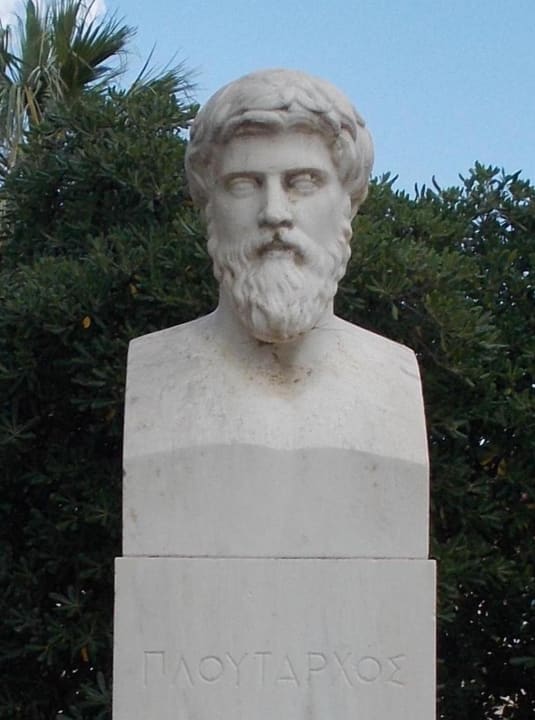

Summary
Plutarch’s Parallel Lives set the life of a famous Greek beside that of a famous Roman, so that each could be measured by the other. Twenty-three pairs survive, most closed by a short Comparison in which Plutarch weighs the two men, together with four single Lives: Aratus, Artaxerxes, Galba, and Otho. The pair of Epaminondas and Scipio is lost. The founders come first, Theseus with Romulus and Lycurgus with Numa; then the lawgivers and statesmen of early Athens and the Roman Republic, Solon and Poplicola, Themistocles and Camillus, Pericles and Fabius, Aristides and Cato the Elder; then the generals and kings of the Hellenistic age and the late Republic, from Alcibiades and Coriolanus to Alexander and Caesar, Demosthenes and Cicero, Demetrius and Antony, and Dion and Brutus. Plutarch is clear that he is not writing history. At the opening of the Life of Alexander he explains that great battles often reveal less of a man than a jest or a short saying, and that he will gather such signs of character as a painter studies the face and eyes. The Lives are therefore full of anecdotes: Themistocles telling the Spartan commander to strike but hear him, Cato the Elder preferring to be asked why he had no statue, Caesar telling his friends in an Alpine village that he would rather be first there than second in Rome, Demosthenes training his voice with pebbles in his mouth. The purpose is moral. Plutarch writes so that readers may imitate the virtues of good men and avoid the vices of others; in the pair of Demetrius and Antony he includes two men chiefly as warnings. He praises justice in Aristides and Phocion, temperance in Cato and Agesilaus, piety in Numa and Camillus, magnanimity in Pericles and Timoleon, and he traces how ambition, anger, and love of pleasure undid men of great gifts such as Alcibiades, Marius, Sulla, and Antony. He judges generously but firmly, and lets the facts of a life carry the lesson. The Lives were among the most widely read books of the Renaissance and the early modern world. Amyot’s French version and Sir Thomas North’s English translation from it gave Shakespeare the plots and much of the language of Julius Caesar, Antony and Cleopatra, and Coriolanus. Montaigne counted Plutarch among his two favorite authors, the American founders read him as a school of republican virtue, and the Dryden translation, revised by Clough, became the standard English version of the nineteenth century, the one given here.
Virtues in this work
- Justice: Aristides the Just, Phocion, and Cato the Younger show justice in public office and in poverty.
- Magnanimity: Pericles, Timoleon, and Camillus show greatness of soul toward rivals and the city that wronged them.
- Temperance: Alcibiades, Sulla, Demetrius, and Antony show how great gifts are undone by unruled passion.
Plot or Argument
- The plan of the parallels
Each pair joins a Greek and a Roman of similar career or character: two founders, two lawgivers, two generals who fought invaders, two orators, two men ruined by love and luxury. The Comparison that follows weighs them virtue by virtue.
- Founders and lawgivers
Theseus and Romulus, Lycurgus and Numa, and Solon and Poplicola show how cities were founded and given laws, religion, and customs, with Plutarch sifting legend from probable report.
- Statesmen and generals of the classical age
From Themistocles and Pericles to Aristides, Cimon, Nicias, and Alcibiades, the Greek Lives cover Athens from the Persian Wars through the Peloponnesian War, paired with Romans of the early and middle Republic.
- Kings and the fall of the Republic
Alexander, Pyrrhus, Demetrius, and the Spartan reformers Agis and Cleomenes are set beside Marius, Sulla, Pompey, Caesar, the Gracchi, Cicero, Antony, and Brutus, the men whose contests ended the Roman Republic.
Characters
- Plutarch, narrator and moralist
Speaks in his own voice, addresses his friend Sosius Senecio, weighs sources, and draws the comparisons.
- Alexander the Great, subject of a Life
Macedonian conqueror, paired with Caesar; Plutarch searches his small acts and sayings for his character.
- Julius Caesar, subject of a Life
Roman general and dictator, whose Life supplied Shakespeare with the plot of Julius Caesar.
- Cato the Younger, subject of a Life
Stoic senator of unbending integrity, opponent of Caesar.
- Pericles, subject of a Life
Athenian statesman whose calm, eloquence, and incorruptibility Plutarch praises.
Lessons
Character shows in small things
Plutarch looks for character in sayings and jests as well as battles. A student learns to read a person by habits and small choices, which reveal what great occasions can hide.
- Why does Plutarch think a jest can reveal more than a battle?
- What small habit in one Life told you most about the man?
Comparison as a way to judge
By setting two lives side by side, Plutarch makes the reader weigh virtues against each other: Aristides’ justice against Cato’s industry, Demosthenes’ eloquence against Cicero’s. Comparison sharpens judgment without flattery.
- Choose one Comparison. Do you agree with Plutarch’s verdict?
- What do you see in each man that you would not see if you read him alone?
Great gifts need governed passions
Alcibiades, Marius, Sulla, Coriolanus, and Antony had rare gifts, yet ambition, anger, or pleasure undid them. Plutarch shows again and again that ability without temperance ruins both the man and the city.
- Which Life shows most clearly a gift undone by a passion?
- What did education do, or fail to do, for that man?
Public service and private integrity
Aristides died poor, Phocion refused Alexander’s gifts, Cato the Younger kept the treasury honest. Plutarch presents integrity in small public duties as the foundation of trust.
- Why does Plutarch care so much about how statesmen handled money?
- Is private honesty necessary for public greatness?
Context
Plutarch wrote in the settled peace of the Roman Empire under Trajan and Hadrian, as a Greek proud of Greece’s past and at home among Romans. The Lives helped Greeks and Romans see their histories as one moral inheritance, centuries after most of the events described.
Composition
The Lives were written in the later part of Plutarch’s life, probably between about AD 100 and 120, and dedicated to the Roman senator Sosius Senecio. The order in which the pairs were written is uncertain; the order here follows the Dryden/Clough edition.
Reception
Translated into Latin in the fifteenth century, into French by Jacques Amyot (1559), and from Amyot into English by Sir Thomas North (1579), the Lives shaped Shakespeare, Montaigne, and generations of statesmen. Dryden’s team translated them in 1683-86; Clough revised that version in 1859-64.
Comparisons
- plutarch-essays
The Moralia analyze in argument the virtues and vices the Lives show in action.
- the-history-of-the-peloponnesian-war
Thucydides is Plutarch’s chief source for Pericles, Nicias, and Alcibiades.
- the-twelve-caesars
Suetonius, Plutarch’s younger contemporary, wrote Roman imperial lives by topic rather than by moral comparison.
- the-age-of-alexander
A modern selection of nine of these Greek Lives.
- the-fall-of-the-roman-republic
A modern selection of six of these Roman Lives.
Quotes
“the most glorious exploits do not always furnish us with the clearest discoveries of virtue or vice in men; sometimes a matter of less moment, an expression or a jest, informs us better of their characters and inclinations, than the most famous sieges, the greatest armaments, or the bloodiest battles whatsoever”
“Strike if you will, but hear”
“The city is well fortified which hath a wall of men instead of brick”
“I would," said he, "much rather be asked, why I have not one, than why I have one”
“Also, Carthage, methinks, ought utterly to be destroyed”
“For my part, I had rather be the first man among these fellows, than the second man in Rome”
“The die is cast”
“I came, saw, and conquered”
“more worshiped the rising than the setting sun”
“his inarticulate and stammering pronunciation he overcame and rendered more distinct by speaking with pebbles in his mouth”
“The ship wherein Theseus and the youth of Athens returned had thirty oars”
“But Cleopatra was busied in making a collection of all varieties of poisonous drugs, and, in order to see which of them were the least painful in the operation, she had them tried upon prisoners condemned to die”
For Students
A reading companion for classical Christian high school students. See the student guide.
Reading Guide
Watch for
- Plutarch’s own comments, often at the beginning of a Life, on why he chose these men and what he hopes readers will imitate.
- Short sayings and anecdotes that reveal character, as he promises at the start of the Life of Alexander.
- The Comparisons at the end of each pair, where Plutarch weighs one virtue against another.
- How education, or the lack of it, shapes men of great natural gifts such as Coriolanus, Alcibiades, and Marius.
- Where Plutarch doubts his sources or separates legend from probable history.
Key terms and names
- Parallel Lives
- Plutarch’s pairing of a Greek and a Roman life for comparison.
- Synkrisis
- The Greek rhetorical exercise of comparison, which Plutarch’s Comparisons follow.
- Ethos
- Character, the settled disposition that Plutarch seeks to reveal through deeds and sayings.
- Ostracism
- The Athenian vote to exile a citizen for ten years, used against Aristides, Themistocles, and Cimon.
- Dictator
- At Rome, a magistrate given supreme power for an emergency, as Fabius and Camillus were; Sulla and Caesar extended the office.
- Proscription
- Sulla’s posted lists of citizens who could be killed and their property seized, later used by the triumvirs against Cicero.
Seminar Questions
- Comprehension Name three pairs of Lives and explain why Plutarch put each pair together.
- Comprehension What does Plutarch say at the beginning of the Life of Alexander about the difference between lives and histories?
- Interpretation Why does Plutarch include men such as Demetrius and Antony whom he does not hold up for imitation?
- Interpretation In several Lives a man of great gifts is ruined by a single passion. Choose one and trace how it happens.
- Interpretation How does Plutarch treat the gods, oracles, and omens in the Lives?
- Big Question Can reading about the virtues of others make us virtuous? What else is needed?
Faith Connections
- Hebrews 13:7 (Scripture)
The writer to the Hebrews tells believers to remember those who led them and to follow their faith, considering the end of their conversation: imitation of good lives is a Christian practice too.
- Proverbs 16:18 (Scripture)
Pride goeth before destruction: the falls of Alcibiades, Coriolanus, and Pompey illustrate the proverb.
- Basil the Great, Address to Young Men on Greek Literature (Church Fathers)
Basil commends reading the deeds of virtuous pagans as preparation for Christian virtue, taking what is good like bees from flowers.
Logic and Rhetoric
Central argument: Virtue and vice are best learned by contemplating the lives of men who showed them; comparing two lives lets the reader judge which qualities are truly admirable.
Rhetorical device: synkrisis (comparison). In the Comparison of Aristides with Cato the Elder, Plutarch weighs justice in poverty against industry and thrift, giving each man his due.
Debate: Resolved: A statesman’s private character is a proper concern of the citizens he serves.
Memory Work
the most glorious exploits do not always furnish us with the clearest discoveries of virtue or vice in men; sometimes a matter of less moment, an expression or a jest, informs us better of their characters and inclinations, than the most famous sieges, the greatest armaments, or the bloodiest battles whatsoever
The city is well fortified which hath a wall of men instead of brick
Writing Prompts
Essay: Choose one pair of Lives and write your own Comparison of the two men, weighing at least two virtues, before reading Plutarch’s.
Comparison with The Twelve Caesars: Compare Plutarch’s Life of Caesar with Suetonius’ Julius: how does each biographer reveal character?
Medical Lens
The Lives record illness and death as part of character: Pericles in the Athenian plague, Alexander’s fatal fever, Cato the Elder’s household medicine and distrust of Greek physicians, and the poisonings and suicides that end several Roman Lives. They are sources for ancient attitudes to sickness and remedies, read with care since Plutarch wrote centuries after many of the events.
- Life of Pericles
Pericles, sick in the plague years, shows a friend an amulet the women had hung on him, as a sign of how far illness had worn him down.
- Life of Marcus Cato
Cato keeps a book of household remedies for his family and expresses his suspicion of Greek physicians.
- Life of Alexander, last chapters
The account of Alexander’s final illness from the royal diaries, day by day, with Plutarch’s doubts about the rumors of poison.
- Life of Antony
Cleopatra tests poisons on condemned prisoners and studies the bite of venomous creatures before her death.
- Life of Cato the Younger, end
Cato’s death at Utica, including his tearing open the wound the physician had dressed.
Creative Prompts
- Essay
Write your own Comparison of two people you have read about, in Plutarch’s manner, weighing them virtue by virtue.
- Dialogue
Write the conversation between Cineas and Pyrrhus about what Pyrrhus will do after he conquers the world.
- Classroom
Keep a class commonplace book of one saying or anecdote from each Life, with the virtue or vice it shows.
Further Reading
- Julius Caesar; Antony and Cleopatra; Coriolanus, William Shakespeare
The Roman plays drawn from North’s Plutarch.
- Moralia (Essays), Plutarch
- Plutarch, D. A. Russell
- Plutarch’s Lives (North translation, 1579), Sir Thomas North
The Elizabethan version Shakespeare used.
Verification notes
The list of Lives, pairs, and surviving Comparisons follows the Dryden/Clough text in the library. Dates of the subjects are conventional; legendary figures are marked as such. Quotations are copied from the attached Gutenberg text.
No verification flags recorded.