Work record
On Friendship
1580 (Essays) · Renaissance Early Modern · Essays · French
Abstract
Background. Montaigne and La Boétie served together in the Bordeaux parlement, and La Boétie's death of illness in 1563 left Montaigne bereft. Withdrawing to his tower library in 1571, he composed this chapter as a tribute, among the earliest pieces of the first book.
Occasion. The essay was planned as a decorative border for La Boétie's youthful Discourse on Voluntary Servitude; because Protestant partisans had seized on that treatise, Montaigne left it out and let his own reflections stand alone.
Argument. Drawing on Aristotle and Cicero, Montaigne ranks family ties, sexual passion and useful acquaintance below a friendship in which two wills merge. Such union admits no third person, no debts and no thanks; asked its cause, he can say only that it was he, and that it was I.
Content. Ancient anecdotes test the ideal, chiefly Blossius's loyalty to Gracchus and the testament of Eudamidas. The closing pages describe the four years they shared and the diminished life left after, in which Montaigne feels he has been robbed of half of himself and enjoys nothing fully.
Significance. Florio's 1603 rendering carried the essay to Shakespeare's England and to Bacon, whose own 'Of Friendship' answers it, and it remains a central text on friendship and grief.
Key figures
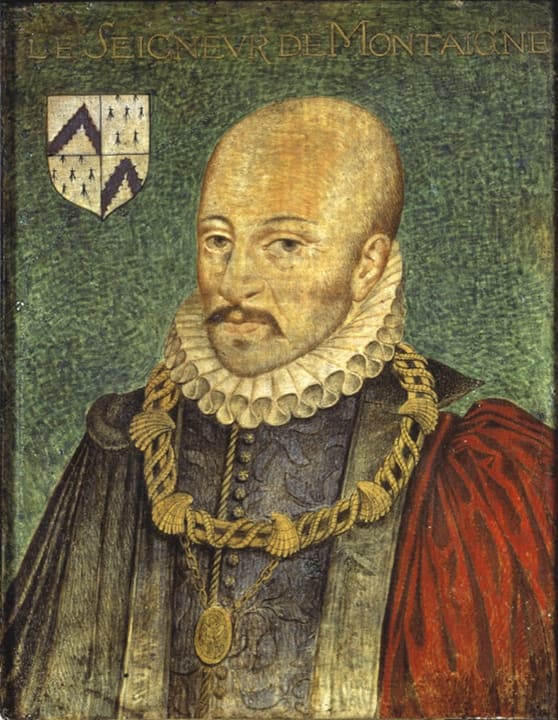
- Michel de Montaigne: Essayist, former Bordeaux magistrate, writing in retirement
- Étienne de La Boétie: Fellow magistrate and humanist, Montaigne's friend, dead at thirty-two in 1563
- Gaius Blossius: Friend of Tiberius Gracchus, who said he would have obeyed any order of his
- Eudamidas: Corinthian who bequeathed his poor mother and daughter to his friends' care

Summary
This small volume presents Montaigne's celebrated essay on friendship together with other essays from the Essais in M. A. Screech's translation. The title essay, 'Of Friendship' (Book I, Chapter 28 in modern numbering), was written as a memorial to Étienne de La Boétie, the young magistrate and humanist whom Montaigne met in Bordeaux around 1558 and who died in 1563. Montaigne begins by comparing himself to a painter who fills the borders of a wall with grotesques around a central picture: his essay was meant to frame La Boétie's treatise On Voluntary Servitude, which he decided not to print there because it had been misused by Protestant pamphleteers. He then distinguishes perfect friendship from other human bonds. The relations of parents and children are bound by duty and inequality; brotherhood is complicated by inheritance; erotic love for women is a feverish, fickle fire; and Greek love between men, as the ancients practised it, is unequal and tied to bodily beauty. Ordinary friendships are alliances of convenience, which must be conducted with prudence. The friendship Montaigne shared with La Boétie, by contrast, was a complete fusion of two wills, so that neither could say what belonged to whom; it arose suddenly from their first meeting and lasted only four years. Asked why he loved La Boétie, Montaigne answers that he can say only: because it was he, because it was I. He argues that such a friendship can exist only between two, cannot be divided, and makes ordinary obligations such as gratitude meaningless, since friends own everything in common. He illustrates with classical examples, especially Gaius Blossius's loyalty to Tiberius Gracchus, and with a story of Eudamidas bequeathing his friends the duty of caring for his mother and daughter. The essay ends with a grief-stricken account of the dull, smoky life Montaigne has led since his friend's death, in which every pleasure seems halved. Other essays in This selection (contents vary by edition) extend Montaigne's reflections on affection, solitude and the self.
Virtues in this work
- Friendship: Montaigne’s essay on his friendship with La Boetie.
Plot or Argument
- The frame and La Boétie's treatise
Montaigne compares his essay to grotesques framing a painting and explains why he will not print On Voluntary Servitude.
- Kinds of human bonds
Distinctions between friendship and the bonds of parents and children, brothers, lovers and Greek pederasty.
- The perfect friendship
The fusion of two souls; 'because it was he, because it was I'; indivisibility and the meaninglessness of debts between true friends.
- Classical examples
Blossius and Gracchus, the will of Eudamidas, and other ancient illustrations.
- Mourning
Montaigne's description of life after La Boétie's death, a half-life in which nothing is fully enjoyed.
Characters
- Michel de Montaigne, author
Essayist reflecting on his friendship and his grief.
- Étienne de La Boétie, Montaigne's friend
Humanist and magistrate, author of On Voluntary Servitude, who died in 1563.
Key claims
The main steps of the argument, in order, and how they fit together.
- Every human bond contains some friendship, but ties of family, law and desire are mixed with duty, inequality or passion.How it is supported: Comparison of parents and children, brothers, erotic love and Greek love, drawing on Aristotle and Cicero.
- Erotic love is a feverish and fickle fire, while friendship is a steady, even warmth that grows as it is enjoyed.How it is supported: Contrast between the restlessness of passion and the calm of a settled bond.
- Ordinary friendships are useful alliances that must be handled with prudence and some reserve.How it is supported: Observation of common acquaintance formed by convenience or chance.
- Perfect friendship is a free meeting of two souls that merge into one will, so neither can tell what belongs to whom.How it is supported: His own friendship with La Boétie, which began at their first meeting.
- The cause of such a friendship cannot be fully explained beyond the two persons themselves: because it was he, because it was I.How it is supported: Personal testimony about his bond with La Boétie.
- Between perfect friends there are no debts, gifts or thanks, since they hold everything in common.How it is supported: The testament of Eudamidas, who left his friends the duty of caring for his family.
- Perfect friendship cannot be divided among several people and is so rare it appears perhaps once in three centuries.How it is supported: Reasoning from the total gift of self, tested by Blossius's loyalty to Gracchus.
- Losing such a friend leaves only half a life, in which nothing can be fully enjoyed.How it is supported: Montaigne's account of the years after La Boétie's death.
Argument map
Supported by
- 1Every human bond contains some friendship, but ties of family, law and desire are mixed with duty, inequality or passion.
which rests on
- 2Erotic love is a feverish and fickle fire, while friendship is a steady, even warmth that grows as it is enjoyed.
- 3Ordinary friendships are useful alliances that must be handled with prudence and some reserve.
- 4Perfect friendship is a free meeting of two souls that merge into one will, so neither can tell what belongs to whom.
which rests on
- 5The cause of such a friendship cannot be fully explained beyond the two persons themselves: because it was he, because it was I.
- 6Between perfect friends there are no debts, gifts or thanks, since they hold everything in common.
- 7Perfect friendship cannot be divided among several people and is so rare it appears perhaps once in three centuries.
- 8Losing such a friend leaves only half a life, in which nothing can be fully enjoyed.
Therefore
Plain-language summaries of the author's argument, not quotations.
Lessons
Friendship as union
Montaigne describes friendship not as an exchange of favours but as a merging of wills. The essay sets a high, perhaps impossible, ideal against which to measure our relationships.
- Is Montaigne's ideal friendship possible, or even desirable?
- Why can it exist only between two?
- What does 'because it was he, because it was I' mean?
Grief for a friend
The essay is an act of mourning. It shows how loss can be honoured by writing and how a friendship can shape a whole life afterward.
- How does grief shape the essay's argument?
- Is writing an essay about a friend a form of continuing the friendship?
Comparing loves
Montaigne contrasts friendship with family duty and erotic passion, revealing assumptions of his time, including about women. Readers can test his distinctions against their own experience.
- Why does Montaigne think women incapable of such friendship, and how should we respond?
- Are family bonds lesser forms of love?
Context
Montaigne wrote during the French Wars of Religion, when Catholic and Protestant factions fought for control of France. La Boétie's essay On Voluntary Servitude, written in his youth, was co-opted by Huguenot propagandists, which is why Montaigne withheld it. The essay draws on classical theories of friendship in Aristotle's Nicomachean Ethics and Cicero's De Amicitia.
Composition
'Of Friendship' appeared in the first edition of the Essais (1580) and was revised in later editions up to Montaigne's death. Montaigne also wrote a letter to his father describing La Boétie's death in detail.
Reception
The essay became one of the most famous texts on friendship in Western literature. John Florio's 1603 English translation was read by Shakespeare and Bacon, whose own essay 'Of Friendship' engages with Montaigne's.
Comparisons
- phaedrus-and-letters-vii-and-viii
Plato's dialogue on love between men is one of the models Montaigne discusses and distinguishes from friendship.
- plutarch-essays
Montaigne's favourite author; Plutarch's essays on friendship and flattery shape his own.
- kokoro
Sōseki's novel shows friendship destroyed by rivalry and guilt, the opposite of Montaigne's perfect union.
- meditations
Both are introspective writings drawn from the classical tradition of moral philosophy and the examined life.
Quotes
“If a man urge me to tell wherefore I loved him, I feel it cannot be expressed, but by answering; Because it was he, because it was my selfe.”
For Students
A reading companion for classical Christian high school students. See the student guide.
Reading Guide
Watch for
- The opening image of a painter who fills the borders of a wall with grotesques around a central picture. Ask what the central picture was meant to be and why Montaigne decided not to print it.
- The sorting of human bonds in the middle of the essay: fathers and sons, brothers, love for women, and Greek love between men. Note what flaw Montaigne finds in each before he reaches perfect friendship.
- Montaigne's account of his first meeting with La Boétie at a large gathering in the city, and his claim that they were already seeking each other before they met.
- The classical examples of Blossius answering for Tiberius Gracchus and of Eudamidas leaving his friends the care of his mother and daughter in his will. Ask what each proves about the unity of friends.
- The closing pages on life after La Boétie's death, where every pleasure seems to Montaigne only half enjoyed because his friend has no share in it.
Key terms and names
- Étienne de La Boétie
- The young magistrate of the Bordeaux parlement whom Montaigne loved, and who died in 1563 after about four years of friendship. The whole essay is a memorial to him.
- On Voluntary Servitude
- La Boétie's youthful treatise on why people submit to tyrants. Montaigne first meant to set it at the heart of his book but withheld it because Protestant partisans had published it for their own cause.
- Grotesques
- Fanciful decorative paintings with no fixed shape, used to fill the margins of a wall. Montaigne compares his own essays to them, calling them shapeless pieces framing his friend's work.
- Common friendships
- Ordinary alliances formed by occasion or advantage, which Montaigne says must be handled with prudence and reserve. He contrasts them with the single perfect friendship that admits no reserve.
- Blossius and Gracchus
- Gaius Blossius, questioned before the Roman consuls about what he would have done for Tiberius Gracchus, said he would have done anything Gracchus asked, since Gracchus would never ask a wrong thing. Montaigne defends the answer as proof that the two wills were one.
- Eudamidas
- A poor Corinthian who, in his will, left to his two rich friends the duties of supporting his mother and dowering his daughter. Montaigne praises the will because it treated his friends' wealth as already shared.
Seminar Questions
- Comprehension Why does Montaigne say his essay is like the grotesques around a painting, and why does he decide not to print La Boétie's treatise in its place?
- Comprehension What objections does Montaigne raise to calling the bond between father and son, or between brothers, a perfect friendship?
- Comprehension How did Montaigne and La Boétie first meet, and how long did their friendship last?
- Interpretation Montaigne says he can explain his love for La Boétie only by answering that it was because it was he, and because it was himself. Is this a refusal to explain, or the best possible explanation?
- Interpretation Why does Montaigne insist that perfect friendship can exist only between two people, and that gifts and thanks between such friends make no sense?
- Interpretation Why does Montaigne defend Blossius's answer about Gracchus when the consuls found it alarming? What limits, if any, does his defense place on a friend's loyalty?
- Big Question Is a friendship in which two wills become one the highest form of love, or does love require that each person remain distinct enough to correct the other?
Faith Connections
- 1 Samuel 18:1-4 (Scripture)
The soul of Jonathan was knit with the soul of David, and Jonathan loved him as his own soul. Montaigne's description of two souls mixed so completely that the seam cannot be found is very close to this account.
- 2 Samuel 1:26 (Scripture)
David mourns Jonathan by saying his love surpassed the love of women. Montaigne's closing pages are a similar lament, and he too ranks this friendship above the love between men and women.
- John 15:13-15 (Scripture)
Jesus calls his disciples friends rather than servants because he has shared everything with them. Montaigne's claim that friends hold all things in common, including their secrets, fits this pattern, though Jesus extends friendship to many and Montaigne limits it to one.
- Augustine, Confessions IV (Church Fathers)
Augustine describes the death of a young friend at Thagaste and says he felt that his soul and his friend's had been one soul in two bodies, so that he hated to live as half. He later judges that his grief was disordered because he loved a mortal as if he would never die, a judgment that sets up a conversation with Montaigne's undiminished mourning.
Logic and Rhetoric
Central argument: Every human bond has a measure of friendship in it, but bonds of nature, law and desire are mixed with duty, inequality or passion. Perfect friendship arises only from the free meeting of two souls who become one will. Since such friends own all things in common, ordinary duties of gratitude and exchange no longer apply between them, and the friendship cannot be divided among several people. Such a friendship is rare, perhaps once in three centuries, and Montaigne had it with La Boétie; therefore its loss leaves a half-life that no other relationship can fill.
Rhetorical device: isocolon. Montaigne's answer about why he loved La Boétie, which the record gives in Florio's English as "Because it was he, because it was my selfe" (Essays I.28), sets two clauses of equal length side by side. The balanced form enacts the equality and union of the two friends.
Debate: Resolved: A person can have only one true friend in the sense Montaigne describes.
Writing Prompts
Essay: Montaigne ranks friendship above the bonds of parents and children, brothers, and husbands and wives. Reconstruct his reasons for each ranking and argue whether his account of perfect friendship can survive his own admission that it was granted to him only once.
Comparison with The Nicomachean Ethics: Aristotle in Books VIII and IX distinguishes friendships of utility, pleasure and virtue, and Montaigne cites him in this essay. Compare Aristotle's friendship of virtue with Montaigne's union with La Boétie and argue which account better explains why a friend is another self.
Medical Lens
The essay is primarily a meditation on friendship but closes as a document of bereavement, describing a lasting dulling of pleasure after La Boétie's death. Montaigne's separate letter describing La Boétie's death (from an illness often described as dysentery or plague) is a valuable early account of a deathbed. Elsewhere in the Essais, Montaigne writes extensively on his kidney stones, physicians and the practice of philosophy as preparation for death, but whether those essays appear in this volume depends on the edition.
- 'Of Friendship', closing pages
Montaigne's description of the dull, half-life he has led since his friend's death.
Creative Prompts
- Essay
Write an essay on a friendship of your own in Montaigne's manner, beginning from 'because it was he, because it was I'.
- Dialogue
Imagine La Boétie replying to the essay. What would he say about Montaigne's portrait of their friendship?
- Classroom
Compare Montaigne's essay with Cicero's De Amicitia and Bacon's 'Of Friendship'.
Further Reading
- How to Live: A Life of Montaigne, Sarah Bakewell
- On Friendship (De Amicitia), Cicero
- Discourse on Voluntary Servitude, Étienne de La Boétie
- Essays, Francis Bacon
Includes 'Of Friendship'.
Verification notes
The content of 'Of Friendship' and its context are well established. The full contents of this volume vary and are not listed. The Florio quotation is from memory and spelling should be checked; Florio numbers the essay I.27.
- Florio's exact spelling and punctuation of the quoted sentence.
- Contents of the 'On Friendship' volume.
- Cause of La Boétie's death as described in Montaigne's letter.
- Year of Montaigne's first meeting with La Boétie (c. 1558–1559).