Work record
Julius Caesar
1599 · Renaissance Early Modern · Drama · English
Abstract
Background. Shakespeare built the play from Thomas North's 1579 translation of Plutarch's Lives of Caesar, Brutus and Antony, often versifying North's sentences. An English audience under an ageing, heirless queen heard its arguments over tyranny and succession with keen interest.
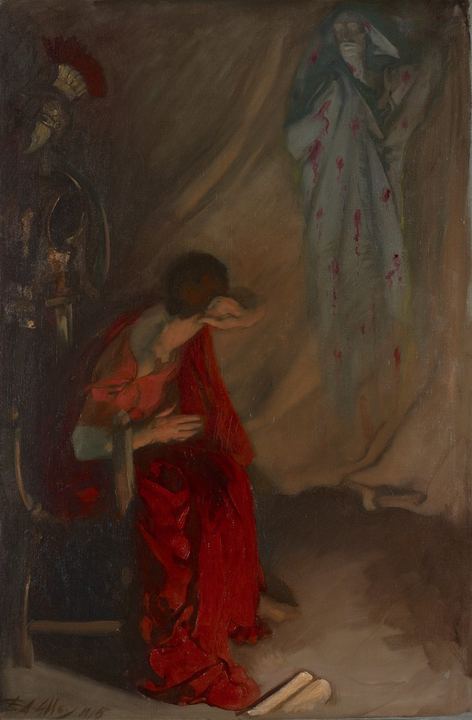
Plot. Cassius works on Brutus with flattery and planted letters until Brutus, sleepless in his orchard, decides Caesar must die before ambition makes him king. Ignoring Calphurnia's dream, Caesar goes to the Capitol and is stabbed. Brutus justifies the deed to the crowd in plain prose; Antony, allowed to speak, inflames it with the refrain "Brutus is an honourable man" and the reading of the will. At Sardis the two leaders quarrel and are reconciled, Caesar's ghost appears, and at Philippi Cassius and then Brutus die by their own choice.
Structure. The assassination falls at the centre of Act III, so the second half traces its consequences rather than its preparation.
Themes. Honour and self-deception, public persuasion and the fickleness of crowds, omens and free will, friendship strained by politics, and Caesar's bodily frailty, his deafness and falling sickness, set against his claim to be constant as the northern star.
Significance. Antony's oration is among the most closely studied speeches in English, and the play has long been a school text for rhetoric.
Main characters
- Marcus Brutus: High-minded senator who joins the conspiracy for the republic's sake
- Julius Caesar: Victorious dictator, proud and ailing, slain on the Ides of March
- Caius Cassius: Watchful, resentful organiser of the plot
- Mark Antony: Caesar's friend, whose funeral oration turns Rome against the assassins
- Octavius Caesar: Caesar's young heir and fellow triumvir
- Portia: Brutus's wife, Cato's daughter, who demands his confidence
- Calphurnia: Caesar's wife, frightened by an ominous dream
- Casca: Blunt conspirator who strikes the first blow
- The Soothsayer: Warns Caesar to beware the Ides of March

Watch the summary
Julius Caesar in 122 seconds · 2:02
Summary
Julius Caesar, Shakespeare's tragedy of the assassination of 44 BC, begins as Rome celebrates Caesar's triumph over the sons of Pompey. The tribunes rebuke the fickle crowd, a soothsayer warns Caesar to beware the Ides of March, and Caesar is offered a crown three times by Mark Antony and refuses it, then falls in a fit of the falling sickness. Cassius, resentful and shrewd, works on his friend Marcus Brutus, a man revered for his honesty, by flattery and forged letters, telling him that the fault is not in our stars but in ourselves. Brutus, sleepless, persuades himself in his orchard that Caesar must die not for any personal cause but for the general good, lest ambition make him a tyrant. He joins the conspirators but overrules Cassius twice: Antony is to be spared, and later allowed to speak at the funeral. Brutus's wife Portia, who has wounded her own thigh to prove her constancy, begs to share his secret. On the morning of the Ides, Caesar's wife Calphurnia, terrified by dreams and portents, persuades him to stay home, but Decius flatters him into going to the Capitol. There, as he declares himself constant as the northern star, the conspirators stab him, Brutus last; Caesar's last words are 'Et tu, Brute?' Brutus explains to the people that he loved Caesar but loved Rome more, and wins them. Antony then speaks over the body, repeating that Brutus is an honourable man until the phrase turns to irony, showing the wounds and reading Caesar's will, and turns the crowd into a mob that burns the conspirators' houses and kills the poet Cinna for his name. Antony, Octavius and Lepidus form a triumvirate. In the camp at Sardis, Brutus and Cassius quarrel bitterly over money and honor and are reconciled; Brutus then reveals that Portia has killed herself, and Caesar's ghost appears to him promising to meet him at Philippi. In the battle Cassius, mistaking a report, has his servant kill him; Brutus, defeated, runs on his own sword, saying Caesar may now be still. Antony praises Brutus as the noblest Roman of them all, the only conspirator who acted for the common good.
Virtues in this work
- Honor: Brutus acts from love of Rome rather than envy, and Antony calls him the noblest Roman of them all.
- Prudence: The play shows the cost of its absence as Brutus spares Antony and lets him speak against Cassius's advice.
- Friendship: Brutus and Cassius reconcile after their quarrel and stand together to the end at Philippi.
- Fortitude: Portia proves her constancy by a self-inflicted wound to be trusted with her husband's secret.
Plot or Argument
- Act I: Ambition and suspicion
Caesar refuses the crown and suffers a fit; the soothsayer warns of the Ides; Cassius sounds out Brutus and Casca, and a night of portents brings Cassius's plan forward.
- Act II: The orchard and the house
Brutus reasons himself into the conspiracy, refuses an oath and spares Antony; Portia pleads for his trust; Calphurnia's dream nearly keeps Caesar home until Decius reinterprets it.
- Act III: The Ides of March
Caesar is murdered at the Capitol; Brutus addresses the people in prose, Antony in verse, and the city erupts; Cinna the poet is torn apart.
- Act IV: The quarrel
The triumvirs proscribe their enemies; Brutus and Cassius quarrel and reconcile; Portia's death is told, and Caesar's ghost visits Brutus.
- Act V: Philippi
The armies meet; Cassius dies by his servant's hand after a mistaken report; Brutus runs on his sword, and Antony and Octavius honor him.
Characters
- Marcus Brutus, tragic hero and conspirator
An honorable, idealistic Roman who kills his friend for the republic and errs through trust in his own reasoning.
- Julius Caesar, dictator of Rome
A great general, proud and partly deaf and epileptic, who speaks of himself in the third person and is assassinated on the Ides of March.
- Caius Cassius, leader of the conspiracy
A lean, observant, envious man who engineers the plot and yields to Brutus's judgment.
- Mark Antony, Caesar's friend
A pleasure-loving athlete who proves a brilliant orator and avenger.
- Portia, Brutus's wife
Cato's daughter, who wounds herself to prove her firmness and later dies by swallowing fire.
- Calphurnia, Caesar's wife
Frightened by dreams and portents, she begs Caesar to stay home.
- Casca, conspirator
A blunt man who reports the crown scene and strikes Caesar first.
- Octavius Caesar, Caesar's heir
Young, cool and determined, a partner in the triumvirate.
- The Soothsayer, prophet
Warns Caesar to beware the Ides of March.
Lessons
Good men can reason their way to wrong
Brutus admits he knows no personal cause against Caesar and kills him for what he might become. The play shows how an honorable man, trusting abstract reasoning, can do a grave wrong and set loose worse evils.
- What reasons does Brutus give in his orchard soliloquy?
- Does he kill Caesar for what Caesar has done or for what he might do?
- What does the murder actually produce in Rome?
The power of rhetoric
Brutus speaks to the crowd's reason in plain prose; Antony moves their passions with irony, the wounds and the will. The funeral scene is a lesson in how speech can sway a people for good or ill.
- How does Antony turn 'Brutus is an honourable man' into an accusation?
- Why does Brutus allow Antony to speak?
- What does the killing of Cinna the poet show about a mob?
Friendship tested by power
Brutus betrays Caesar's friendship for Rome, and Brutus and Cassius nearly break their own friendship in the tent at Sardis. The play makes loyalty and its limits a central moral question.
- Why does Caesar's 'Et tu, Brute?' strike so hard?
- What causes the quarrel of Brutus and Cassius, and what ends it?
Fate, omen and choice
Storms, dreams, the soothsayer and the ghost all warn, yet characters choose and bear responsibility. Cassius's line about the stars puts the burden on human choice.
- Does Caesar ignore warnings from pride or from courage?
- Is Cassius right that the fault is in ourselves?
Context
The play dramatizes the end of the Roman Republic: Caesar, after civil war, was made dictator for life, and on 15 March 44 BC a group of senators led by Brutus and Cassius killed him in the theatre of Pompey. The conspirators' defeat by Antony and Octavius at Philippi in 42 BC led to the empire. Elizabethan audiences, under an aging queen without a named heir, followed questions of succession, tyranny and rebellion closely.
Composition
Shakespeare drew on Thomas North's 1579 English translation of Plutarch's Lives of Caesar, Brutus and Antony, often turning North's prose into verse. A Swiss traveler, Thomas Platter, saw the play at the Globe in September 1599. It was first printed in the First Folio of 1623.
Reception
The play has been continuously performed and widely taught, especially for its rhetoric. Antony's funeral oration is among the most studied speeches in English, and the play has been staged repeatedly as commentary on dictatorship and revolution.
Comparisons
- the-civil-war
Caesar's own account of the civil war shows the general before the dictatorship that Brutus feared.
- plutarch-lives
Shakespeare's direct source; Plutarch's Lives of Caesar and Brutus supply the omens, Portia's wound and Brutus's ghost.
- macbeth
Both tragedies turn on the murder of a ruler and its consequences, but Brutus kills from principle and Macbeth from ambition.
- the-prince
Machiavelli's analysis of conspiracies and of a ruler's need for fear and love bears directly on Caesar, Brutus and Antony.
Quotes
Frequently cited
“Beware the Ides of March”
Frequently cited
“The fault, dear Brutus, is not in our stars, But in ourselves, that we are underlings”
Frequently cited
“Yond Cassius has a lean and hungry look; He thinks too much: such men are dangerous”
Frequently cited
“Cowards die many times before their deaths; The valiant never taste of death but once”
Frequently cited
“Not that I loved Caesar less, but that I loved Rome more”
Frequently cited
“Friends, Romans, countrymen, lend me your ears; I come to bury Caesar, not to praise him”
Frequently cited
“The evil that men do lives after them, The good is oft interred with their bones”
Frequently cited
“There is a tide in the affairs of men, Which, taken at the flood, leads on to fortune”
Frequently cited
“This was the noblest Roman of them all”
“It must be by his death: and for my part, I know no personal cause to spurn at him, But for the general”
“Between the acting of a dreadful thing And the first motion, all the interim is Like a phantasma, or a hideous dream”
“But I am constant as the northern star”
“His life was gentle, and the elements So mix’d in him that Nature might stand up And say to all the world, “This was a man”
For Students
A reading companion for classical Christian high school students. See the student guide.
Reading Guide
Watch for
- How Cassius flatters and manipulates Brutus in Act 1, Scene 2, and the forged letters he plants.
- Brutus's orchard soliloquy in Act 2, Scene 1: notice where his reasoning starts and where it ends.
- The two decisions where Brutus overrules Cassius: sparing Antony and letting him speak.
- The contrast between Brutus's prose speech and Antony's verse oration in Act 3, Scene 2.
- The quarrel scene in Act 4, Scene 3 and what it reveals about each man.
Key terms and names
- Ides of March
- The fifteenth day of March in the Roman calendar, the date of Caesar's assassination in 44 BC.
- Republic
- Rome's government by elected magistrates and the Senate, which the conspirators claim to defend against a king.
- Tribune
- An officer elected to protect the common people; Flavius and Marullus rebuke the crowd in Act 1.
- Triumvirate
- Rule by three men; Antony, Octavius and Lepidus form one after the murder.
- Verbal irony
- Saying one thing while meaning another, as Antony does with 'honourable man'.
- Falling sickness
- The Elizabethan name for epilepsy, from which Caesar suffers.
Seminar Questions
- Comprehension What happens when Antony offers Caesar a crown, according to Casca?
- Comprehension What reasons does Brutus give the crowd for the murder, and how does Antony answer them?
- Comprehension How do Cassius and Brutus die?
- Interpretation Is Brutus the tragic hero of the play rather than Caesar? Defend your answer.
- Interpretation Brutus kills Caesar to prevent tyranny, yet the result is civil war and empire. Does the outcome judge his choice, or only his judgment?
- Interpretation Why does the crowd change sides so quickly, and what does the death of Cinna the poet add?
- Big Question Is it ever right to kill a ruler for what he might do?
Faith Connections
- Romans 13:1-2 (Scripture)
Paul teaches that rulers are instituted by God and that resistance brings judgment. The play's chaos after the murder can be read alongside this teaching on authority.
- Proverbs 16:18 (Scripture)
Pride goes before destruction. Caesar's declaration that he is constant as the northern star comes moments before his fall.
- Augustine, City of God V.12 (Church Fathers)
Augustine discusses the Roman love of glory and praise; the play's characters, Brutus and Caesar alike, are driven by Roman honor in the terms Augustine examines.
Logic and Rhetoric
Central argument: Brutus reasons that Caesar may become a tyrant and must therefore die for the general good. He acts honorably by his own lights but misjudges Antony and the people. Antony's rhetoric turns the city against the conspirators, and civil war destroys the republic Brutus meant to save. Therefore the play argues that noble motives and sound-seeming reasoning cannot justify a murder whose consequences the actor cannot control.
Rhetorical device: verbal irony through repetition. Antony repeats that Brutus is an honourable man after each proof of Caesar's generosity until the words mean their opposite and the crowd shouts 'traitors'.
Debate: Resolved: that Brutus was right to join the conspiracy against Caesar.
Memory Work
Friends, Romans, countrymen, lend me your ears; I come to bury Caesar, not to praise him
The fault, dear Brutus, is not in our stars, But in ourselves, that we are underlings
Writing Prompts
Essay: Compare Brutus's and Antony's funeral speeches in Act 3, Scene 2. Analyze the appeals each makes to reason, emotion and character, and argue why Antony succeeds.
Comparison with Lives of the Noble Grecians and Romans: Read Plutarch's account of Brutus and compare it with Shakespeare's. Argue which details Shakespeare kept, which he changed, and how the changes shape our judgment of Brutus.
Medical Lens
Shakespeare gives Caesar the falling sickness (epilepsy), which Plutarch records, and a deaf ear he invents, so the would-be god is shown in a frail body. Brutus suffers sleeplessness and inner turmoil before the murder; Calphurnia's dreams and the ghost raise questions of omen and imagination. Portia's self-wounding and her death by swallowing fire, and the suicides of Cassius, Titinius and Brutus, follow Roman ideas of honorable death, which the play presents without endorsement. Antony's final tribute to Brutus's well-mixed elements uses the language of humoral temperament.
- Act 1, Scene 2
Casca reports that Caesar fell down in the market-place and foamed at the mouth; Brutus says he has the falling sickness. Caesar also tells Antony he is deaf in one ear.
- Act 2, Scene 1
Brutus has not slept since Cassius first stirred him and compares the interval before the deed to a hideous dream; Portia notes his sickness of mind.
- Act 2, Scene 2
Calphurnia's dream of Caesar's statue running blood, and Decius's flattering reinterpretation.
- Act 4, Scene 3
Brutus reports that Portia, distracted by grief and fear, swallowed fire; Caesar's ghost then appears to him at night.
- Act 5, Scenes 3 and 5
Cassius has Pindarus kill him, Titinius kills himself, and Brutus runs on his sword.
Listen to the book
Public-domain audiobook from LibriVox, read by Various volunteers. Recording: Julius Caesar on LibriVox (Internet Archive).
LibriVox recordings are volunteer readings released into the public domain. The reading may follow a different edition from the text in this library.
Creative Prompts
- Classroom
Have pairs perform Brutus's and Antony's funeral speeches back to back and let the class vote as the crowd, then discuss what moved them.
- Essay
Analyze how Antony's repetition of 'Brutus is an honourable man' changes meaning across his speech.
- Dialogue
Write a conversation between Portia and Calphurnia on the morning of the Ides of March.
- Fiction
Tell the funeral scene from the point of view of one ordinary citizen in the crowd.
Further Reading
- Lives of the Noble Grecians and Romans, Plutarch (trans. Thomas North)
Shakespeare's source.
- Antony and Cleopatra, William Shakespeare
- Shakespeare's Roman Plays and Their Background, M. W. MacCallum
- The Twelve Caesars, Suetonius
Verification notes
Plot, sources and stage history are standard. Act and scene locators follow the attached Gutenberg text, which spells Caesar's wife Calphurnia. Quotes are verified against that text.
No verification flags recorded.