Work record
Essays: First Series (Self-Reliance and Other Essays)
1841 · 19th Century · Essays · English
Abstract
Background. Having left the Unitarian pulpit and stirred Harvard with the 1838 Divinity School Address, Emerson shaped his journal entries and Boston lecture courses into his first book of essays, issued by James Munroe; Carlyle introduced the London printing.
Argument. One universal mind, the essays hold, lives in each person and in nature, so the soul's own intuition is a surer guide than custom or authority. Self-Reliance presses the point hardest: conformity, fear of contradicting oneself, borrowed creeds, imitation of European models and restless touring all betray the inner voice. Companion essays apply it elsewhere, finding a balancing law in every loss, a ladder from romance to universal beauty, sincerity as the core of friendship, and an unending widening of every truth.
Structure. History opens and Art closes the twelve pieces. Emerson builds by accumulation, setting aphorism after aphorism and example after example rather than proceeding by formal proof.
Key Concepts. Self-trust, nonconformity, compensation, spiritual law, the Over-Soul, and the widening circle. Each names a way in which Emerson believes an impersonal, benevolent order works through private character, so that the person who obeys his own best perception finds himself in step with the whole.
Significance. Its sentences became American proverbs; Thoreau, Whitman and Nietzsche drew on it, and Christian readers still wrestle with its confident account of the soul.
Key figures
- Ralph Waldo Emerson: Essayist speaking in his own voice as lecturer and moral counsellor
- Pythagoras, Socrates, Jesus, Luther, Copernicus, Galileo, Newton: Named in Self-Reliance as great souls misunderstood in their time
- Moses, Plato and Milton: Praised at the start of Self-Reliance for speaking their own thought
- Shakespeare, Franklin and Washington: Cited as originals no master could have taught
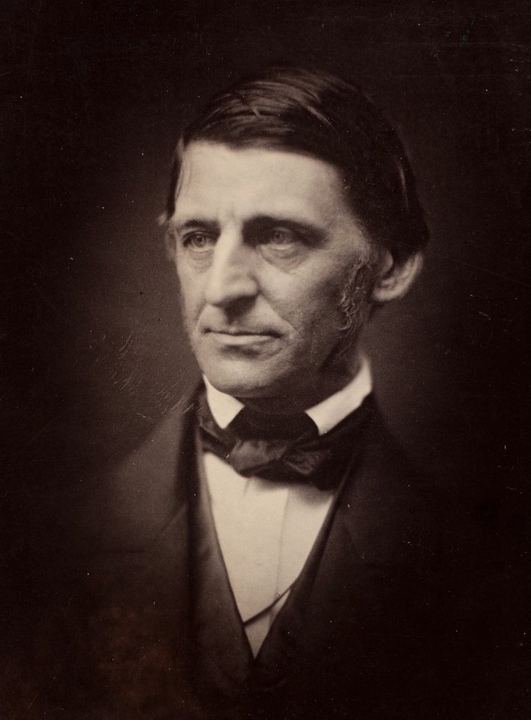

Summary
Essays: First Series gathers twelve essays that Emerson worked up from his journals and from the lecture courses he gave in Boston in the late 1830s. Each pursues one idea through a rush of aphorisms, examples and images rather than a step-by-step argument, and together they set out his conviction that the same universal mind or soul speaks in every person and in nature. History argues that each mind must relive the whole past for itself, so that history is finally biography and every great event is a possibility of the reader's own nature. Self-Reliance, the centre of the book and its most famous essay, urges the reader to trust the inner voice against conformity to society, tradition and one's own past opinions. It attacks the fear of inconsistency, declares that to be great is to be misunderstood, and turns on prayer, creeds, travel, imitation of foreign models and faith in property and political parties as forms of dependence, ending with the claim that nothing can bring peace but oneself and the triumph of principles. Compensation describes a moral law of balance by which every gain has its cost and every act rewards or punishes itself, so that no one can finally be cheated except by himself. Spiritual Laws counsels a kind of trustful ease: if we stop meddling, a higher law directs our work, our associations and our characters, and we pass for what we are. Love traces passion from a youth's first romance toward a love of the universal beauty seen through a beloved. Friendship praises truth and tenderness as the two elements of friendship and asks that friends be equals who can bear sincerity. Prudence defends attention to the body, money and weather as the lower but necessary art of living. Heroism praises self-trust in the face of danger and contempt. The Over-Soul names the universal mind in which every particular person and thing is contained and through which revelation comes to the individual. Circles pictures every truth and achievement as a circle that a larger one will enclose, and celebrates the unsettled, growing soul. Intellect and Art close the book with reflections on how thought and beauty are received rather than manufactured. The collection was published in Boston by James Munroe and Company in 1841, with a London edition the same year introduced by Thomas Carlyle; Emerson revised it for a second edition in 1847, and the Essays: Second Series followed in 1844.
Virtues in this work
- Fortitude: Self-Reliance calls the reader to speak his convictions in hard words even when the whole cry of voices is on the other side.
- Friendship: The essay Friendship defines a friend as one with whom we may be sincere and demands truth and tenderness between equals.
- Industry: Self-Reliance teaches that no kernel of nourishing corn comes except through toil on the plot of ground given to each person.
- Prudence: The essay Prudence honours care for health, money and time as the necessary art of daily life.
Plot or Argument
- I. History
There is one mind common to all; every reader must find in himself the facts of the past, so that history is properly biography and the great men of the past are possibilities of the reader's own nature.
- II. Self-Reliance: trust thyself
Genius is believing one's own thought; society conspires against the individual; the self-reliant person must be a nonconformist and ignore the demand for consistency.
- II. Self-Reliance: the source of trust
Self-trust rests on the intuition through which the divine speaks in the soul; therefore dependence on the past, on borrowed creeds and on mediators weakens it.
- II. Self-Reliance: applications
Emerson criticizes prayers that beg for private ends, travel undertaken to escape oneself, imitation of foreign art, and trust in property, parties and progress; peace comes only from within and from principle.
- III-IV. Compensation and Spiritual Laws
A law of balance governs every gain and loss; the soul that stops striving against its nature finds its proper work and is known by what it is.
- V-VI. Love and Friendship
Romantic love leads from a single beloved toward universal beauty; friendship requires truth and tenderness between equals.
- VII-VIII. Prudence and Heroism
Ordinary prudence about health, money and time is honoured as the art of the senses; heroism is the soul's warlike self-trust against danger and opinion.
- IX. The Over-Soul
A universal soul contains every individual; revelation is its influx into the private mind, and the person who receives it speaks with authority.
- X-XII. Circles, Intellect, Art
Every truth is surpassed by a wider one; the intellect receives truths rather than making them; art at its best is nature passed through a human soul.
Key claims
The main steps of the argument, in order, and how they fit together.
- One universal mind is shared by all people, so each person can find the whole of history and greatness within his own nature.How it is supported: The essay History, which treats history as biography
- The divine speaks directly in each soul through intuition, which is a surer guide than custom, tradition, or authority.How it is supported: The account of revelation as the influx of the Over-Soul
- Society rewards conformity and imitation, and these silence the inner voice and weaken the individual.How it is supported: Accumulated examples and aphorisms in Self-Reliance
- The self-reliant person must be a nonconformist and need not fear contradicting his own earlier opinions.How it is supported: Examples of great men who were misunderstood
- Begging prayers, borrowed creeds, escapist travel, imitation of foreign models, and trust in property or parties are forms of dependence.How it is supported: Applications that close Self-Reliance
- A law of balance governs every gain and loss, so no one is finally cheated except by himself.How it is supported: The essay Compensation
- Every truth is surpassed by a wider truth, so the soul keeps growing beyond its present views.How it is supported: The image of widening circles
Argument map
Supported by
- 2The divine speaks directly in each soul through intuition, which is a surer guide than custom, tradition, or authority.
which rests on
- 1One universal mind is shared by all people, so each person can find the whole of history and greatness within his own nature.
- 4The self-reliant person must be a nonconformist and need not fear contradicting his own earlier opinions.
which rests on
- 3Society rewards conformity and imitation, and these silence the inner voice and weaken the individual.
- 7Every truth is surpassed by a wider truth, so the soul keeps growing beyond its present views.
- 5Begging prayers, borrowed creeds, escapist travel, imitation of foreign models, and trust in property or parties are forms of dependence.
- 6A law of balance governs every gain and loss, so no one is finally cheated except by himself.
Therefore
Plain-language summaries of the author's argument, not quotations.
Lessons
Trusting the voice within
Self-Reliance asks readers to stop borrowing their opinions and to act on what they actually perceive. Emerson's target is cowardice and imitation: the man who says what the crowd says and hides what he thinks. Read carefully, his self is not mere preference; he grounds it in the divine life he believes speaks in every soul.
- What does Emerson mean by saying that envy is ignorance and imitation is suicide?
- On what does Emerson ground the trustworthiness of the self?
- When is it right to stand against the opinion of everyone around you, and how can you tell?
Consistency and growth
Emerson's line on foolish consistency attacks the fear of contradicting one's own past words, not the duty to keep promises or to reason clearly. He names Pythagoras, Socrates, Jesus, Luther, Copernicus, Galileo and Newton as men misunderstood in their time. Circles carries the thought further: every settled view may be enclosed by a larger one.
- What kind of consistency does Emerson call foolish? Is there a wise kind?
- Is being misunderstood a sign of greatness, or can it also be a sign of error?
No escape from the self
Emerson writes that travelling is a fool's paradise: he packs his trunk for Naples and finds there the same sad self he fled. Restlessness, he argues, is a symptom of a mind that has not settled its own work. The lesson is practical: changing place does not change character.
- What does Emerson find waiting for him in Naples?
- Does Emerson condemn all travel, or only a certain motive for it?
- How might this passage apply to the habits of distraction in your own life?
Friendship as truth and tenderness
In Friendship Emerson describes a friend as one with whom we can think aloud and stop performing. He sets a high bar: friendship needs equals who can bear the truth from one another. The essay honours a classical ideal of friendship rooted in virtue rather than usefulness.
- Why does Emerson think sincerity is so rare outside friendship?
- What are the two elements he says every friendship must have?
Context
Emerson wrote in the decade when New England Transcendentalism took shape: a loose circle of writers and ministers, including Margaret Fuller, Bronson Alcott and the young Henry David Thoreau, who held that truth is known by intuition and that the divine is present in nature and in the soul. Emerson had left the Unitarian ministry in 1832, and his Divinity School Address of 1838, which criticized historical Christianity's dependence on miracles and tradition, had made him controversial at Harvard. The Essays carry these convictions into general life: conduct, friendship, love, work and art.
Composition
The essays were assembled largely from Emerson's journals and from his lecture series of 1836-1839 and published in Boston by James Munroe and Company in 1841. A London edition with a preface by Thomas Carlyle, Emerson's friend and correspondent, appeared the same year. Emerson revised the volume in 1847, when it was reissued as Essays: First Series to distinguish it from the Essays: Second Series of 1844. The library text (Project Gutenberg #2944) prints short verse mottoes before each essay.
Reception
Self-Reliance became one of the most quoted American essays and shaped American ideals of individual initiative and independent thought. Nietzsche read Emerson closely, Thoreau's Walden develops his self-trust into an experiment in living, and later American writers from Whitman onward acknowledged his influence. Christian readers have long engaged him both as a moral teacher of courage and sincerity and as a theologian whose view of the soul departs from orthodox teaching on sin and grace.
Comparisons
- walden
Thoreau, Emerson's Concord neighbour and protege, built his cabin on Emerson's land at Walden Pond and turned the counsel of Self-Reliance into two years of deliberate living.
- essays-montaigne
Emerson admired Montaigne; both write essays that test ideas against the self, but Montaigne doubts his own judgement where Emerson calls on the reader to trust his.
- meditations
Marcus Aurelius also seeks peace within rather than from fortune; Emerson's closing claim that nothing can bring peace but yourself is close to the Stoic inner citadel.
- the-varieties-of-religious-experience
William James, whose father knew Emerson, studies first-hand religious experience of the kind The Over-Soul describes as the soul's direct reception of truth.
- essays-bacon
Bacon's essays on friendship and travel give compact practical counsel; Emerson's essays on the same subjects reach for the spiritual law behind the practice.
- confessions
Augustine also turns inward to find God, but discovers there a restless heart that needs grace, while Emerson finds in the soul a source to be trusted.
Quotes
Frequently cited
“Trust thyself: every heart vibrates to that iron string.”
Frequently cited
“Whoso would be a man, must be a nonconformist.”
Frequently cited
“A foolish consistency is the hobgoblin of little minds, adored by little statesmen and philosophers and divines.”
Frequently cited
“Nothing can bring you peace but yourself. Nothing can bring you peace but the triumph of principles.”
Frequently cited
“A friend is a person with whom I may be sincere. Before him I may think aloud.”
Frequently cited
“Nothing great was ever achieved without enthusiasm.”
“there is properly no history, only biography.”
“Travelling is a fool’s paradise.”
For Students
A reading companion for classical Christian high school students. See the student guide.
Reading Guide
Watch for
- The opening of Self-Reliance, where genius is defined as believing your own thought, and the painter's verses that prompt it.
- Society pictured as a joint-stock company in which members surrender liberty for bread.
- The list of the misunderstood great, from Pythagoras to Newton, that follows the line on foolish consistency.
- The traveller who wakes up in Naples beside the same sad self, and the turn to American art and architecture.
- In The Over-Soul and Circles, how Emerson describes the source of the self he asks you to trust.
Key terms and names
- Self-reliance
- Emerson's name for trusting the intuition of one's own soul over custom, opinion and imitation.
- Nonconformist
- In Self-Reliance, one who refuses to adopt society's opinions merely because they are expected.
- Over-Soul
- The universal mind or soul in which, Emerson holds, every individual soul shares and from which revelation comes.
- Compensation
- Emerson's law that every gain has its cost and every act carries its own reward or penalty.
- Transcendentalism
- The New England movement of the 1830s-1840s, led by Emerson, holding that truth is known by intuition beyond the senses.
- Aphorism
- A short, pointed statement of a truth; Emerson's essays are built from strings of them.
Seminar Questions
- Comprehension According to Self-Reliance, what does society ask of its members, and what does it give in return?
- Comprehension What does Emerson say happens when he travels to Naples and Rome?
- Comprehension In Friendship, what two elements does Emerson say every friendship needs?
- Interpretation Emerson tells the reader to trust himself and also to accept the place divine providence has found for him. Are these two counsels in tension?
- Interpretation What kind of consistency does Emerson condemn, and would he accept a person breaking a promise in the name of today's thought?
- Interpretation How does The Over-Soul explain why Emerson thinks the self can be trusted at all?
- Big Question Is the deepest voice within a person the voice of God, of conscience, or of the self, and how would we know the difference?
- Big Question Can a person be both humble and self-reliant?
Faith Connections
- Jeremiah 17:5-9 (Scripture)
Jeremiah warns against trusting in man and calls the heart deceitful above all things. A reader can set this against Emerson's trust in the heart, while noting that Emerson too condemns trust in borrowed props.
- Romans 12:2 (Scripture)
Be not conformed to this world, but be ye transformed by the renewing of your mind. Paul and Emerson both reject conformity, but Paul's renewal comes from God's mercy rather than from the self's own resources.
- Augustine, Confessions X (Church Fathers)
Augustine also turns inward and finds God more inward than his inmost self, yet he confesses that he is a question to himself, a humility in sharp contrast with Emerson's confidence.
- Pascal, Pensees (Great Conversation)
Pascal's greatness and wretchedness of man offers a fair counterweight: he shares Emerson's sense of human dignity but insists on human misery without God.
Logic and Rhetoric
Central argument: The divine mind speaks directly in each soul. What the soul perceives in its own intuition is therefore more trustworthy than custom, tradition or the opinions of others. Society rewards conformity and imitation, which silence that voice. Therefore a person should trust himself, act on his own perception, ignore the demand for consistency, and seek peace in principle rather than in fortune.
Rhetorical device: aphorism and antithesis. In Self-Reliance Emerson compresses arguments into balanced sentences such as the line that a foolish consistency is the hobgoblin of little minds, and the pair of sentences that close the essay on peace.
Debate: Resolved: that Emerson's counsel to trust thyself is a sound guide for a young person choosing a vocation.
Memory Work
A friend is a person with whom I may be sincere. Before him I may think aloud.
A foolish consistency is the hobgoblin of little minds, adored by little statesmen and philosophers and divines.
Writing Prompts
Essay: Self-Reliance condemns prayer that seeks private ends but praises the soul that receives the divine. Explain what Emerson means by true and false prayer, and evaluate his view in light of the Lord's Prayer.
Comparison with Walden: Thoreau went to Walden Pond to live deliberately. Compare Walden with Self-Reliance and argue whether Thoreau's experiment is the best application of Emerson's counsel or a departure from it.
Medical Lens
The Essays are not about medicine, but they belong to the long tradition of philosophy as care of the soul. Self-Reliance diagnoses restlessness, imitation and dependence on fortune as sources of unhappiness and prescribes inner settledness and principle; its Naples passage, where the traveller finds the sad self waiting for him abroad, is a vivid nineteenth-century description of low mood that change of scene cannot cure, against the period's habit of prescribing travel for melancholy. Prudence gives attention to the body, sleep and diet as part of wise living. Modern readers sometimes connect Emerson's counsel with cognitive and existential approaches to therapy; that connection is a later reading, not his frame. Emerson's own life included the deaths of his first wife Ellen from tuberculosis in 1831 and of his son Waldo in 1842, the year after this book appeared.
- II. Self-Reliance, early paragraphs on nonconformity
Emerson says he wants his life to be sound and sweet and not to need diet and bleeding, using the period's standard remedies as a figure for a life propped up from outside.
- II. Self-Reliance, section on travel
The traveller arrives in Naples and finds the sad self he fled; restlessness is called a symptom of a deeper unsoundness.
- II. Self-Reliance, closing paragraphs
Emerson warns against letting a rise of rents or the recovery of the sick raise one's spirits and locates peace in principle.
- VII. Prudence
Counsel on health, diet, sleep and the body as the lower but necessary art of living.
Listen to the book
Public-domain audiobook from LibriVox, read by Bob Neufeld. Recording: Essays, First Series (version 2) on LibriVox (Internet Archive).
LibriVox recordings are volunteer readings released into the public domain. The reading may follow a different edition from the text in this library.
Creative Prompts
- Classroom
Collect five aphorisms from Self-Reliance on the board and have students restate each one in plain words, then argue for or against it.
- Essay
Emerson says nothing can bring you peace but yourself; Augustine says our heart is restless until it rests in God. Write an essay weighing the two claims.
- Dialogue
Write a conversation between Emerson and a young Concord neighbour who has just been told to be a nonconformist and is not sure what to do on Monday morning.
Further Reading
- Nature, Ralph Waldo Emerson
- Essays: Second Series, Ralph Waldo Emerson
- Emerson: The Mind on Fire, Robert D. Richardson Jr.
- Walden, Henry David Thoreau
Verification notes
Contents and essay order follow the attached Project Gutenberg text (#2944). Publication by James Munroe in Boston in 1841, the London edition with Carlyle's preface, the 1847 revision and the 1844 Second Series are standard and were checked against the Wikipedia article on Essays: First Series. The essays' origin in Emerson's journals and late-1830s lectures is standard but the matching of particular essays to particular lectures is not given here. All quotes were found in the attached text.
- Confirm whether the verse mottoes printed before each essay in the Gutenberg text first appeared in the 1841 edition or were added in the 1847 revision.