Work record
Much Ado About Nothing
c. 1598-99 (published 1600) · Renaissance Early Modern · Drama · English
Abstract
Background. Shakespeare took the slandered-bride story from a tradition running through Ariosto's Orlando Furioso and Bandello's novelle, then added Beatrice and Benedick, a pair of reluctant lovers of his own devising, and the comic constabulary of Dogberry and Verges, parts written for Will Kemp and Richard Cowley.
Plot. Two courtships run in counterpoint. Claudio, wooing Hero through the Prince, is persuaded by Don John that she receives a lover at her chamber window, and he shames her at the altar. Meanwhile staged conversations in Leonato's orchard convince Benedick and Beatrice that each secretly loves the other, and the broken wedding brings their real feeling into the open. Night watchmen, overhearing Borachio boast, expose the plot; Hero, kept hidden as if dead, is restored to a penitent Claudio.
Structure. Nearly three-quarters of the dialogue is prose, unusual for Shakespeare. Paired eavesdropping scenes in Acts 2 and 3 mirror each other, and the church scene of Act 4 swings from public catastrophe to private confession.
Themes. Reputation and slander, the reliability of the senses, pride softened into love, and the title's pun on noting.
Significance. Beatrice and Benedick set a pattern for sparring lovers on the English stage and later in fiction and film, and the comedy remains among the most frequently performed of Shakespeare's plays.
Main characters
- Beatrice: Leonato's niece, sharpest tongue in Messina
- Benedick: Paduan soldier sworn to bachelorhood
- Hero: Leonato's daughter, slandered on her wedding day
- Claudio: Florentine count who loves Hero and too readily believes the slander
- Don Pedro: Prince of Aragon and amiable matchmaker
- Don John: His bastard brother, the sullen plotter
- Leonato: Governor of Messina, host to the returning army
- Borachio: Don John's agent who stages the scene at the window
- Dogberry: Word-mangling constable whose Watch catches the villains
- Friar Francis: Priest who devises Hero's pretended death

Summary
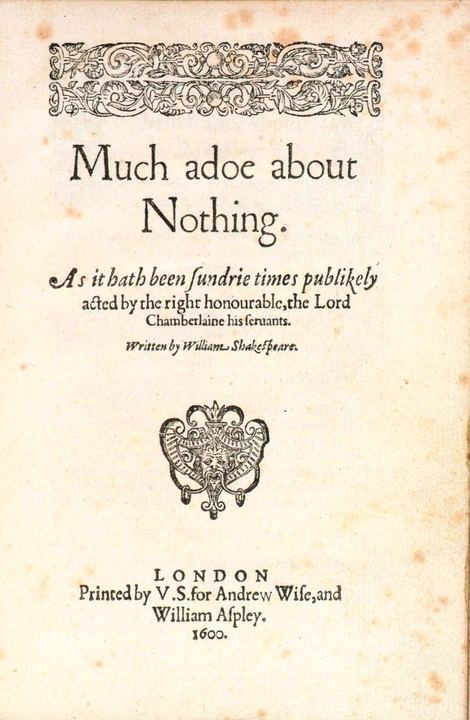
Much Ado About Nothing is set in Messina, Sicily, where the governor Leonato welcomes Don Pedro, Prince of Aragon, and his officers home from a victorious war. With the Prince come the young Florentine lord Claudio and the witty Paduan soldier Benedick, and also the Prince's sullen half-brother Don John, lately reconciled after a rebellion. Claudio falls at once for Leonato's daughter Hero, and Don Pedro offers to woo her on his behalf at a masked dance. Meanwhile Leonato's niece Beatrice resumes what her uncle calls a merry war with Benedick: both scorn love and marriage, and each takes every opportunity to mock the other. Don John, who confesses himself a plain-dealing villain, tries first to persuade Claudio that the Prince is wooing Hero for himself; the confusion is cleared and the wedding is fixed. To pass the week before it, Don Pedro proposes a labour of Hercules: to bring Benedick and Beatrice into a mountain of affection. In the orchard Benedick overhears the Prince, Claudio and Leonato say that Beatrice is dying of love for him, and resolves that the world must be peopled; Hero and her gentlewoman Ursula play the same trick on Beatrice, who bids farewell to contempt and maiden pride. Don John's follower Borachio then stages a deception: at night he courts Hero's gentlewoman Margaret at Hero's window, and Claudio and Don Pedro, watching from below, believe Hero false. The bumbling constable Dogberry and his Watch overhear Borachio boasting of the plot to Conrade and arrest them, but Dogberry is so long-winded that Leonato puts him off before the wedding. At the altar Claudio rejects Hero as a rotten orange and Don Pedro confirms the charge; Hero swoons, and Leonato wishes her dead. Friar Francis, convinced of her innocence, advises that she be reported dead so that Claudio may remember her truly. Alone in the church, Benedick and Beatrice confess their love, and Beatrice demands that he prove it: kill Claudio. Benedick challenges his friend. Dogberry's examination of the prisoners at last brings out the truth, Borachio confesses, and Don John is found to have fled. A grieving Claudio hangs an epitaph at Hero's tomb and agrees to marry Leonato's supposed niece unseen; when she unmasks, she is Hero. Benedick and Beatrice, exposed by love sonnets each has written to the other, agree to marry, Benedick silencing her with a kiss, and the play ends with a dance as word comes that Don John has been captured. The play was probably written in 1598-99, was printed in a quarto in 1600, and appeared again in the First Folio of 1623.
Virtues in this work
- Humility: Beatrice and Benedick each lay down their pride after hearing friends describe their scorn, and admit they were wrong about marriage.
- Friendship: Beatrice stands by her cousin Hero when the Prince, Claudio and even Leonato believe the slander.
- Justice: Benedick risks his friendship with Claudio and the Prince to challenge the man who shamed an innocent woman.
- Hope: Friar Francis reads Hero's innocence in her face and devises a plan to restore her name rather than despair at the altar.
Plot or Argument
- Act 1: Soldiers home in Messina
Leonato receives Don Pedro's company; Beatrice and Benedick renew their skirmish of wit; Claudio confides his love for Hero, and Don Pedro offers to woo her for him; Don John and his followers learn of the plan and resolve to spoil it.
- Act 2: The masked dance and the first plot
At the masked ball Beatrice tells the disguised Benedick what she thinks of him; Don John persuades Claudio that the Prince has wooed for himself, until Don Pedro presents Hero as Claudio's bride. Don Pedro plans to make Benedick and Beatrice fall in love; Borachio proposes the window deception; Benedick is gulled in the orchard while Balthasar sings Sigh no more.
- Act 3: Gullings, the window, and the Watch
Hero and Ursula gull Beatrice in the arbour. Don John tells Claudio that Hero is disloyal and promises proof. Dogberry instructs the Watch, who overhear Borachio boasting of the night's work at the window and arrest him and Conrade. Hero dresses for the wedding while Beatrice nurses a cold, and Dogberry fails to make Leonato listen.
- Act 4: The broken wedding
Claudio denounces Hero at the altar; she swoons, and Don John and the Prince leave. Friar Francis proposes to give out that she has died. Benedick and Beatrice declare their love, and she asks him to kill Claudio. In the prison Dogberry and the Sexton examine Borachio and Conrade, and Dogberry is called an ass.
- Act 5: Truth and two weddings
Leonato and Antonio confront Claudio; Benedick delivers his challenge; Borachio confesses before the Prince and Claudio. Claudio mourns at Hero's tomb and accepts Leonato's offer of a second bride, who unmasks as Hero; Benedick and Beatrice are betrayed by their sonnets, marry, and lead a dance.
Characters
- Beatrice, Leonato's niece
A quick-tongued, generous woman who mocks marriage and Benedick until she hears she is loved and that she is thought proud.
- Benedick, lord of Padua, soldier
A self-declared bachelor and wit who, once gulled, becomes a lover and a loyal champion of Beatrice's wronged cousin.
- Hero, Leonato's daughter
A gentle, mostly quiet young woman falsely accused of unchastity on her wedding day.
- Claudio, young lord of Florence
A brave but credulous young soldier who woos by proxy and believes the worst of Hero on slight evidence.
- Don Pedro, Prince of Aragon
A genial commander who arranges matches and is himself deceived by his brother.
- Don John, the Prince's half-brother
A sullen malcontent who makes mischief out of envy and flees when found out.
- Leonato, Governor of Messina
Hero's father and Beatrice's uncle, hospitable, then wild with shame and grief at the wedding.
- Dogberry, master constable
A self-important officer who mangles words but whose Watch uncovers the plot.
- Borachio, follower of Don John
Designs and carries out the window deception, then confesses it.
- Friar Francis, priest
Reads Hero's innocence in her face and proposes the feigned death.
- Margaret, Hero's gentlewoman
Unwittingly impersonates Hero at the window.
- Antonio, Leonato's brother
Joins Leonato in challenging Claudio and presents Hero as his supposed daughter.
Lessons
Seeing and believing
Almost everyone in the play acts on what they overhear or think they see. Benedick and Beatrice are deceived into a truth; Claudio and Don Pedro are deceived into a lie at Hero's window. The play asks what kind of evidence deserves our trust, and how quickly suspicion should become accusation.
- Why do the orchard deceptions lead to happiness while the window deception leads to disaster?
- What should Claudio have done after Don John's first lie about the Prince was exposed?
- Why does Friar Francis believe Hero when her father does not?
Wit and pride
Beatrice and Benedick are the best talkers in Messina, and their wit protects them from being hurt. When each hears friends describe their pride, they set it aside. Shakespeare suggests that cleverness can be a fortress against love until humility opens the gate.
- What does Beatrice hear about herself in Act 3, Scene 1 that changes her?
- Is Benedick's change of mind in the orchard a defeat or a growth?
- How is their speech to each other different in Act 4, Scene 1?
Honor and a slandered name
Hero's reputation is destroyed in a public moment by men who believe they are defending honor. The play shows how slander works, how shame leaves the accused almost wordless, and how the truth comes out through the humblest officers in the city.
- Why does Leonato believe the accusation against his own daughter?
- What does the Friar hope Hero's reported death will accomplish?
- Is Claudio's penance at the tomb enough?
Fools who find the truth
Dogberry cannot say what he means, yet his Watch catches the villains that the Prince and his lords cannot see. The comedy echoes Paul's teaching that God chooses the foolish things of the world to confound the wise.
- Why does Leonato fail to listen to Dogberry before the wedding?
- What makes Dogberry funny, and what makes him useful?
Context
Shakespeare set the play in Messina, then under the Spanish crown of Aragon, among soldiers returning from an unnamed war. The plot of a lady falsely shown to be unfaithful by a servant dressed in her clothes at a window had wide currency in Renaissance Europe: it appears in Ariosto's Orlando Furioso (Canto V, translated into English by Sir John Harington in 1591) and in one of Matteo Bandello's novelle, which François de Belleforest retold in French. The Beatrice-Benedick plot appears to be Shakespeare's own.
Composition
Much Ado was probably written in 1598-99. It is not in Francis Meres's list of Shakespeare's plays published in 1598, and the quarto of 1600 names Will Kemp and Richard Cowley in speech prefixes for Dogberry and Verges, which shows the parts were written for those actors of the Lord Chamberlain's Men. The quarto was entered in the Stationers' Register in August 1600; the First Folio text of 1623 follows it closely.
Reception
The play has stayed popular chiefly for Beatrice and Benedick, whose sparring influenced English stage comedy from the Restoration onward; Charles I reportedly wrote their names beside the title in his copy of the Second Folio. Hector Berlioz based his opera Béatrice et Bénédict (1862) on it, and it has been filmed several times, notably by Kenneth Branagh in 1993.
Comparisons
- romeo-and-juliet
Both plays are set in Italian cities and turn on a Friar's plan to give out that a young bride is dead; in Verona the scheme ends in tragedy, in Messina it leads to marriage.
- the-taming-of-the-shrew
Katherina and Petruchio are an earlier pair of sharp-tongued lovers; Beatrice and Benedick are brought together by friends and their own choice rather than by one partner's campaign.
- twelfth-night
Both comedies contrast a melancholy plotter with a festive household and use letters and overhearing to expose self-love, in Malvolio's case and in Benedick's.
- pride-and-prejudice
Elizabeth Bennet and Darcy, like Beatrice and Benedick, begin in mutual scorn and must each give up pride before they can love.
- tales-from-shakespeare
Charles and Mary Lamb retell the Hero and Claudio story for young readers; comparing the retelling with the play shows what Dogberry and the prose wit add.
Quotes
Frequently cited
“There is a kind of merry war betwixt Signior Benedick and her; they never meet but there’s a skirmish of wit between them.”
Frequently cited
“the world must be peopled. When I said I would die a bachelor, I did not think I should live till I were married.”
Frequently cited
“I love you with so much of my heart that none is left to protest.”
Frequently cited
“O that he were here to write me down an ass!”
“Contempt, farewell! and maiden pride, adieu! No glory lives behind the back of such.”
“Give not this rotten orange to your friend;”
“Come, lady, die to live: this wedding day Perhaps is but prolong’d: have patience and endure.”
“man is a giddy thing, and this is my conclusion.”
For Students
A reading companion for classical Christian high school students. See the student guide.
Reading Guide
Watch for
- Every scene in which someone overhears or watches in secret: the orchard, the arbour, Hero's window, and the Watch in the street.
- How Beatrice and Benedick shift from prose jousting to plain, short sentences when they are alone in the church in Act 4, Scene 1.
- Don John's few lines in Act 1, Scene 3, where he explains why he will not pretend to be cheerful.
- Dogberry's misused words, and how often what he says by accident is truer than what he means.
- The Friar's reasoning in Act 4, Scene 1 about how Claudio will remember Hero once he hears she has died.
Key terms and names
- Messina
- The Sicilian port city, ruled from Aragon, where Leonato is governor and the whole play takes place.
- Gulling
- Tricking someone for sport; Don Pedro's friends gull Benedick and Hero's women gull Beatrice by letting them overhear staged conversations.
- The Watch
- Messina's night constables under Dogberry and Verges, who arrest Borachio and Conrade.
- Malapropism
- Using a wrong word that sounds like the right one; Dogberry says odorous for odious and calls the arrested men aspicious when he means suspicious.
- Noting
- In Shakespeare's pronunciation nothing and noting sounded alike, so the title also hints at a play about watching, overhearing and taking note.
- Epitaph
- The verses Claudio hangs at Hero's supposed tomb in Act 5, Scene 3, mourning a lady done to death by slander.
Seminar Questions
- Comprehension How does Don John's first attempt to make trouble fail, and how does his second succeed?
- Comprehension What exactly do Claudio and Don Pedro see at Hero's window, and who is really there?
- Comprehension How is the truth about the plot finally brought to Leonato and Claudio?
- Interpretation Why does Beatrice ask Benedick to kill Claudio, and why does Benedick agree to challenge him?
- Interpretation Both Benedick and Claudio change their minds about a woman because of what they overhear. What makes one change good and the other cruel?
- Interpretation Hero says very little in the play. What does her silence at the altar and her speech in Act 4, Scene 1 tell us about her?
- Big Question How should a person respond to an accusation against someone they love when the evidence seems strong?
- Big Question Can a marriage built on a trick, like Beatrice and Benedick's, be a true marriage?
Faith Connections
- Proverbs 18:17 (Scripture)
He that is first in his own cause seemeth just; but his neighbour cometh and searcheth him. Claudio condemns Hero on Don John's word without letting her answer, and only a searching examination clears her.
- 1 Corinthians 1:27 (Scripture)
God hath chosen the foolish things of the world to confound the wise. The Prince and his lords are fooled, while Dogberry's bumbling Watch uncovers the truth.
- 1 Corinthians 13:7 (Scripture)
Charity believeth all things, hopeth all things. Beatrice and the Friar trust Hero against appearances; Claudio's love fails this test.
- Thomas Aquinas, Summa Theologiae II-II, q. 60 (Great Conversation)
Aquinas treats rash judgment as an injustice: suspicion should not pass into condemnation without sufficient cause, and doubts should be read in the best light. Claudio's public accusation is a dramatic study of exactly this fault.
Logic and Rhetoric
Central argument: Every character acts on what he overhears or sees. Those who listen with charity, like Beatrice and the Friar toward Hero, or with humility, like Benedick and Beatrice toward their own faults, find the truth. Those who listen with suspicion and wounded pride, like Claudio and Don Pedro, are deceived. Therefore the play argues that right judgment depends less on the eye than on the disposition of the heart.
Rhetorical device: malapropism. Dogberry's Comparisons are odorous in Act 3, Scene 5 and his wish to be written down an ass in Act 4, Scene 2 (quote 6) turn his pride in his office into comedy.
Debate: Resolved: that Claudio's public rejection of Hero at the altar is less forgivable than Don John's plot.
Memory Work
Contempt, farewell! and maiden pride, adieu! No glory lives behind the back of such.
Come, lady, die to live: this wedding day Perhaps is but prolong’d: have patience and endure.
Writing Prompts
Essay: The title can be heard as Much Ado About Noting. Argue how watching, overhearing and misreading drive both plots, using the orchard, the window and the Watch.
Comparison with Romeo and Juliet: Friar Francis and Friar Laurence both plan that a young bride should be thought dead. Compare their plans, their reasons and their results, and argue why one comedy and one tragedy grow from the same device.
Medical Lens
The play is not medical, but it uses the period's humoral and astrological language of temperament. Don John refuses the moral medicine of patience offered by Conrade, who says he was born under Saturn (the planet of the melancholy humour), and insists that he must be sad when he has cause; Beatrice, by contrast, says that a star danced when she was born. Hero's swoon at the altar and the Friar's plan to publish her death rely on the uncertainty of a faint as a sign of death, a motif Shakespeare uses also in Romeo and Juliet. Margaret's prescription of Carduus benedictus (holy thistle) for Beatrice's cold reflects common herbal practice, and Leonato's remark that no philosopher ever endured the toothache patiently questions Stoic consolation in the face of pain and grief.
- Act 1, Scene 3
Don John rejects Conrade's counsel of patient sufferance, which he calls a moral medicine, and insists on showing his sadness.
- Act 3, Scene 4
Margaret recommends distilled Carduus benedictus for Beatrice's cold, with a pun on Benedick.
- Act 4, Scene 1
Hero swoons after the accusation; the Friar proposes reporting her dead.
- Act 5, Scene 1
Leonato rejects Antonio's counsel of patience, saying no philosopher has borne the toothache patiently.
Listen to the book
Public-domain audiobook from LibriVox, read by Various volunteers. Recording: Much Ado About Nothing (version 2) on LibriVox (Internet Archive).
LibriVox recordings are volunteer readings released into the public domain. The reading may follow a different edition from the text in this library.
Creative Prompts
- Classroom
Stage the two orchard scenes (Act 2, Scene 3 and Act 3, Scene 1) side by side, with the hidden listener visible to the audience, and compare how each eavesdropper reacts.
- Dialogue
Write the conversation between Hero and Beatrice on the night after the broken wedding, before either knows the truth will come out.
- Essay
Is Claudio worthy of Hero at the end of the play? Weigh his conduct at the altar against his penance at the tomb.
- Fiction
Write Dogberry's official report of the arrest of Borachio and Conrade, in his own mangled vocabulary.
Further Reading
- Twelfth Night, William Shakespeare
- Orlando Furioso, Ludovico Ariosto
Canto V contains the story of Ginevra and the disguised maid at the window.
- Shakespeare's Festive Comedy, C. L. Barber
- Tales from Shakespeare, Charles and Mary Lamb
Verification notes
Plot, characters and act-scene structure are standard. The attached Gutenberg text prints scene headings only for Act 3, Scenes 1-2 and Act 4, Scene 1, so the quotes from Act 4, Scene 2 and Act 5, Scene 4 are located by standard modern editions. Source attributions (Ariosto, Bandello, Belleforest), the Kemp and Cowley speech prefixes, the 1600 quarto and the absence from Meres's 1598 list are standard editorial facts. All eight quotes were found verbatim in content/texts/much-ado-about-nothing.txt.
- The anecdote that Charles I wrote 'Benedik and Betrice' beside the title in his Second Folio.