Work record
The Adventures of Pinocchio
1881-1883 (Italian; book 1883) · 19th Century · Novel · Italian
Abstract
Background. Lorenzini, a Florentine journalist writing as Collodi, began the tale as a weekly feature for a new Italian children's paper, a few years after school attendance became compulsory in the young kingdom.
Plot. A puppet carved by a penniless father skips school, falls in with swindlers, is hanged from an oak and revived, and finds that every lie lengthens his nose. Cycles of repentance and relapse carry him to prison, a chicken coop, a schoolroom brawl, and a land of endless play, where he and his friend grow long ears and become beasts of burden. Swallowed at sea, he discovers Geppetto alive inside the monster and carries him home.
Structure. Episodic chapters, each opened by a headnote, alternate temptation and rescue, and the same tempters and helpers return in new guises. The narrator often speaks to his child listeners directly, teasing them and asking them to guess.
Themes. Obedience and filial love, the cost of idleness, truthfulness, deceit by flatterers, poverty and hunger in rural Tuscany, and growth from self-will into generous labour.
Significance. Among the most translated books of any kind, it gave the world the long-nosed liar as a proverbial figure. The 1940 Disney film spread the story further, while Italian readers prize the original's sharper satire and its picture of post-unification village life.
Main characters
- Pinocchio: Wooden marionette, kind at heart but idle and gullible
- Geppetto: Impoverished old woodcarver who makes him and loves him
- The Fairy with Azure Hair: Blue-haired rescuer who acts as his sister and then mother
- The Talking Cricket: Unwelcome adviser whose warnings prove correct
- The Fox and the Cat: Pair of tricksters who covet his gold coins
- Lamp-Wick: Lazy schoolmate who leads him to the Land of Toys
- Fire Eater: Puppet-show master whose sneezes signal mercy
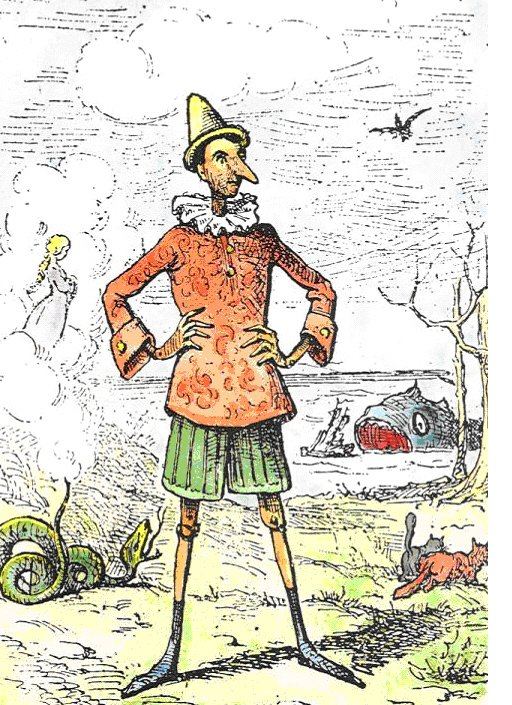

Summary
In a Tuscan village the carpenter Mastro Cherry finds a log that cries out when he strikes it, and gladly hands it to his poor friend Geppetto, who carves it into a marionette and names him Pinocchio. The puppet runs off before his feet are finished, gets Geppetto taken to jail, and kills the Talking Cricket with a hammer when it warns him that disobedient boys come to grief. Hungry and alone, he burns his feet off on a foot warmer; Geppetto comes home, gives him his own three pears, carves new feet, and sells his only coat to buy him a spelling book. Pinocchio sells the book for a ticket to the puppet show. The showman Fire Eater means to burn him for firewood but sneezes with pity and sends him home with five gold pieces for his father. On the road the Fox and the Cat, pretending to be lame and blind, lure him toward the Field of Wonders, where buried coins are said to grow into trees of gold; disguised as assassins, they hang him from a great oak. The Fairy with Azure Hair rescues him, summons three doctors, and coaxes him into his medicine; when he lies, his nose grows. Robbed at last of his gold, he is jailed by a gorilla judge for being the victim. Through a long chain of episodes, as a farmer's watchdog, mourner at the Fairy's grave, worker on the Island of the Busy Bees, schoolboy fighting on the beach, and fish almost fried by the Green Fisherman, he keeps promising to be good and keeps failing. On the very eve of becoming a real boy he runs off with his idle friend Lamp-Wick to the Land of Toys, where after five months of play both turn into donkeys. Sold to a circus, lamed, and thrown into the sea to be skinned for a drum, Pinocchio is freed by fishes and swallowed by the Terrible Shark, inside which he finds Geppetto, who has lived there two years by candlelight. He carries his father out on his back, is helped ashore by a Tunny, and for months draws water and weaves baskets to buy milk for the old man, studying at night. When he gives his savings for a new suit to the Fairy, who is ill and poor, he wakes to find himself a real boy and Geppetto restored. Collodi published the story in instalments in the children's weekly Giornale per i bambini from July 1881 to January 1883; it appeared as a book in February 1883, published in Florence by Felice Paggi with drawings by Enrico Mazzanti. The library text is Carol Della Chiesa's 1926 English translation.
Virtues in this work
- Piety: After rescuing Geppetto from the Shark, Pinocchio draws a hundred buckets of water every morning to buy milk for his weak father.
- Charity: Hearing that the Fairy is ill and penniless, Pinocchio gives the Snail the fifty pennies he had saved for a new suit.
- Industry: On the Island of the Busy Bees he learns that bread must be earned, and in the last chapter he weaves baskets late into the night.
- Prudence: Pinocchio's belief that buried gold coins will grow into a money tree costs him his father's five gold pieces and four months in jail.
Plot or Argument
- The talking log and the runaway puppet (Chapters 1-8)
Mastro Cherry's speaking log becomes Geppetto's marionette. Pinocchio flees, kills the Talking Cricket with a thrown hammer, burns his feet while sleeping hungry by the fire, and is forgiven: Geppetto feeds him his breakfast pears, makes him new feet, and sells his coat for an A-B-C book.
- The puppet theater and Fire Eater (Chapters 9-12)
Pinocchio trades the schoolbook for a theater ticket, is recognized by the other marionettes, and is nearly thrown on the fire by the showman Fire Eater, who instead sneezes, spares him and Harlequin, and gives him five gold pieces for Geppetto.
- The Fox, the Cat, and the hanging (Chapters 12-15)
The pretended lame Fox and blind Cat lead him to the Inn of the Red Lobster and then, disguised as Assassins, chase him through the night and hang him from the Big Oak because he has hidden the coins in his mouth.
- The Fairy, the doctors, and the growing nose (Chapters 16-17)
The Fairy with Azure Hair has him cut down, calls the Crow, the Owl, and the Talking Cricket to judge whether he is dead, and wins him to his medicine only when four black rabbits arrive with a coffin. His lies about the gold make his nose grow until woodpeckers peck it back.
- The Field of Wonders and its consequences (Chapters 18-23)
In the City of Simple Simons he buries his coins, a Parrot laughs at him, and the gorilla judge jails him for four months. Freed, he is trapped stealing grapes, serves as a farmer's watchdog, refuses the bribe of thieving Weasels, and returns to find a gravestone saying the Fairy died of grief; a Pigeon carries him to the shore where Geppetto is lost at sea.
- The Island of the Busy Bees and school (Chapters 24-29)
He finds the Fairy grown into a woman, promises to work and study, and does well until classmates lure him to the beach with a false tale of a shark; a thrown book wounds Eugene, he flees two Carabineers, is nearly fried by the Green Fisherman, and returns to be forgiven and promised that tomorrow he will become a boy.
- The Land of Toys and the donkey fever (Chapters 30-33)
Lamp-Wick persuades him to ride the coach of the oily Little Man to a country without schools. After five months of play both grow donkey ears, are sold, and Pinocchio is trained for the circus until he goes lame and is bought for his hide.
- Inside the Shark and the end of the marionette (Chapters 34-36)
Thrown into the sea, he becomes a puppet again and is swallowed by the Terrible Shark, where he finds Geppetto. He swims him to land with the Tunny's help, works daily for the old man's milk, gives his savings to the sick Fairy, and wakes as a real boy beside the limp wooden puppet he used to be.
Characters
- Pinocchio, protagonist
A marionette carved from a talking log, good-hearted but idle, boastful, and easily led, whose nose grows when he lies.
- Geppetto, father
A poor old woodcarver who makes Pinocchio, sells his coat for his schoolbook, and searches the sea for him.
- The Fairy with Azure Hair, guardian
First a little girl, then a woman and a mother to Pinocchio, who rescues, rebukes, forgives, and finally rewards him.
- The Talking Cricket, counselor
The voice of plain advice, killed by Pinocchio in Chapter 4 but returning as a doctor's ghost and finally as the landlord of the hut in Chapter 36.
- The Fox and the Cat, villains
Swindlers who fake lameness and blindness to lure Pinocchio to the Field of Wonders and later rob and hang him.
- Lamp-Wick, bad companion
The laziest boy in school, who leads Pinocchio to the Land of Toys and dies a worn-out donkey.
- Fire Eater, showman
The fierce bearded director of the puppet theater who sneezes whenever he is moved to pity.
- Mastro Cherry, carpenter
Geppetto's neighbor, nicknamed for his red nose, who first finds the talking piece of wood.
- The Tunny, helper
A philosophical fish swallowed with Pinocchio, who carries him and Geppetto to shore.
Lessons
Promises are kept in deeds, not in good feelings
Pinocchio repeatedly weeps, resolves to be good, and runs off again the same day, as when he sells the spelling book Geppetto bought with his coat. Only in the last chapter, when he draws a hundred buckets of water every morning for his father's milk, does a resolution become a habit. Collodi shows that a changed heart is proved by steady work over months.
- How many times does Pinocchio promise to be good? Which promise does he finally keep?
- Why is drawing water every morning harder than making a promise?
- What is the difference between feeling sorry and becoming better?
Easy riches and easy pleasures are traps
The Field of Wonders promises two thousand gold pieces for burying four, and the Land of Toys promises a year of Saturdays. Both are offered by smiling strangers, and both end with Pinocchio poorer and worse off: jailed for being robbed, and turned into a donkey for doing nothing but play.
- Why does Pinocchio believe the Fox and the Cat?
- How is the Land of Toys like the Field of Wonders?
- What warning signs could Pinocchio have noticed about the Little Man's coach?
A father's love goes ahead of the son's repentance
Geppetto forgives Pinocchio for his first escape before he asks, gives him his breakfast, sells his coat in winter, and later sets out to sea to find him. When Pinocchio finds him inside the Shark, the old man asks only whether this is really his own dear boy. The book's happiest scene is a reunion of father and son.
- What does Geppetto give up for Pinocchio in the first eight chapters?
- How does Pinocchio finally repay his father?
- Why do you think Collodi puts the reunion inside the belly of a great fish?
Lies grow and good advice is often unwelcome
Pinocchio's nose grows with each lie until he cannot turn around in the room, and the Fairy tells him that lies are easy to spot. The Talking Cricket is right about everything and is killed for saying so, yet his warnings follow Pinocchio until the end.
- Why does Pinocchio throw the hammer at the Talking Cricket?
- What happens to the nose each time Pinocchio tells a lie about the gold pieces?
- Who in your life tells you things you would rather not hear, and why are they worth listening to?
Context
Pinocchio was written in Florence two decades after Italian unification, in a Tuscany of carpenters, peasants, carabinieri, travelling puppet shows, and village schools. The new Italian state was trying to make a nation of readers, and the 1877 Coppino law had made elementary schooling compulsory; Collodi had already written school readers. His puppet comes from the tradition of the commedia dell'arte, whose masks Harlequin and Punchinello appear in Fire Eater's theater, and his story mixes Tuscan folk tale, fable, and the moral tale for children.
Composition
The story began on 7 July 1881 in the first issue of the Giornale per i bambini, a weekly for children edited by Ferdinando Martini, under the title La storia di un burattino. Instalments ran until 25 January 1883, and the book, Le avventure di Pinocchio: Storia di un burattino, was published in Florence by Felice Paggi in February 1883 with illustrations by Enrico Mazzanti. Carol Della Chiesa's English translation, used here, appeared in 1926.
Reception
Pinocchio became the most widely read Italian book in the world and one of the most translated of all children's books. Walt Disney's animated film of 1940 made the puppet familiar everywhere, though it softened Collodi's harsher episodes. In Italy the book is read both as a children's adventure and as a portrait of the poor Tuscan countryside and the newly united nation.
Comparisons
- the-velveteen-rabbit
Both stories are about a toy that longs to be real. Margery Williams's rabbit becomes Real through being loved, while Collodi's marionette becomes a boy only after he learns to love and work for others.
- the-pilgrims-progress
The Land of Toys plays the part of Bunyan's Vanity Fair and By-path Meadow, and the Fox and the Cat are Pinocchio's Flatterers; both books are journeys of repeated temptation, rescue, and arrival.
- the-wonderful-wizard-of-oz
Two journey fairy tales of the late nineteenth century in which a child meets talking animals and humbug; Dorothy wants to get home, Pinocchio must learn to make a home for his father.
- the-adventures-of-tom-sawyer
Twain's Tom and Collodi's puppet are both truants who love play and showing off, but Tom's mischief is treated as charming boyhood while Pinocchio's has to be outgrown.
- confessions
Augustine's account of putting off conversion with the words not yet mirrors Pinocchio's repeated promise to start being good tomorrow; both describe a will divided against itself.
Quotes
Frequently cited
“No, children, you are mistaken. Once upon a time there was a piece of wood.”
Frequently cited
“Lies, my boy, are known in a moment. There are two kinds of lies, lies with short legs and lies with long noses.”
Frequently cited
“How ridiculous I was as a Marionette! And how happy I am, now that I have become a real boy!”
“Woe to boys who refuse to obey their parents and run away from home! They will never be happy in this world, and when they are older they will be very sorry for it.”
“I say that a wise doctor, when he does not know what he is talking about, should know enough to keep his mouth shut.”
“Boys ought to know, after all, that medicine, taken in time, can save them from much pain and even from death.”
“In the Land of Toys, every day, except Sunday, is a Saturday.”
“When bad boys become good and kind, they have the power of making their homes gay and new with happiness.”
For Students
A reading companion for classical Christian high school students. See the student guide.
Reading Guide
Watch for
- Every time Pinocchio says he will be good starting tomorrow, and what happens next.
- What Geppetto gives up for Pinocchio: his breakfast, his coat, and finally his safety at sea.
- Pinocchio's nose in Chapter 17, and what makes it grow.
- The Talking Cricket, who is killed in Chapter 4 but keeps coming back.
- How Pinocchio spends his fifty pennies in the last chapter.
Key terms and names
- Marionette
- A puppet worked by strings; Pinocchio is a wooden marionette who can walk and talk without them.
- Field of Wonders
- The make-believe field near the City of Simple Simons where the Fox and the Cat say buried gold coins will grow into a tree of money.
- Land of Toys
- The country with no schools or books where Lamp-Wick and Pinocchio play for five months and turn into donkeys.
- Fairy with Azure Hair
- Pinocchio's rescuer, with hair the color of a blue sky, who becomes like a mother to him.
- Terrible Shark
- The huge sea monster, as Della Chiesa's translation names it, that swallows Geppetto and then Pinocchio.
- Carabineer
- An Italian military policeman; a Carabineer catches the runaway puppet by his long nose in Chapter 3, and two arrest Pinocchio after the beach fight.
Seminar Questions
- Comprehension What does Geppetto sell to buy Pinocchio a spelling book, and what does Pinocchio do with the book?
- Comprehension What do the Fox and the Cat tell Pinocchio will happen if he buries his gold in the Field of Wonders?
- Comprehension Who does Pinocchio find inside the Terrible Shark, and how do they get out?
- Interpretation Why do you think Pinocchio's nose grows when he lies, instead of some other part of him changing?
- Interpretation The boys in the Land of Toys turn into donkeys. Why donkeys? What is Collodi saying about boys who never learn?
- Interpretation Pinocchio becomes a real boy after he gives his money to the sick Fairy, not after he does well in school. Why does the story end that way?
- Big Question What makes someone a real person: what they are made of, or how they love and act?
Faith Connections
- Luke 15:11-32 (Scripture)
The prodigal son spends his inheritance, tends swine, and comes home to a father who runs to meet him. Pinocchio wastes Geppetto's gold pieces and ends up among donkeys before finding his father again.
- Jonah 1:17-2:10 (Scripture)
Jonah is swallowed by a great fish after running from his duty and is brought out alive. Pinocchio's rescue of Geppetto from inside the Shark echoes this story of deliverance from the deep.
- Proverbs 12:19 (Scripture)
The lip of truth is established for ever, but a lying tongue is but for a moment. The Fairy tells Pinocchio that lies are known at once, and his nose shows it.
- Augustine, Confessions VIII (Church Fathers)
Augustine describes praying for virtue but adding not yet, and his will being divided against itself. Pinocchio's endless promise to start being good tomorrow is the same divided will in a child's story.
Logic and Rhetoric
Central argument: A boy who follows his appetites becomes less than a boy, as the Land of Toys turns idle children into donkeys. A boy who works, tells the truth, and cares for others grows into a real person. Pinocchio becomes a real boy only when he works for his father and gives away his savings, so being fully human is a matter of love shown in deeds.
Rhetorical device: direct address to the reader. The first chapter opens by correcting the children who expect a king, and later chapters call out to my dear children or invite them to guess what Pinocchio finds inside the Shark.
Debate: Resolved: that the Fairy was right to let Pinocchio suffer the results of his choices instead of always rescuing him.
Memory Work
Lies, my boy, are known in a moment. There are two kinds of lies, lies with short legs and lies with long noses.
How ridiculous I was as a Marionette! And how happy I am, now that I have become a real boy!
Writing Prompts
Essay: Pinocchio has many bad companions and several good guides. Choose one of each, such as the Fox and the Talking Cricket, and explain how each one changes what Pinocchio does.
Comparison with The Velveteen Rabbit: Both the Velveteen Rabbit and Pinocchio become real at the end. Compare how each one becomes real, and whose love makes the difference.
Medical Lens
Pinocchio is a comic book, but medicine and hunger run through it. The consultation of the Crow, the Owl, and the Talking Cricket in Chapter 16 belongs to the old satirical tradition, familiar from Molière, of learned physicians who contradict each other with confident nonsense: one pronounces the patient dead unless he is alive, the other alive unless he is dead. Chapter 17 is a small fable of medication refusal, in which a child bargains for sugar, refuses the bitter draught, and complies only when the undertakers arrive. Hunger is the book's constant background in a poor Tuscan household: Pinocchio burns his feet asleep by the fire after a failed attempt at an omelet, Geppetto gives up his three pears, and the donkey Lamp-Wick dies worn out from hunger and work. The book also contains feigned disability (the Fox's pretended lameness and the Cat's pretended blindness, the Cat's blindness becoming real in the last chapter), the comic donkey fever diagnosed by a Dormouse who takes the pulse, and a son's months of caregiving for a weak old father restored by daily milk. These are moral and comic devices, not clinical observations, and should be read as such.
- Chapter 16
The Fairy calls three doctors, a Crow, an Owl, and the Talking Cricket, to decide whether the hanged puppet is alive; the first two give circular verdicts and the Cricket answers with a moral diagnosis instead.
- Chapter 17
Feverish Pinocchio refuses his bitter medicine until four black rabbits bring a coffin for him; he swallows it and recovers at once.
- Chapters 5-7
Alone and starving, Pinocchio searches the house for food, falls asleep with his feet on the foot warmer, and wakes with them burned off; Geppetto feeds him his own pears.
- Chapters 12 and 36
The Fox and the Cat feign lameness and blindness to win sympathy; at the end the Cat has truly lost his sight and the starving Fox has sold his own tail for food.
- Chapter 32
A Dormouse feels Pinocchio's pulse and diagnoses the donkey fever that turns lazy boys into donkeys.
- Chapter 36
Pinocchio draws water each dawn to earn milk for his weak father, builds him a wheeled chair, and finds his friend Lamp-Wick dying as an overworked donkey.
Listen to the book
Public-domain audiobook from LibriVox, read by Mark F. Smith, translated by Carol Della Chiesa. Recording: Adventures of Pinocchio (version 2) on LibriVox (Internet Archive).
LibriVox recordings are volunteer readings released into the public domain. The reading may follow a different edition or translation from the text in this library.
Creative Prompts
- Classroom
Act out the three doctors' visit from Chapter 16: one student is the Crow, one the Owl, one the Talking Cricket, and the class decides which doctor they would trust and why.
- Fiction
Write the letter Pinocchio might have sent to Lamp-Wick after the first week in the Land of Toys, and then the one he would write after the donkey ears appear.
- Essay
Choose three of Pinocchio's promises to be good and explain why each one failed, and what was different about the one he kept in Chapter 36.
- Adaptation
Make a picture map of Pinocchio's journey, from Geppetto's room through the Field of Wonders and the Island of the Busy Bees to the inside of the Shark, marking where he made each promise.
Further Reading
- The Adventures of Pinocchio: Story of a Puppet (bilingual edition), Carlo Collodi, trans. Nicolas J. Perella
Italian and English on facing pages, with a long introduction.
- The Adventures of Pinocchio, Carlo Collodi, trans. Ann Lawson Lucas
A modern annotated translation with notes on Tuscan life and Collodi's career.
- Italian Folktales, Italo Calvino
Collected Italian tales that show the folk world Pinocchio draws on.
- The Velveteen Rabbit, Margery Williams
Another toy who longs to become real.
Verification notes
Serial and book dates confirmed at https://en.wikipedia.org/wiki/The_Adventures_of_Pinocchio: instalments in the Giornale per i bambini from 7 July 1881 to 25 January 1883, book from Felice Paggi, Florence, February 1883, with Enrico Mazzanti's illustrations. The serial is widely reported to have first stopped at the hanging (now Chapter 15) and resumed by popular demand; the record does not depend on that. Ferdinando Martini as editor of the Giornale and the 1877 Coppino schooling law are standard facts but were not separately checked. Della Chiesa uses English names (Mastro Cherry, the City of Simple Simons, the Terrible Shark, Lamp-Wick, Farmer John) that differ from other translations, which call the sea creature a dogfish or whale and the city Catchfools. All quotations were checked by exact search against content/texts/the-adventures-of-pinocchio.txt.
No verification flags recorded.