Work record
Uncle Tom's Cabin
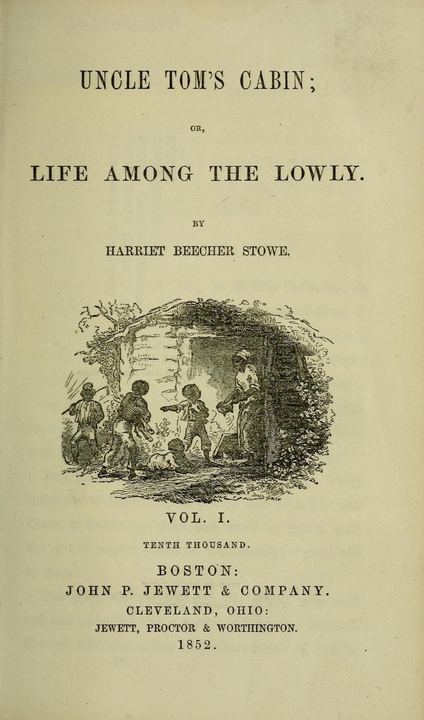
1852 (serialized 1851-52) · 19th Century · Novel · English
Abstract
Background. Stowe, a minister's daughter who had spent eighteen years in Cincinnati on the border of slave territory, began the book in Maine in response to the federal Fugitive Slave Act of 1850. Gamaliel Bailey's antislavery paper printed it weekly before Jewett issued it in Boston.
Plot. A debt-ridden Kentucky planter sells two of his people. The child's mother escapes north over the ice-choked Ohio, is passed among sympathizers and Quakers, and joins her husband for the run to Canada. Tom goes south, rescues a small girl on a river steamer, and serves her father in New Orleans until both father and daughter die. Auctioned to a Louisiana brute, he shields two women who hide and flee, and is flogged to death.
Method. Stowe interrupts the story to speak to her readers, alternates scenes of comedy and anguish, and renders Kentucky and Louisiana speech in dialect. She closes by insisting that its incidents had counterparts in fact.
Themes. The sanctity of the family, the soul's freedom under bondage, Christian forgiveness and martyrdom, and the guilt shared by North and South.
Significance. The century's best-selling American novel stirred Northern opinion in the decade before the Civil War, provoked angry Southern rejoinders, and was staged and translated across the world.
Main characters
- Uncle Tom: Devout enslaved man sold south, who dies forgiving his tormentors
- Eliza Harris: Mother who escapes with her boy over the frozen river
- George Harris: Her husband, a fugitive mechanic who defends his family
- Eva St. Clare: Saintly child who befriends Tom and dies of consumption
- Augustine St. Clare: Ironic New Orleans master who delays Tom's freedom
- Miss Ophelia: Upright Vermont cousin who learns to love Topsy
- Topsy: Untaught, impish girl transformed by Eva's affection
- Simon Legree: Cruel cotton planter who has Tom flogged to death
- Cassy: Legree's captive, broken by loss, later reunited with Eliza
- George Shelby: Tom's young friend, who frees his own slaves

Summary
Uncle Tom's Cabin follows two lines of story that begin on the Kentucky farm of Arthur Shelby, a kindly but indebted master who agrees to sell two slaves to the trader Haley: Uncle Tom, his faithful and devout manager, and Harry, the small son of Eliza, Mrs. Shelby's maid. Overhearing the bargain, Eliza flees north with Harry that night, and with the slave-catchers close behind she crosses the Ohio River by leaping from one floating cake of ice to another. In Ohio she is sheltered by Senator Bird, who has just voted for a law against aiding fugitives but cannot turn away a mother and child, and then by a Quaker settlement, where she is reunited with her husband George Harris, an inventive young man who has escaped a cruel master. Pursued by the slave-hunters Tom Loker and Marks, the family defends itself at a rocky pass, wounds Loker, has him nursed by the Quakers, and at last crosses Lake Erie to freedom in Canada. Tom, meanwhile, refuses to run so that the Shelbys will not be ruined, parts from his wife Aunt Chloe and their children, and is carried down the Mississippi. On the steamboat he saves Eva St. Clare, a fair and spiritually luminous child, from drowning, and her father Augustine buys him. In the St. Clare household in New Orleans Tom lives among Augustine's self-pitying wife Marie, his conscientious Vermont cousin Miss Ophelia, and Topsy, a neglected girl who says she was never born but just grew. Eva's love wins Topsy's heart, while Eva herself wastes slowly from consumption; before dying she gives locks of her hair to the household servants and begs her father to free Tom. St. Clare, a skeptic softened by grief, begins the legal papers but is stabbed while trying to part two quarrelling men in a café and dies before completing them. Marie sells Tom at auction to Simon Legree, a brutal cotton planter on the Red River. There Tom meets Cassy, Legree's despairing concubine, and the young Emmeline, and keeps his faith through overwork and beatings. When Cassy and Emmeline escape by hiding in the garret, which Legree fears is haunted, Tom refuses to betray them, and Legree has him beaten to death by the drivers Sambo and Quimbo, whom Tom forgives and who are moved to repentance. George Shelby, his old master's son, arrives too late to redeem him and buries him. Returning to Kentucky, George frees all his slaves in Tom's name. Cassy proves to be Eliza's mother, and the reunited family sail for Liberia. First serialized in the National Era from June 1851 to April 1852, the novel appeared in two volumes in Boston in March 1852 and became the best-selling American novel of the nineteenth century.
Virtues in this work
- Faith: Tom tells Legree that his soul belongs to Christ and keeps his trust through the beatings of Chapters XXXIII and XL.
- Charity: Eva's love for Topsy and Tom's forgiveness of Sambo and Quimbo turn hard hearts to repentance.
- Fortitude: Eliza leaps across the floating ice of the Ohio with her son in her arms to save him from sale.
- Justice: George Shelby frees every slave on his Kentucky farm in Tom's memory.
- Hope: Tom passes through despair on Legree's plantation to a renewed hope of heaven in Chapter XXXVIII.
Plot or Argument
- Chapters I-VIII: The sale and the flight
Shelby sells Tom and Harry to Haley to pay his debts. Eliza escapes with her son and crosses the icy Ohio while Sam and Andy slyly delay the pursuit; Tom stays behind to spare his master and says goodbye to Aunt Chloe and the children.
- Chapters IX-XVII: Ohio and the Quakers
Senator Bird and his wife hide Eliza against his own vote. Eliza reaches the Quaker settlement of Rachel and Simeon Halliday, where George Harris joins her; the family fights off Loker's posse at the rocks, and George declares himself a free man on God's soil.
- Chapters XII-XIV: Down the river
On Haley's boat Tom sees Lucy, a mother whose infant has been sold, drown herself in despair. He rescues Eva St. Clare when she falls overboard, and her father buys him.
- Chapters XV-XXVII: The St. Clare household
In New Orleans Miss Ophelia struggles to manage the household and to reform Topsy, while St. Clare argues brilliantly against slavery yet keeps his slaves. The tale of old Prue shows the cruelty beyond the house. Eva sickens with consumption, gives her hair to the servants, and dies in peace.
- Chapters XXVIII-XXX: Death of St. Clare and the auction
Grieving, St. Clare turns toward faith and promises Tom his freedom, but is killed in a café quarrel. Marie sends Tom and others to a slave warehouse, where he is sold to Simon Legree.
- Chapters XXXI-XL: Legree's plantation
On the Red River Tom refuses to flog his fellow slaves and declares that his soul belongs to Christ, not to Legree. Cassy tells her history, Tom passes through despair to renewed faith, and Cassy and Emmeline hide in the garret that Legree believes haunted.
- Chapters XLI-XLIV: Tom's death and the reunions
Tom dies of his beating, forgiving his tormentors, as young George Shelby arrives. Legree dies raving from drink. Cassy and Emmeline escape north; Cassy finds her daughter Eliza and George Harris's sister is found; George Shelby frees his slaves in Kentucky.
- Chapter XLV: Concluding Remarks
Stowe tells readers that the incidents have parallels in fact, urges each reader to feel rightly and pray, and warns that the nation can be saved only by repentance, justice and mercy.
Characters
- Uncle Tom, enslaved Christian
A strong, gentle and faithful man whose Christian patience endures sale, separation and martyrdom.
- Eliza Harris, Mrs. Shelby's maid
A young mother who flees across the river ice to save her son from sale.
- George Harris, Eliza's husband
An inventive mechanic who escapes a jealous master and fights for his family's freedom.
- Harry, Eliza's son
The small boy whose sale sets Eliza's flight in motion.
- Arthur and Emily Shelby, Kentucky owners
A kindly but indebted master and his devout wife, who opposes the sale.
- Aunt Chloe, Tom's wife
The Shelbys' proud cook, who hires herself out to raise money to buy Tom back.
- George Shelby, the Shelbys' son
Tom's young friend, who comes too late to redeem him and frees his slaves in his memory.
- Eva St. Clare, Augustine's daughter
A loving, spiritually precocious child whose life and death change those around her.
- Augustine St. Clare, Tom's second master
A witty, generous and skeptical New Orleans gentleman who condemns slavery yet does nothing until too late.
- Miss Ophelia, St. Clare's cousin
A brisk, dutiful Vermont spinster who learns from Eva to love Topsy.
- Topsy, enslaved girl
A mischievous, neglected child who says no one ever made her and is won by Eva's love.
- Marie St. Clare, Augustine's wife
A self-absorbed invalid who sells Tom after her husband's death.
- Simon Legree, Red River planter
A brutal, superstitious master who has Tom beaten to death.
- Cassy, Legree's concubine
A once-educated woman driven to despair by her losses, who escapes and finds her daughter Eliza.
- Haley, slave trader
The trader who buys Tom and Harry and carries Tom south.
Lessons
A soul that cannot be bought
Tom is bought and sold three times, but when Legree demands that he flog others or betray Cassy, he says that his soul was bought by Christ and cannot be bought again. Stowe shows freedom of conscience surviving the loss of every other freedom.
- Why does Tom refuse to flog the sick woman in Chapter XXXIII?
- What does he mean by saying his soul has already been bought and paid for?
- How is Tom's obedience different from weakness?
The mother's leap
Eliza's crossing of the Ohio on the river ice makes a mother's love the force that defies law and danger. Stowe repeatedly asks her readers, especially mothers, to imagine their own children sold, and the Concluding Remarks name the crossing as a well-known fact.
- Why does Eliza run when Tom stays?
- How does Mrs. Bird persuade the senator to help Eliza?
- Why does Stowe address mothers so directly?
Love that changes a hard heart
Miss Ophelia disapproves of slavery but shrinks from Topsy; Eva simply loves her, and Topsy weeps for the first time. After Eva's death Ophelia learns to love the child herself. The novel teaches that principles must become personal charity to be real.
- What does Eva do for Topsy that Miss Ophelia could not?
- What does Ophelia learn about herself after Eva's death?
- Is it enough to hold correct opinions about an injustice?
The cost of delay
St. Clare sees the wrong of slavery more clearly than anyone, yet he postpones freeing Tom until he is killed. His good intentions die with him, and Tom is sold to Legree. Stowe shows that knowing the right without doing it can be fatal to others.
- Why does St. Clare keep putting off freeing Tom?
- Who suffers because of his delay?
- What does the novel suggest about conscience and action?
Forgiveness to the end
Tom forgives Legree and the drivers Sambo and Quimbo even as they beat him, and his patience leads the two men to repentance. Stowe presents his death as a martyrdom modeled on Christ's.
- How do Sambo and Quimbo respond to Tom's forgiveness?
- Is Tom's death a defeat or a victory?
- Why does George Shelby free his slaves after Tom's death?
Context
The Compromise of 1850 included a strengthened Fugitive Slave Act requiring citizens of free states to assist in returning escaped slaves, which angered many Northerners and moved Stowe to write. The domestic slave trade carried enslaved people from the upper South, including Kentucky, to the cotton plantations of the lower Mississippi valley, the journey Tom makes. In the Concluding Remarks Stowe defends the novel's incidents as drawn from fact, and in A Key to Uncle Tom's Cabin (1853) she gathered documents, including the narrative of Josiah Henson, to support it.
Composition
The novel was serialized in weekly installments in the antislavery the National Era of Washington, edited by Gamaliel Bailey, from 5 June 1851 to 1 April 1852, and published in two volumes by John P. Jewett of Boston on 20 March 1852. It reportedly sold some 300,000 copies in the United States in its first year and many more in Britain.
Reception
Uncle Tom's Cabin was the best-selling American novel of the nineteenth century, translated widely and adapted endlessly for the stage. It hardened antislavery feeling in the North, drew furious replies from Southern writers, and became one of the most influential novels in American history. A family tradition holds that Lincoln greeted Stowe in 1862 as the little woman who started the great war, but the remark is not documented.
Comparisons
- narrative-and-fourth-of-july
Douglass's Narrative gives a firsthand account of slavery and of escape, including Douglass's own reflections on slaveholding religion, against which Stowe's fiction can be measured.
- twelve-years-a-slave
Northup dedicated his 1853 account of enslavement on Louisiana's Red River plantations to Stowe, and it describes the very region where Tom dies.
- adventures-of-huckleberry-finn
Both novels travel the Mississippi and turn on a white character's conscience about helping a runaway; Twain's Jim and Stowe's Tom are often read together.
- lincoln-second-inaugural-address
Stowe's Concluding Remarks and Lincoln's address both read slavery as a national sin under the judgment of God, North and South alike.
- up-from-slavery
Washington's memoir begins where Stowe's world ends, with a boy born enslaved in Virginia who lives to see emancipation and builds Tuskegee.
- the-pilgrims-progress
Tom's life is shaped as a Christian pilgrimage through trials toward the Celestial City, much as Bunyan's Christian travels through the Valley of the Shadow of Death.
Quotes
Frequently cited
“But now I’m a free man, standing on God’s free soil; and my wife and my child I claim as mine.”
Frequently cited
“I spect I grow’d. Don’t think nobody never made me.”
Frequently cited
“No! no! no! my soul an’t yours, Mas’r! You haven’t bought it,—ye can’t buy it! It’s been bought and paid for, by one that is able to keep it”
Frequently cited
“Who,—who,—who shall separate us from the love of Christ?”
“Whipping and abuse are like laudanum; you have to double the dose as the sensibilities decline.”
“I can love you; I do, and I’ll try to help you to grow up a good Christian girl.”
“there ain’t no more ye can do! I forgive ye, with all my soul!”
“Not by combining together, to protect injustice and cruelty, and making a common capital of sin, is this Union to be saved,—but by repentance, justice and mercy”
For Students
A reading companion for classical Christian high school students. See the student guide.
Reading Guide
Watch for
- How the book alternates between Eliza's flight north and Tom's journey south, and where the two lines meet again.
- Eliza's crossing of the Ohio in Chapter VII and the way Senator Bird's principles give way in Chapter IX.
- St. Clare's arguments about slavery in Chapter XIX and why they never become action.
- Tom's struggle with despair and his renewed faith on Legree's plantation in Chapter XXXVIII.
- Stowe's direct address to the reader in Chapter XLV.
Key terms and names
- Fugitive Slave Act
- The 1850 federal law requiring free-state citizens to help return escaped slaves; Senator Bird's debate with his wife in Chapter IX reflects it.
- Quakers
- The Society of Friends, whose settlement under Rachel and Simeon Halliday shelters Eliza and George in Chapter XIII.
- Red River
- The Louisiana river where Legree's isolated cotton plantation lies.
- Consumption
- The nineteenth-century name for tuberculosis, the wasting illness of which Eva dies.
- Driver
- An enslaved overseer who forced others to work; Sambo and Quimbo are Legree's drivers.
- National Era
- The Washington antislavery weekly in which the novel first appeared in installments.
Seminar Questions
- Comprehension Why does Mr. Shelby sell Tom and Harry, and why do Eliza and Tom respond so differently?
- Comprehension What does Eva ask of her father before she dies, and why is the request never fulfilled?
- Comprehension Why does Legree have Tom beaten to death?
- Interpretation Mr. Shelby, St. Clare and Legree are all slaveholders. What does Stowe gain by showing a kind master, a thoughtful master and a cruel one?
- Interpretation George Harris resists with arms while Tom refuses to resist. Does the novel honor both men, and how?
- Interpretation Why does Stowe make a Northern woman, Miss Ophelia, struggle to love Topsy?
- Big Question Can a novel change a nation's conscience, and what does it ask of a reader who has finished it?
Faith Connections
- Romans 8:35-39 (Scripture)
Tom's dying words come from this passage, which declares that no tribulation, persecution or sword can separate believers from the love of Christ.
- Matthew 10:28 (Scripture)
Christ tells his disciples not to fear those who kill the body but cannot kill the soul. Tom answers Legree in this spirit when he says his soul cannot be bought.
- Matthew 25:31-46 (Scripture)
Service to the least is service to Christ. Mrs. Bird, the Quakers and Eva act on this teaching, and Stowe's Concluding Remarks apply it to the nation.
- Gregory of Nyssa, Homilies on Ecclesiastes, Homily IV (Church Fathers)
Gregory condemned the ownership of human beings as a usurpation of God's dominion over his image-bearers, a fourth-century voice for the conviction Stowe makes the moral center of her book.
Logic and Rhetoric
Central argument: Slavery treats persons made in God's image as property. Even under kind masters, the law allows families to be sold apart and men like Tom to fall to men like Legree. Therefore no Christian and no free state can stand aside, and the nation must repent and end slavery or face God's judgment.
Rhetorical device: apostrophe. In Chapter XLV Stowe turns from the story to address the mothers, men and churches of America directly, asking each reader to see whether their sympathies agree with Christ's.
Debate: Resolved: that Uncle Tom's refusal to resist Legree is the highest form of courage in the novel.
Memory Work
No! no! no! my soul an’t yours, Mas’r! You haven’t bought it,—ye can’t buy it! It’s been bought and paid for, by one that is able to keep it
But now I’m a free man, standing on God’s free soil; and my wife and my child I claim as mine.
Writing Prompts
Essay: Stowe tells her readers that the one thing each of them can do is to feel rightly. Argue whether the novel shows right feeling to be enough, using St. Clare, Senator Bird and George Shelby.
Comparison with Narrative of the Life and What to the Slave Is the Fourth of July?: Compare Stowe's Uncle Tom with Douglass's account of himself in the Narrative. Argue what a firsthand testimony gives that a novel cannot, and what a novel gives that testimony cannot.
Medical Lens
Eva's slow decline in Chapters XXII-XXVI follows the nineteenth-century literary picture of consumption: a dry cough, a brightening cheek, hectic fever and an airy spiritual buoyancy, with the family slow to admit what Miss Ophelia and the physician see. Marie St. Clare's chronic sick-headaches and complaints, set beside her daughter's real illness, form a portrait of invalidism used to command attention. Laudanum appears twice: St. Clare compares cruelty to the opiate whose dose must be doubled as sensitivity declines, a contemporary description of tolerance, and Cassy tells how she gave her infant son a fatal dose rather than see him sold. Despair runs through the book, from Lucy's drowning after her baby is sold to Prue's drinking to forget and Cassy's near-madness, and Legree dies raving with visions after heavy drinking, which a reader may connect with delirium tremens though Stowe names no disease. The Quakers' nursing of the wounded slave-hunter Loker gives a counter-image of care given to an enemy. The emotional states should be read as Stowe presents them, as the fruits of separation and cruelty, without retrospective diagnosis.
- Chapters XXII-XXVI
Eva's cough, flushed cheek and slow fever; Marie dismisses it while Ophelia and the doctor recognize consumption; Eva's death.
- Chapter XV
Marie St. Clare's sick-headaches and complaints, and Miss Ophelia's offer of juniper-berry tea.
- Chapter XX; Chapter XXXIV
St. Clare's comparison of cruelty to laudanum; Cassy's account of giving her baby laudanum.
- Chapter XII; Chapter XVIII
Lucy drowns herself from Haley's boat after her child is sold; old Prue drinks to forget the child she lost.
- Chapter XVII; Chapter XXXVII
George's shot wounds the slave-hunter Tom Loker, and the Quakers take him in and nurse him back to health.
- Chapter XLII
Legree drinks recklessly and dies raving and screaming of visions.
Listen to the book
Public-domain audiobook from LibriVox, read by Larraine Paquette. Recording: Uncle Tom's Cabin (version 2) on LibriVox (Internet Archive).
LibriVox recordings are volunteer readings released into the public domain. The reading may follow a different edition from the text in this library.
Creative Prompts
- Classroom
Map Tom's journey and Eliza's journey on one map of the United States and Canada, marking each chapter's setting.
- Essay
Compare St. Clare and Miss Ophelia: which comes closer to Stowe's idea of right feeling, and why?
- Fiction
Write Aunt Chloe's letter to Tom while she is hired out to earn money to buy him back.
- Dialogue
Write the conversation between George Shelby and his freed workers the day after his announcement in Chapter XLIV.
Further Reading
- A Key to Uncle Tom's Cabin, Harriet Beecher Stowe
Stowe's documentary defense of the novel's facts.
- Incidents in the Life of a Slave Girl, Harriet Jacobs
- The Life of Josiah Henson, Formerly a Slave, Josiah Henson
A narrative Stowe cited in the Key.
- Harriet Beecher Stowe: A Life, Joan D. Hedrick
Verification notes
Plot, serialization dates and publication details are standard. Chapter locators follow the attached Gutenberg text. The 300,000-copy first-year figure is the commonly cited estimate, and the Lincoln remark is presented as an undocumented tradition. Quotes were checked against the attached text; dialect spellings are copied as printed.
No verification flags recorded.