Work record
The Trojan War
1952 · Postwar Contemporary · Short Stories · English
Abstract
Background. An Oxford-trained classicist who had taught Greek and Latin, Coolidge wrote this as the sequel to her Greek Myths, drawing on Homer, the lost epic cycle as reported by later writers, Athenian tragedy, Virgil and medieval romance.
Content. The sequence runs from a quarrel of goddesses on Olympus to the stringing of a bow in an Ithacan hall. Its first quarter assembles the armies; the second condenses the Iliad's wrath, deaths and ransom; the third covers the post-Homeric deaths of Achilles and Paris and the stratagems that take the city; the last follows the scattered victors homeward.
Structure. Because each chapter centres on one episode or one figure, the book reads as linked tales rather than a single novel, suited to reading aloud a chapter at a sitting. Gods appear as active persons who argue, bargain and intervene, and the prose moves at a storyteller's pace, explaining customs such as oaths, ransom and funeral games as they arise.
Themes. Pride and its consequences, wrath and mercy, the competing claims of strength and cunning, and the suffering that war leaves on both sides after the fighting ends.
Significance. Continuously reprinted since the early 1950s, it remains one of the standard introductions to the whole Troy cycle for students in the middle grades, often read before Homer himself.
Main characters
- Paris: Trojan prince whose award of the apple sets everything in motion
- Helen: Spartan queen taken to Troy
- Achilles: Greek champion, son of the sea goddess Thetis
- Hector: Troy's chief defender
- Agamemnon: High king leading the Greek host
- Priam: Aged king of Troy
- Odysseus: Resourceful Ithacan, deviser of the horse
- Andromache: Hector's wife, later a captive

Summary
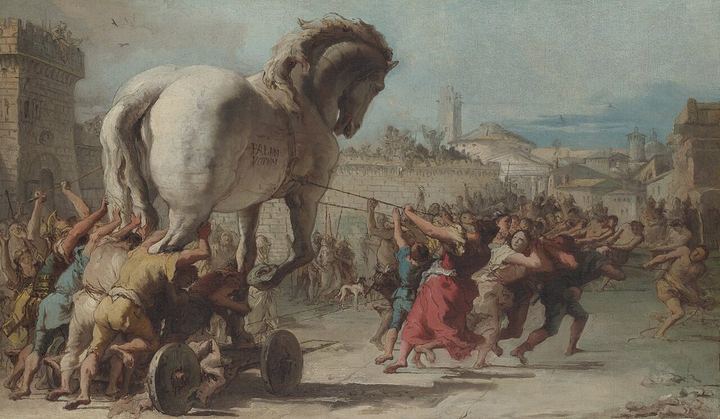
Olivia Coolidge's The Trojan War retells the whole legend of Troy, from its cause in heaven to the homecomings of the Greek kings, in 33 short chapters that can each be read as a story on its own. It begins with the golden apple thrown among the goddesses, the judgment of Paris, and the beauty of Helen, whom Paris carries off from her husband Menelaus of Sparta. The Greek leaders who once swore to defend Helen's marriage are called to war: Odysseus pretends to be mad to stay with Penelope and his infant son, and is exposed; the young Achilles, hidden by his mother Thetis among the daughters of a king, is discovered; and at Aulis Agamemnon's daughter Iphigenia is demanded as the price of a fair wind. Chapters on the Trojan princes, Hector and Paris among the sons of Priam, and on the mustering of the host bring both sides into view. The middle chapters follow the long siege and then the events of Homer's Iliad: the time of discouragement, the quarrel between Agamemnon and Achilles, the duel of Paris and Menelaus, Hector's parting from Andromache and their child, the night raid of Odysseus and Diomedes, the death of Patroclus in Achilles' armor, Achilles' revenge on Hector, the funeral games, and Priam's journey by night to ransom his son's body. Coolidge also includes the medieval love story of Troilus and Cressida. The last part draws on later Greek and Roman tradition: Penthesilea, queen of the Amazons, comes to help Troy; Achilles falls to an arrow from Paris; Ajax and Odysseus contend for his armor; Achilles' son Pyrrhus is brought to the war; the bow of Heracles is fetched from the wounded Philoctetes; Paris, struck down, seeks healing from the nymph Oenone, whom he had abandoned; Odysseus and Diomedes steal the Palladium; and the wooden horse brings about the sack of the city. The book closes with the fates of the conquered and the conquerors: the Trojan women led away captive, Agamemnon murdered on his return, the wanderings of Menelaus and Helen, Telemachus's visit to old Nestor, Odysseus's return in disguise to the hut of his swineherd, and the stringing of the great bow in his hall. Houghton Mifflin published it in Boston in 1952, with drawings by Edouard Sandoz, as a companion to Coolidge's Greek Myths.
Virtues in this work
- Fortitude: Hector goes out to face Achilles before the walls of Troy, knowing the danger, to defend his city and family.
- Humility: Priam goes alone by night to the tent of the man who killed his son and begs for Hector's body.
- Friendship: Achilles' grief and fury at Patroclus's death show how deeply the two companions were bound.
- Prudence: Odysseus returns to Ithaca in disguise and waits in the swineherd's hut until the moment comes to string his bow.
Plot or Argument
- Chapters 1–8: Causes and gathering (The golden apple to The host musters)
The golden apple and Paris's judgment, the taking of Helen, Odysseus's feigned madness, the discovery of Achilles, the sacrifice demanded at Aulis, the princes of Troy, and the assembling of the Greek army.
- Chapters 9–10: The long siege (Troilus and Cressida; The time of discouragement)
A medieval love story set inside the besieged city, and the weary years before the events of the Iliad.
- Chapters 11–18: The wrath of Achilles (The quarrel to The ransom)
Coolidge's version of the Iliad: Agamemnon and Achilles quarrel, Paris and Menelaus fight in single combat, Hector bids farewell to Andromache, Odysseus and Diomedes raid by night, Patroclus dies, Achilles kills Hector, the games are held for Patroclus, and Priam ransoms Hector's body.
- Chapters 19–25: The end of the heroes (The queen of the Amazons to The taking of the Palladium)
Penthesilea's arrival, the death of Achilles, the contest for his armor, the coming of Pyrrhus, the bow of Heracles and Philoctetes, the death of Paris and Oenone's part in it, and the theft of the Palladium.
- Chapters 26–28: The fall of Troy (The Trojan horse to The women)
The wooden horse is built and taken into the city, Troy is sacked, and its women are divided among the victors.
- Chapters 29–33: The homecomings (Agamemnon's death to The bow is bent)
Agamemnon dies at home, Menelaus and Helen wander before reaching Sparta, Telemachus visits Nestor at Pylos, and Odysseus returns disguised to Eumaeus's hut and finally strings his bow against the suitors.
Characters
- Paris, Trojan prince
Son of Priam whose judgment of the goddesses and theft of Helen start the war.
- Helen, queen of Sparta
Wife of Menelaus, carried to Troy by Paris, the occasion of the war.
- Menelaus, king of Sparta
Helen's husband, who fights Paris and later wanders home with her.
- Agamemnon, commander of the Greeks
Menelaus's brother, whose quarrel with Achilles divides the army and who is murdered on his return.
- Achilles, Greek champion
Son of Thetis, greatest of the Greek warriors, whose anger and grief drive the central chapters.
- Patroclus, Achilles' friend
Goes into battle in Achilles' armor and is killed by Hector.
- Hector, Trojan champion
Eldest son of Priam, defender of the city, husband of Andromache.
- Andromache, Hector's wife
Parts from Hector on the walls and is led away captive after the sack.
- Priam, king of Troy
Father of Hector and Paris, who goes to Achilles' tent to ransom his son's body.
- Odysseus, king of Ithaca
The cleverest of the Greeks, from his feigned madness to the horse and his return home.
- Ajax, Greek warrior
Mighty fighter who contends with Odysseus for Achilles' armor.
- Penelope and Telemachus, Odysseus's wife and son
Wait in Ithaca through the war and the long return.
Lessons
Small choices, great wars
The war begins with a golden apple and a young man's vanity, and it ends with a city burned and kings murdered at their own hearths. Coolidge's opening chapters let readers see how pride, desire and broken oaths grow into catastrophe for thousands who had no part in the first choice.
- Which choice in the first chapters do you think made the war most certain?
- Who suffers in the war who had nothing to do with Helen?
- Could anyone have stopped the war once the Greek kings had gathered?
Anger and its cost
Achilles' quarrel with Agamemnon leads him to sit out the fighting until his friend Patroclus dies in his place. His anger then turns into a revenge so fierce that he drags Hector's body. Only when old Priam comes to him in grief does Achilles remember his own father and give the body back.
- Was Achilles right to be angry with Agamemnon? Was he right to stop fighting?
- Why does Priam's visit soften Achilles when nothing else could?
- What does the story suggest about anger that is never let go?
Two kinds of hero
Hector fights to defend his family and city, knowing he may lose; Odysseus wins by wit, disguise and patience. The book holds up strength, cunning, loyalty and endurance as different shapes of courage and lets readers weigh them.
- Whom do you admire more, Hector or Achilles? Why?
- Is the trick of the wooden horse an act of courage or of deceit?
- What does Odysseus need in the last chapters that he did not need on the battlefield?
Victory is not the end
The final chapters show the Greek winners scattered, delayed and even killed on returning home, while the Trojan women go into slavery. Coolidge carries the story past the sack of Troy so that readers see what war leaves behind.
- Why does Coolidge tell what happened after Troy fell instead of stopping with the horse?
- Which homecoming in the last chapters is the most sorrowful, and which the most hopeful?
Context
The Trojan War belongs to a mid-century wave of English-language retellings of classical myth for children, written by authors who knew the Greek sources directly. Coolidge, trained in classics at Oxford and a teacher of Greek and Latin, gathered episodes from Homer's Iliad and Odyssey and from the later tradition of the epic cycle, Greek tragedy, Virgil, and medieval romance into one continuous sequence of stories.
Composition
Coolidge wrote it after Greek Myths (1949) and Legends of the North (1951), and Houghton Mifflin of Boston published it in 1952 with drawings by Edouard Sandoz, who had illustrated her earlier books. The 244-page book is organized in 33 titled chapters. It has been reissued several times in paperback and hardcover.
Reception
The book has stayed in print for more than seventy years and is widely used in homes and schools as an introduction to the Troy legend before students read Homer. Coolidge's later Men of Athens was a Newbery Honor book in 1963, and her retellings remain standard reading for middle-grade students of the classics.
Comparisons
- the-iliad
Chapters 11–18 retell the Iliad from the quarrel to the ransom of Hector, but Coolidge sets them inside the whole war, so readers meet the causes and the fall of the city that Homer only foreshadows.
- the-odyssey
The last chapters, Nestor at home, In the house of the swineherd and The bow is bent, condense Telemachus's journey and Odysseus's return to Ithaca from the second half of the Odyssey.
- black-ships-before-troy
Sutcliff's later retelling covers much of the same ground from the apple to the horse in a more elevated, Homeric prose; Coolidge's chapters are shorter and go on to the homecomings.
- the-aeneid
Virgil's Book II is the classic source for the wooden horse and the night of the sack that Coolidge retells in Chapters 26–27, told there from the Trojan side by Aeneas.
- the-oresteia
Aeschylus's Agamemnon dramatizes the king's murder on his return, the subject of Coolidge's Chapter 29, and traces it back to the sacrifice at Aulis that she tells in Chapter 5.
Quotes
For Students
A reading companion for classical Christian high school students. See the student guide.
Reading Guide
Watch for
- The chain of causes in the first chapters, from the golden apple through the judgment of Paris, the taking of Helen, and the oath that binds the Greek kings to fight.
- The two great anger stories: Achilles against Agamemnon in The quarrel, and Achilles against Hector after Patroclus dies.
- Hector's farewell to Andromache and his child, and Priam's night journey in The ransom, two quiet family scenes set in the middle of the war.
- How Troy finally falls not by strength but through prophecies fulfilled and tricks: Pyrrhus, the bow of Heracles, the Palladium and the horse.
- The homecomings in the last five chapters and how differently Agamemnon, Menelaus and Odysseus are received at home.
Key terms and names
- Golden apple
- The prize marked for the fairest, thrown among the goddesses. Paris's choice to give it to Aphrodite in return for Helen begins the war.
- Aulis
- The harbor where the Greek fleet waits for a wind, and where Agamemnon is required to sacrifice his daughter Iphigenia.
- Myrmidons
- Achilles' own warriors, who stay out of battle while he is angry and go out under Patroclus when Patroclus borrows his armor.
- Ransom
- A price paid to free a captive or recover a body. Priam brings treasure to Achilles to buy back the body of Hector.
- Palladium
- A sacred image of Athena kept in Troy; the city was believed safe while it remained, so Odysseus and Diomedes steal it.
- Ithaca
- Odysseus's island kingdom, where Penelope and Telemachus wait and where the last chapter's contest of the bow takes place.
Seminar Questions
- Comprehension How does the quarrel over the golden apple lead to Paris taking Helen to Troy?
- Comprehension Why does Achilles stop fighting, and what makes him return to battle?
- Comprehension What happens when Priam goes alone to Achilles' tent?
- Interpretation Odysseus tries to escape the war by pretending to be mad, yet he becomes the man who ends it. What changed, and what does this show about him?
- Interpretation Why do you think Coolidge placed Hector's farewell to Andromache right before the hardest battles?
- Interpretation Troy is taken by a trick rather than in open battle. Does that make the Greek victory less honorable?
- Big Question The gods in this book take sides and quarrel among themselves. How is the God of the Bible different from the gods who fight over Troy, and why does that difference matter for how people live?
Faith Connections
- Proverbs 16:18 (Scripture)
Solomon warns that a haughty spirit comes before a fall. The vanity of the goddesses, Paris's choice and Agamemnon's insult to Achilles each bring ruin far beyond the person who was proud.
- Matthew 5:43-44 (Scripture)
Jesus commands love of enemies. Achilles' kindness to Priam, his greatest enemy's father, is the nearest the story comes to that command, and it lasts only a night.
- Acts 17:22-28 (Scripture)
Paul tells the Athenians, heirs of these stories, that the true God made the world, needs nothing from human hands, and is not far from anyone. The jealous, bargaining gods of the Troy legend are the background against which his sermon sounded new.
- Augustine, City of God, Book I (Great Conversation)
Writing after the sack of Rome in 410, Augustine points out that Troy's gods did not save Troy, and contrasts the slaughter in pagan sacks with the sanctuary Christian churches gave even to enemies in Rome.
Logic and Rhetoric
Central argument: A single proud choice, Paris's judgment and his theft of Helen, binds many kings by oath to war. In that war, anger, honor and grief drive the heroes to deeds of great courage and great cruelty, and the city falls not by strength alone but by cunning and the fulfillment of prophecy. Since the victors, too, come home to murder, delay or long trouble, Coolidge's sequence argues that war consumes winners and losers alike, and that the qualities that endure are loyalty, mercy and patient faithfulness, as in Priam, Penelope and the returning Odysseus.
Rhetorical device: foreshadowing. The sacrifice demanded at Aulis in Chapter 5 prepares for Agamemnon's death at the hands of his own household in Chapter 29, so the book's structure links the war's beginning to its aftermath.
Debate: Resolved: Hector, not Achilles, is the true hero of the Trojan War.
Writing Prompts
Essay: Choose three chapters in which a character must decide between personal honor and the good of others, for example Achilles in The quarrel, Hector before the walls, and Odysseus in the house of the swineherd, and argue which choice was wisest.
Comparison with The Iliad: Read Hector's farewell to Andromache and Priam's ransom of Hector in Homer's Iliad (Books 6 and 24) alongside Coolidge's chapters on the same scenes. What does Coolidge keep, what does she leave out, and how does her retelling change the effect on the reader?
Medical Lens
The legend Coolidge retells contains several episodes of interest to the history of medicine and of madness, though she tells them as story, not as clinical description. Odysseus's feigned madness to escape the draft is one of the oldest stories of malingering detected. In the traditional versions of the quarrel, Apollo's plague on the Greek camp, sent for the dishonor of his priest, frames epidemic disease as divine punishment. The contest for Achilles' armor traditionally ends in Ajax's madness and death by his own hand, and Philoctetes is abandoned for years because of a festering snakebite wound before the Greeks need his bow. Paris, wounded by that bow, seeks healing from the nymph Oenone, a figure of healing knowledge in Greek legend. Readers should check how fully Coolidge, writing for young readers, includes each of these details.
- Chapter 3, The madness of Odysseus
Odysseus pretends to be mad to avoid going to war, and the pretense is exposed.
- Chapter 11, The quarrel
The quarrel between Agamemnon and Achilles, which in Homer arises from Apollo's plague on the camp.
- Chapter 21, The armor of Achilles
Ajax and Odysseus contend for the dead hero's armor; in the tradition Ajax's defeat ends in madness and suicide.
- Chapters 23–24, The bow of Heracles; Oenone
The wounded Philoctetes and his bow are brought to Troy; the wounded Paris turns to the healer Oenone.
Creative Prompts
- Fiction
Retell the night the wooden horse is drawn into Troy from the point of view of a Trojan child who sees it from a window.
- Dialogue
Write the conversation between Priam and Achilles in Achilles' tent, in your own words, as each speaks of his own father or son.
- Classroom
Build a family tree and map for the book: the houses of Priam and of Atreus, and the homes of the Greek leaders from Ithaca to Sparta to Pylos, marking where each chapter takes place.
- Essay
Hector or Odysseus: argue which of the two is the better model of courage, using at least two chapters for each.
- Poetry
Write a short lament for Andromache or one of the other Trojan women of Chapter 28, in her own voice.
Further Reading
- Greek Myths, Olivia Coolidge
Coolidge's earlier collection, also illustrated by Edouard Sandoz.
- Men of Athens, Olivia Coolidge
- Black Ships Before Troy, Rosemary Sutcliff
- The Children's Homer, Padraic Colum
- The Iliad, Homer
- The Odyssey, Homer
Verification notes
The 33 chapter titles, publisher (Houghton Mifflin, Boston), year (1952), page count (244) and illustrator (Edouard Sandoz) were checked on the Internet Archive record (https://archive.org/details/trojanwar00cool) and Open Library (https://openlibrary.org/books/OL6110850M/The_Trojan_War). Coolidge's life and books were checked against the Wikipedia article (https://en.wikipedia.org/wiki/Olivia_Coolidge). The contents of each chapter are described from the chapter titles and the traditional legend they name; the details of Coolidge's own handling of each episode should be checked against the book. No quotations are given: I could not confirm any sentence of the text on a reliable page (an opening sentence recorded on Open Library is user-entered catalog data and could not be cross-checked).
- Text is under copyright; check quotations against an authorized edition before publication.
- Whom the chapter The foremost man concerns, and what The time of discouragement covers.
- How Coolidge handles Ajax's madness and death, Apollo's plague, Philoctetes' wound, and Oenone's refusal to heal Paris.
- Whether Coolidge names Achilles' son Pyrrhus only, or also Neoptolemus.
- Whether Iphigenia is sacrificed or rescued by Artemis in Coolidge's version.
- Dates and publishers of later reissues.