Work record
Paradise Lost
1667; revised 1674 · Renaissance Early Modern · Epic · English
Abstract
Background. Blind since 1652 and out of favour after the Restoration of Charles II, Milton dictated the poem to amanuenses, having set aside an early plan for an Arthurian epic in favour of Genesis 1-3. His stated aim is to assert Eternal Providence and to vindicate God's dealings with humankind.
Narrative. Opening in medias res, the rebel angels wake on Hell's burning lake, raise Pandaemonium and adopt Beelzebub's scheme of revenge through the new race of men. Satan crosses Chaos, slips past Uriel and spies on Adam and Eve in Eden. Raphael, sent as a warning, recounts the war in Heaven, loyal Abdiel and the six days of Creation. In Book IX the serpent's flattery persuades Eve to eat, and Adam eats rather than lose her; after judgment, quarrel and repentance, Michael reveals future history and leads the couple out of Paradise.
Structure. Milton follows Homer and Virgil in his invocations, infernal council, celestial battle and long retrospective narration, while his note on the verse defends unrhymed lines as a recovery of ancient liberty.
Themes. Free will is the theological centre: creatures made able to stand chose to fall, so foreknowledge is not their cause. Satan's grandeur decays into envy and deceit, and the poem ends on the hope of a paradise within.
Significance. Addison and Johnson placed it beside the ancient epics, Blake and Shelley made a hero of Satan, and C. S. Lewis answered them with a reading of self-deceiving pride.
Main characters
- Satan: Fallen archangel whose eloquent defiance hardens into envy and self-torment
- God the Father: Foreknowing Creator who made angels and men free and promises grace
- The Son: Victor in the war in Heaven, agent of Creation, and willing Redeemer
- Adam: The first man, an eager questioner who eats the fruit rather than lose Eve
- Eve: The first woman, deceived by the serpent and first to seek reconciliation
- Beelzebub: Satan's second, who proposes in council to strike God through man
- Sin and Death: Satan's allegorical daughter and her son, keepers of Hell's gate
- Raphael: The affable archangel who warns Adam and narrates the war and Creation
- Abdiel: The lone seraph of Satan's company who refuses to rebel
- Michael: Archangel who shows Adam future history and leads the pair from Eden

Summary
Paradise Lost is John Milton's epic in twelve books of blank verse on the fall of man, written, as the opening invocation says, to assert Eternal Providence and justify the ways of God to men. It begins in the middle of things. Satan and his rebel angels, cast out of Heaven after their war against God, lie stunned on a burning lake in Hell. Satan rouses Beelzebub and the fallen host, who raise the palace of Pandaemonium and debate their course: Moloch urges open war, Belial idle ease, Mammon the building of an empire in Hell, and Beelzebub, voicing Satan's plan, the ruin of God's new creature, man. Satan volunteers to go alone, passes Sin and Death at Hell's gate and crosses Chaos toward the created world. In Heaven the Father foresees the Fall, declares that he made man sufficient to have stood though free to fall, and promises grace; the Son offers to die for mankind and is exalted. Satan, disguised as a young cherub, deceives the archangel Uriel and lands in Eden, where he watches Adam and Eve in their innocent love and is torn by envy and despair. Found whispering at the ear of the sleeping Eve, he is expelled by Gabriel's guards. God sends the archangel Raphael to warn Adam. Over a meal Raphael tells of Satan's revolt, of Abdiel, the one angel of Satan's company who refused to follow him, of the war in Heaven ended on the third day by the Son, and of the six days of creation; Adam in turn tells of his own making and his first meeting with Eve. The next morning Eve proposes that they work apart. Satan, entering a serpent, flatters her and persuades her that the forbidden fruit has given him reason and speech. She eats, and Adam, resolved not to live without her, eats too. Lust, then shame and mutual accusation follow. The Son judges them and clothes them; Sin and Death build a causeway from Hell to the world, and Satan, returning to boast of his success, is turned with his followers into hissing serpents. Adam despairs, but Eve's plea for forgiveness reconciles them, and they pray in repentance. The archangel Michael comes to lead them out of Paradise and shows Adam the course of history from Cain and Abel through the Flood to the promised Redeemer. Comforted that good will come of evil and that he may possess a paradise within, Adam goes out with Eve, hand in hand, into the world.
Virtues in this work
- Fortitude: Abdiel rebukes Satan before the whole rebel host and returns alone to God, unmoved and unshaken.
- Charity: In Book III the Son freely offers his own life so that man may find grace.
- Humility: Eve's tearful plea to Adam in Book X ends their quarrel and leads both to repentance and prayer.
- Temperance: Raphael counsels Adam to be lowly wise and Michael names temperance among the virtues that make a paradise within.
- Hope: Adam leaves Eden comforted by the promise that good will come of evil through the Redeemer.
Plot or Argument
- Books I-II: Council in Hell
The fallen angels wake on the burning lake, build Pandaemonium and debate; Satan undertakes the journey to the new world, meets Sin and Death at Hell's gate and crosses Chaos.
- Book III: The Son offers himself
Milton invokes holy Light; the Father foresees man's fall and the Son volunteers to die for him; Satan deceives Uriel on the sun.
- Book IV: Eden
Satan sees Adam and Eve in Paradise, confesses in soliloquy that he himself is Hell, and is driven out by Gabriel's angelic guard after tempting Eve in a dream.
- Books V-VIII: Raphael's visit
Raphael warns Adam, narrates the revolt in Heaven, Abdiel's loyalty, the war in Heaven and the Son's victory, and the six days of creation; Adam recounts his creation and the gift of Eve.
- Book IX: The Fall
Eve works apart, the serpent tempts her with flattery and false reasoning, she eats, and Adam eats with her; innocence gives way to lust, shame and quarrel.
- Book X: Judgment and reconciliation
The Son pronounces sentence; Sin and Death bridge Chaos; Satan's triumph becomes a serpent's hiss; Adam and Eve are reconciled and repent.
- Books XI-XII: Michael's vision
Michael shows Adam the future of his descendants down to the Flood and narrates the history to Christ's redemption; Adam and Eve leave Eden with Providence their guide.
Characters
- Satan, Fallen archangel
The leader of the rebel angels, magnificent in speech and will, whose pride hardens into envy, deceit and self-torment as the poem goes on.
- God the Father, Creator
The omnipotent and foreknowing Father who explains that he created angels and men free and promises mercy to man.
- The Son, Son of God
The Messiah who defeats the rebels in Heaven, carries out the work of creation, offers himself to die for man and judges and clothes the fallen pair.
- Adam, The first man
Created upright and reasoning, a curious questioner of Raphael, who falls not deceived but out of love for Eve and learns repentance and hope.
- Eve, The first woman
Adam's partner, lovely and thoughtful, who is deceived by the serpent's arguments and later is the first to seek reconciliation.
- Beelzebub, Satan's second
The fallen angel who proposes in council the plan of attacking God through man.
- Sin and Death, Allegorical figures
Satan's daughter, sprung from his head, and the son she bore him, who keep Hell's gate and later bridge Chaos to the world.
- Raphael, The affable archangel
The messenger who dines with Adam and Eve, warns them of their enemy and tells the history of the war in Heaven and the creation.
- Abdiel, Seraph
The single angel of Satan's company who rebukes him to his face and returns alone to God.
- Michael, Archangel
The captain of Heaven's armies who expels Adam and Eve from Eden after showing Adam the future and the promise of redemption.
Lessons
Free to stand, free to fall
Milton's God says he made man sufficient to have stood, though free to fall. Obedience that could not be refused would be no obedience at all, so the poem places the cause of the Fall in the creature's own choice rather than in God's foreknowledge.
- Why does the Father insist that foreknowledge does not cause the Fall?
- What would love and obedience be worth if Adam and Eve could not choose otherwise?
The hell within
Satan boasts that the mind is its own place, but by Book IV he confesses that wherever he flies is Hell, because he is Hell. Pride does not escape its misery by changing place; it carries its prison with it.
- How does Satan's boast in Book I compare with his soliloquy on Mount Niphates?
- Why can Satan not repent, although he considers it?
One faithful among the faithless
Abdiel alone among Satan's legions answers him with the truth and walks back to God through their scorn. Courage can mean standing apart from a whole company when it is wrong.
- What arguments does Abdiel use against Satan?
- Why does Milton praise his being unmoved and unshaken?
Repentance and the paradise within
After blame and despair, Eve's humble plea begins the couple's reconciliation, and their prayer rises to Heaven. Michael teaches Adam that good will come of evil and that faith, virtue, patience, temperance and charity make a paradise within, happier far.
- Who first moves toward reconciliation in Book X, and how?
- What does Michael tell Adam to add to his knowledge?
Marriage before and after the Fall
Milton celebrates wedded love as a holy gift in Eden, then shows the same love disordered when Adam chooses Eve over obedience. The poem treats marriage as a partnership whose happiness depends on both partners' loyalty to God.
- Why does Eve want to work apart in Book IX, and why does Adam let her go?
- Is Adam's reason for eating the fruit love or something less?
Context
Milton had planned a great English epic since youth and once considered an Arthurian subject before choosing the Fall as told in Genesis. He wrote in the tradition of Homer and Virgil, beginning in the middle of things, with invocations, a council of the gods, a war in Heaven and long narrated episodes, while claiming a higher argument than wrath or wandering. The poem also reflects his Puritan theology, his long study of Scripture and his experience of the English Civil War and the Commonwealth, which ended with the restoration of Charles II in 1660.
Composition
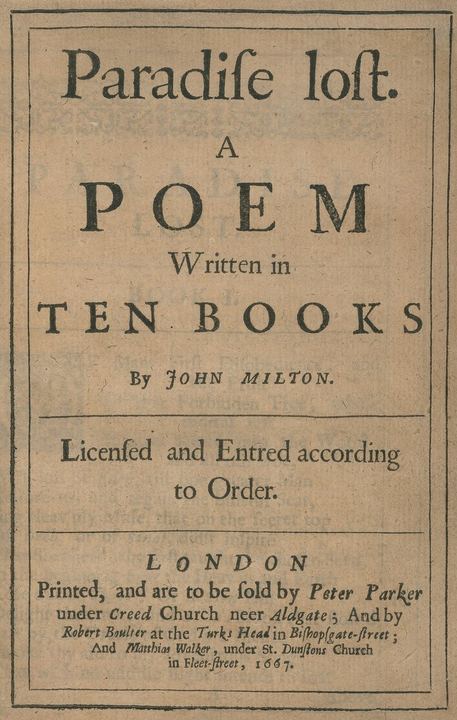
Milton began serious work around 1658 and, totally blind, dictated the poem in passages to his daughters, nephews and other helpers. It was first published in 1667 in ten books, with prose 'Arguments' and a note on the verse added in 1668. The second edition of 1674 divided Books VII and X to make twelve books on the Virgilian model; the attached Gutenberg text follows that twelve-book arrangement.
Reception
Dryden turned the poem into a rhymed opera and called Milton the equal of Homer and Virgil; Addison's Spectator papers of 1712 established it as an English classic, and Johnson judged it among the highest productions of the human mind. The Romantics admired Satan's grandeur, Blake writing that Milton was of the Devil's party without knowing it, while C. S. Lewis's Preface to Paradise Lost (1942) restored the reading of Satan as a study in self-deceiving pride.
Comparisons
- the-aeneid
Virgil's twelve-book epic is Milton's chief formal model, and Milton claims a theme above Virgil's Turnus and Lavinia.
- the-divine-comedy
Dante also maps Hell, Heaven and an earthly Paradise, but through a pilgrim's journey after death rather than the story of the first parents.
- the-bible
Genesis 1-3 supplies the plot, and Milton fills it with material from Isaiah, Revelation, the Psalms and the Pauline epistles.
- frankenstein
Mary Shelley's creature reads Paradise Lost and compares himself both to Adam and to Satan; the novel's epigraph is Adam's complaint to his Maker.
- the-pilgrims-progress
Bunyan, a fellow Puritan writing in the same years, turns the soul's fall and salvation into allegory rather than epic.
Quotes
Frequently cited
“Of Man’s first disobedience, and the fruit Of that forbidden tree whose mortal taste Brought death into the World, and all our woe”
Frequently cited
“I may assert Eternal Providence, And justify the ways of God to men”
Frequently cited
“The mind is its own place, and in itself Can make a Heaven of Hell, a Hell of Heaven”
Frequently cited
“Better to reign in Hell than serve in Heaven”
Frequently cited
“Sufficient to have stood, though free to fall”
Frequently cited
“Which way I fly is Hell; myself am Hell”
Frequently cited
“So farewell, hope; and with hope farewell, fear; Farewell, remorse! all good to me is lost; Evil, be thou my good”
Frequently cited
“Earth felt the wound; and Nature from her seat, Sighing through all her works, gave signs of woe, That all was lost”
Frequently cited
“then wilt thou not be loth To leave this Paradise, but shalt possess A Paradise within thee, happier far”
Frequently cited
“The world was all before them, where to choose Their place of rest, and Providence their guide: They, hand in hand, with wandering steps and slow, Through Eden took their solitary way”
“So much the rather thou, celestial Light, Shine inward, and the mind through all her powers Irradiate; there plant eyes”
“Abashed the Devil stood, And felt how awful goodness is, and saw Virtue in her shape how lovely”
“So spake the Seraph Abdiel, faithful found Among the faithless, faithful only he”
“O Goodness infinite, Goodness immense! That all this good of evil shall produce, And evil turn to good”
For Students
A reading companion for classical Christian high school students. See the student guide.
Reading Guide
Watch for
- The invocations at the start of Books I, III, VII and IX, where Milton speaks in his own voice about his subject, his blindness and his Muse.
- How Satan's speeches change from Book I, where he sounds heroic, to Book IV and Book IX, where he sounds envious and calculating.
- The Father's account of free will and the Son's offer in Book III, and Abdiel's lonely stand against Satan in Books V and VI.
- Each step of the serpent's argument to Eve in Book IX, and Adam's reason for eating.
- Who first seeks forgiveness in Book X, and what Michael teaches Adam to hope for in Book XII.
Key terms and names
- Epic invocation
- A poet's prayer to a Muse for inspiration; Milton calls on the Heavenly Muse who inspired Moses and on the Holy Spirit.
- In medias res
- Latin for 'into the middle of things'; the poem opens after the war in Heaven and tells earlier events later through Raphael.
- Blank verse
- Unrhymed lines of iambic pentameter; Milton defended his choice as freeing English heroic verse from the bondage of rhyme.
- Epic simile
- An extended comparison that unfolds over several lines, such as the fallen angels lying thick as autumn leaves in Vallombrosa.
- Theodicy
- An argument defending God's justice and goodness in the face of evil; Milton aims to justify the ways of God to men.
- Felix culpa
- Latin for 'happy fault', the idea that the Fall occasioned a greater good in the Redemption; Adam voices it in Book XII.
- Pandaemonium
- Milton's coinage, 'all the demons', for the capital the fallen angels build in Hell.
Seminar Questions
- Comprehension What plan does the council in Hell adopt in Book II, and who proposes it?
- Comprehension What does Raphael come to Eden to do, and what stories does he tell?
- Comprehension How does the serpent persuade Eve to eat the fruit?
- Interpretation Is Satan the hero of the poem? Use his speeches in Book I and Book IV as evidence.
- Interpretation Why does Adam eat the fruit, and how does Milton distinguish his fall from Eve's?
- Interpretation What does Michael mean by a paradise within, and how is it different from the paradise lost?
- Big Question If God foresaw the Fall, were Adam and Eve truly free? How does the poem answer, and is its answer convincing?
Faith Connections
- Genesis 3 (Scripture)
The serpent's temptation, the eating of the fruit, the judgment and the expulsion from the garden are the narrative core Milton expands into twelve books.
- Genesis 3:15 (Scripture)
The promise that the woman's seed shall bruise the serpent's head, which the Son pronounces in Book X and Michael explains in Book XII as the promise of Christ.
- Romans 5:19 (Scripture)
As by one man's disobedience many were made sinners, so by the obedience of one shall many be made righteous; the poem's opening contrasts Man's first disobedience with one greater Man who will restore us.
- Augustine, City of God XIV.13 (Church Fathers)
Augustine teaches that pride, the craving for undue exaltation, was the beginning of sin and that the evil act was preceded by an evil will; Milton's Satan and the fall of Adam and Eve follow this pattern.
Logic and Rhetoric
Central argument: God created angels and men sufficient to stand and free to fall, because only free obedience is true love. Satan and then Adam and Eve freely chose to disobey. God's justice therefore does not cause their fall, and his mercy offers redemption through the Son. Therefore the ways of God to men are just, and the Fall becomes the occasion of a greater good.
Rhetorical device: epic simile. In Book I the fallen angels lie on the burning lake thick as autumnal leaves that strow the brooks in Vallombrosa, a comparison that suggests both their vast number and their lifelessness after defeat.
Debate: Resolved: that Adam was more to blame than Eve for the Fall.
Memory Work
Of Man’s first disobedience, and the fruit Of that forbidden tree whose mortal taste Brought death into the World, and all our woe
The world was all before them, where to choose Their place of rest, and Providence their guide: They, hand in hand, with wandering steps and slow, Through Eden took their solitary way
Writing Prompts
Essay: Trace Satan's speeches from Book I through Book IX and argue how Milton shows pride turning from grandeur into self-deception.
Comparison with The Divine Comedy: Milton and Dante both portray Satan. Compare the defiant orator of Paradise Lost with the silent, frozen figure at the bottom of Dante's Inferno, and argue what each image teaches about evil.
Medical Lens
Milton wrote the poem blind, and the invocation to Light in Book III is one of the great first-person passages on the loss of sight, turning bodily blindness into a prayer for inward vision. In the poem's theology disease and death enter the world with the Fall: Death is an allegorical figure born of Sin, and in Book XI Michael shows Adam a lazar-house containing a catalogue of seventeenth-century diseases, from convulsions, epilepsies and catarrhs to demoniac frenzy, moping melancholy and moon-struck madness, attended by Despair. Satan's inner torment in Book IV gives a theological account of despair rather than a medical one.
- Book III
The invocation to holy Light laments the poet's blindness and asks for inward sight.
- Book IV
Satan's soliloquy on Mount Niphates: the self-made hell of envy and despair.
- Book X
Sin and Death come to the world to prey on all created things after the Fall.
- Book XI
Michael's vision of the lazar-house lists the diseases, madness and melancholy that will afflict Adam's descendants.
Listen to the book
Public-domain audiobook from LibriVox, read by Thomas A. Copeland. Recording: Paradise Lost (version 2) on LibriVox (Internet Archive).
LibriVox recordings are volunteer readings released into the public domain. The reading may follow a different edition from the text in this library.
Creative Prompts
- Classroom
Stage the council in Pandaemonium from Book II with four students as Moloch, Belial, Mammon and Beelzebub, then have the class vote and discuss why Beelzebub's plan wins.
- Essay
Compare Satan's speech to Hell in Book I with his soliloquy in Book IV and argue whether the mind really can be its own place.
- Dialogue
Write the conversation Adam and Eve might have on the first evening after leaving Eden, drawing on what Michael has shown them.
Further Reading
- A Preface to Paradise Lost, C. S. Lewis
- Paradise Regained, John Milton
- The Life of Milton, Samuel Johnson
- Surprised by Sin, Stanley Fish
Verification notes
Plot, book divisions and publication history are standard. Book locators follow the attached Gutenberg text of the 1674 twelve-book arrangement. Quotes are verified against that text, which uses modernized spelling in places.
No verification flags recorded.