Work record
Black Ships Before Troy: The Story of the Iliad
1993 · Postwar Contemporary · Novel · English
Abstract
Background. Sutcliff, a veteran of British historical fiction and legend, left this adaptation of Homer nearly finished at her death in 1992; Frances Lincoln issued it the next year with Alan Lee's paintings, which took the Greenaway Medal.
Narrative. An apple of discord at a divine wedding leads a Trojan prince to steal a Spartan queen, and a thousand vessels sail in pursuit. Most of the chapters follow Homer: a dispute over a captive girl, the champion's sulking withdrawal, the loss of his comrade, his killing of Troy's defender and the old king's midnight plea. The final chapters reach beyond the epic to the Amazons, the deaths of Achilles and Paris, and the hollow horse that ends the siege.
Style. Sutcliff uses plain, rhythmic prose with Homeric epithets, condenses battle catalogues, and gives room to intimate scenes such as the farewell at the gate. The gods take sides openly, rescuing favourites from the duel and the battlefield, yet the mortals still choose and suffer for their choices.
Themes. Anger and its price, loyalty among comrades, the gods' hand in human quarrels, grief shared across enemy lines, and the ruin war brings to a city.
Significance. Paired with The Wanderings of Odysseus (1995), it remains a standard first approach to Homer for children in British and American classrooms.
Main characters
- Achilles: Myrmidon prince whose wrath and grief shape the war
- Hector: Troy's defender, husband and father
- Agamemnon: Mycenaean overlord whose pride sparks the quarrel
- Odysseus: Ithacan schemer behind the horse
- Patroclus: Achilles's companion, killed in borrowed armour
- Priam: Aged Trojan king who ransoms his son
- Paris and Helen: The abductor and the queen whose flight begins it all

Summary
Black Ships Before Troy is Rosemary Sutcliff's prose retelling of the Trojan War for young readers, in nineteen short chapters. Although subtitled The Story of the Iliad, it begins long before Homer's poem and ends after it. In The Golden Apple, Eris, the uninvited goddess of discord, throws an apple marked for the fairest among the guests at the wedding of King Peleus and the sea-nymph Thetis; Hera, Athene and Aphrodite quarrel over it, and Paris, a prince of Troy raised as a herdsman on Mount Ida, awards it to Aphrodite for the promise of the most beautiful woman in the world. Paris later carries off Helen, wife of King Menelaus of Sparta, and Agamemnon, Menelaus's brother and High King of Mycenae, gathers the Greek kings and their black ships against Troy. After nine years of siege the Iliad's own story begins. Apollo sends plague on the camp because Agamemnon holds Chryseis, his priest's daughter; forced to return her, Agamemnon takes Briseis from Achilles, and Achilles withdraws from the fighting. The following chapters retell the duel of Paris and Menelaus, Hector's farewell to Andromache and their baby son, the failed embassy to Achilles, the night raid of Odysseus and Diomedes on the horses of King Rhesus, the Trojan assault on the ships, and the death of Patroclus, who fights in Achilles's armour and is killed by Hector. Thetis brings Achilles new armour forged by Hephaestus; Achilles kills Hector and drags his body behind his chariot, holds funeral games for Patroclus, and at last gives up the body when old King Priam comes by night to his hut to beg for it. Sutcliff then continues past the Iliad with material from later Greek and Roman sources: the coming of the Amazon queen Penthesilea, the theft of the Palladium, the image on which Troy's luck depended, the death of Achilles by an arrow from Paris, the fetching of Philoctetes and the bow of Heracles, the poisoned arrow that kills Paris, and finally Odysseus's stratagem of the wooden horse, the night sack of the city and Menelaus taking Helen home. Sutcliff died in July 1992, and the book was published posthumously in 1993 by Frances Lincoln in London, with paintings and drawings by Alan Lee, which won the Kate Greenaway Medal. A companion volume, The Wanderings of Odysseus, followed in 1995.
Virtues in this work
- Fortitude: Hector goes out to face Achilles before the walls, knowing he is likely to die, to defend his city and family.
- Piety: Priam risks his life crossing to the Greek camp by night so that his son's body can receive proper burial.
- Friendship: Patroclus puts on Achilles's armour and leads the Myrmidons to save the Greek ships when his friend will not.
- Charity: Achilles weeps with Priam, returns Hector's body and grants a truce for the funeral.
Plot or Argument
- Chapters 1-2: The Golden Apple and Ship-gathering
The wedding of Peleus and Thetis, the apple of discord, the judgement of Paris on Mount Ida, the taking of Helen from Sparta, and Agamemnon's muster of the Greek kings and ships.
- Chapter 3: Quarrel with the High King
Apollo's plague on the camp over Chryseis; Agamemnon takes Briseis from Achilles, who withdraws to his ships and asks Thetis to win honour for him through Greek defeat.
- Chapters 4-5: Single Combat and The Women of Troy
Paris and Menelaus fight for Helen until Aphrodite snatches Paris away; Helen on the walls with Priam; Hector's parting from Andromache and his son on the Scaean Gate.
- Chapters 6-8: The High King's Embassy, The Horses of King Rhesus, Red Rain
Odysseus, Ajax and old Phoenix plead with Achilles and are refused; Odysseus and Diomedes raid the Thracian camp by night; the Trojans press the Greeks back toward their ships.
- Chapters 9-11: Battle for the Ships, The Armour of Achilles, Vengeance for Patroclus
Patroclus leads the Myrmidons in Achilles's armour and is killed by Hector; Hephaestus forges new arms; Achilles returns to battle and kills Hector before the walls.
- Chapters 12-13: Funeral Games and Ransom for Hector
The burning of Patroclus and the games in his honour; Priam crosses the plain by night, kneels to Achilles and takes Hector's body home for burial.
- Chapters 14-17: The Luck of Troy, Warrior Women, The Death of Achilles, Poisoned Arrow
Episodes from after the Iliad: the Palladium, the Amazon queen Penthesilea, Achilles killed by Paris's arrow, Philoctetes brought with the bow of Heracles, and the death of Paris.
- Chapters 18-19: The Wooden Horse and The Fall of Troy
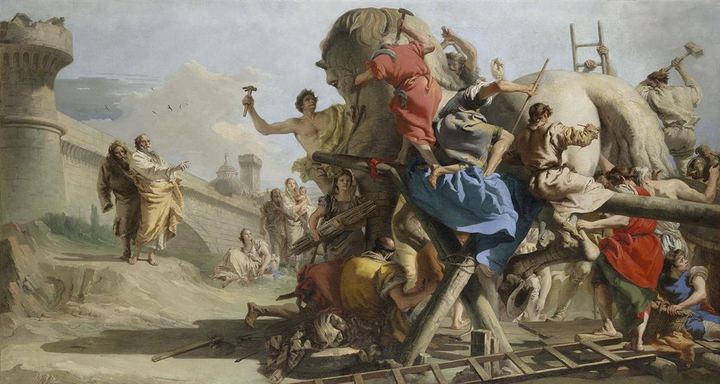
The Greeks feign departure and leave the horse; the Trojans drag it inside; the hidden warriors open the gates; Troy burns and Menelaus takes Helen back to the ships.
Characters
- Achilles, Greek hero
Son of Peleus and Thetis and prince of the Myrmidons, whose wrath and grief drive the central story.
- Hector, Trojan champion
Eldest son of Priam, husband of Andromache, and the defender of Troy until Achilles kills him.
- Agamemnon, High King of Mycenae
Leader of the Greek host whose seizure of Briseis starts the quarrel.
- Odysseus, King of Ithaca
The cleverest of the Greeks, envoy to Achilles, night raider, and deviser of the wooden horse.
- Patroclus, Achilles's friend
Fights in Achilles's armour to save the ships and is killed by Hector.
- Priam, King of Troy
The old king who goes alone to Achilles's hut to ransom his son's body.
- Paris, Trojan prince
Judge of the golden apple, who takes Helen from Sparta and later shoots Achilles.
- Helen, Queen of Sparta
Wife of Menelaus, carried to Troy by Paris and reclaimed when the city falls.
- Menelaus, King of Sparta
Helen's husband and Agamemnon's brother, who duels Paris.
- Andromache, Hector's wife
Begs Hector to fight from the walls and mourns him when he falls.
- Diomedes, Ajax, Nestor, Thetis, Greek heroes and the sea-nymph
Diomedes and Ajax fight in the front rank, Nestor gives old men's counsel, and Thetis brings her son his new armour.
Lessons
Wrath and what it costs
Achilles's anger at Agamemnon is just at first, but by holding on to it he lets his own friends die and loses Patroclus. Sutcliff, like Homer, shows anger turning on the one who keeps it.
- Was Achilles right to be angry when Agamemnon took Briseis?
- When does his anger stop being fair and start doing harm?
- What finally brings Achilles back into the fighting, and what does it cost him?
Courage at home and on the field
Hector knows Troy may fall and still goes out to fight, after holding his frightened son on the wall. The book honours courage that sees the danger plainly and accepts duty anyway.
- Why does Hector go back to battle after Andromache begs him to stay?
- Who is braver, Hector or Achilles? Give reasons from the story.
- Why does Sutcliff include the scene with the baby and the helmet plume?
Mercy between enemies
Priam kisses the hands that killed his son, and Achilles, remembering his own father, weeps with him and gives back Hector's body. The fiercest warrior in the story shows his greatest strength in pity.
- What does Priam say to Achilles that changes his heart?
- Why does Achilles agree to a truce for Hector's funeral?
- Can enemies share grief? What does this scene suggest?
Cleverness and its limits
Odysseus wins the war with a trick, the wooden horse, after ten years of open battle fail. The ending invites readers to weigh the cunning that takes Troy against the burning and killing that follow.
- Why does the wooden horse succeed when force did not?
- Is a trick in war honourable? Why or why not?
Context
The Trojan War is the great legend of early Greece: a ten-year siege of a city on the coast of Asia Minor by a coalition of Bronze Age Greek kings. Homer's Iliad, composed perhaps in the eighth century BC, tells only some weeks of the tenth year, from Achilles's quarrel with Agamemnon to Hector's funeral. The rest of the story, from the apple of discord to the fall of the city, survives in later Greek and Latin poems and summaries, and Sutcliff draws on that wider tradition to give children the whole war in order.
Composition
Sutcliff wrote the book at the end of a long career of historical fiction about Roman and early Britain, and of retellings such as The Chronicles of Robin Hood, Tristan and Iseult and her Arthurian trilogy. She died in July 1992, and Frances Lincoln published the book in London in 1993 in a large illustrated format with paintings and line drawings by Alan Lee. Her retelling of the Odyssey, The Wanderings of Odysseus, was completed from her work and published with Lee's illustrations in 1995.
Reception
Alan Lee's illustrations won the 1993 Kate Greenaway Medal from the Library Association, and Kirkus Reviews praised the book's sense of language, history and heroism. It has since become one of the most widely used introductions to Homer for children in Britain and the United States, often read in the middle-school years before the Iliad itself.
Comparisons
- the-iliad
Sutcliff follows Homer closely for Chapters 3-13, from the quarrel to the ransom of Hector, keeping scenes like Hector and Astyanax and Priam's night visit while compressing the catalogues, the long battle books and most speeches.
- the-trojan-war
Olivia Coolidge's 1952 retelling covers the same cycle from the wedding of Peleus to the sack of Troy; comparing the two shows how different authors choose and order the non-Homeric episodes.
- the-odyssey
Odysseus's tricks in Sutcliff's later chapters, the night raid and the wooden horse, lead straight into his voyage home, which Sutcliff retold in The Wanderings of Odysseus.
- the-aeneid
Virgil's Book II gives the Trojan side of the wooden horse, Sinon and Laocoon, and the burning city; Sutcliff's last two chapters draw on the same tradition from the Greek side.
- the-eagle-of-the-ninth
Sutcliff's best-known novel shares this book's interest in honour, loyalty between comrades and the recovery of a lost emblem, set in Roman Britain rather than Bronze Age Troy.
- tanglewood-tales
Hawthorne's 1853 retellings of Greek myth for children make a useful contrast in tone: his are playful and moralised, while Sutcliff keeps the grief and violence of the heroic world.
Quotes
“All she did—it seemed a small thing—was to toss down on the table a golden apple.”
For Students
A reading companion for classical Christian high school students. See the student guide.
Reading Guide
Watch for
- Where Homer's Iliad begins and ends inside Sutcliff's book: from the quarrel in Chapter 3 to Hector's funeral in Chapter 13.
- Every time a god steps into the fighting, as when Aphrodite carries Paris out of the duel with Menelaus.
- The two scenes of fathers and sons: Hector with his baby on the wall, and Priam kneeling to Achilles.
- How Achilles's anger changes object, from Agamemnon to Hector, and when it finally ends.
- The trick of the wooden horse and the signs the Trojans ignore before dragging it inside.
Key terms and names
- Myrmidons
- Achilles's own warriors from Phthia, who sit idle by their ships while he refuses to fight and later follow Patroclus into battle.
- High King
- Sutcliff's title for Agamemnon of Mycenae, the overlord who leads the separate Greek kings.
- Scaean Gate
- The great western gate of Troy, where Hector parts from Andromache and where the elders watch the fighting.
- Ransom
- A price paid to free a captive or recover a body. Priam brings treasure to Achilles to buy back Hector's corpse.
- Palladium
- An ancient image of Pallas Athene kept in Troy and believed to guard the city; the Greeks must carry it off before Troy can fall.
- Funeral games
- Contests of chariots, running and wrestling held in honour of a dead hero; Achilles holds them for Patroclus.
Seminar Questions
- Comprehension Why does Apollo send a plague on the Greek camp, and how does ending the plague start the quarrel between Agamemnon and Achilles?
- Comprehension How does Patroclus die, and why is he wearing Achilles's armour when he does?
- Comprehension How do the Greeks finally get inside Troy after ten years of war?
- Interpretation The envoys in Chapter 6 offer Achilles gifts and honour, and he still refuses. What does he want that no gift can give him?
- Interpretation Sutcliff begins with a golden apple and a beauty contest among goddesses. What does that opening suggest about the causes of the war?
- Interpretation Why does Achilles weep with Priam, the father of the man who killed his friend?
- Interpretation Sutcliff could have ended with Hector's funeral, as Homer does. What changes when she goes on to the death of Achilles and the burning of Troy?
- Big Question Is it ever right to keep fighting a war for honour after the reason for it has been forgotten?
Faith Connections
- James 1:19-20 (Scripture)
James warns that the wrath of man does not work the righteousness of God. Achilles's anger in Chapter 3 begins with a real wrong but ends by costing him Patroclus.
- Matthew 5:43-45 (Scripture)
Christ commands love of enemies. Priam's kneeling to Achilles and the shared tears in Ransom for Hector are a pagan glimpse of the pity that Christ makes a command.
- 2 Samuel 18:33 (Scripture)
David's cry over Absalom is the Bible's great lament of a father for a son killed in war; set it beside Priam's grief for Hector.
- Augustine, City of God I (Great Conversation)
Augustine opens his book with the sack of Rome and recalls Virgil's burning Troy, where even the temples gave no refuge. The last chapter of Sutcliff's book shows the same pitiless sack of a city.
Logic and Rhetoric
Central argument: Agamemnon wrongs Achilles, and Achilles answers by refusing to fight. Because he will not fight, the Greeks are driven back and Patroclus dies in his place. Grief turns Achilles's anger to Hector, and only when Priam reminds him of his own father does pity end the anger. Therefore the book argues that wrath, even when it begins justly, destroys what the angry man loves, and that mercy is the true end of heroism.
Rhetorical device: epithet. Sutcliff keeps Homer's habit of fixed descriptive titles, calling Agamemnon the High King throughout and naming heroes by their homes and fathers, which gives her plain prose the ring of an old song.
Debate: Resolved: that Achilles was justified in refusing to fight after Agamemnon took Briseis.
Writing Prompts
Essay: Compare the farewell of Hector and Andromache in Chapter 5 with Priam's visit to Achilles in Chapter 13, and argue what these two quiet scenes teach about war that the battle chapters cannot.
Comparison with The Iliad: Read Book XXIV of Homer's Iliad alongside Sutcliff's Ransom for Hector. What does Sutcliff keep, what does she leave out, and is her version faithful to Homer's meaning?
Medical Lens
The war story opens with an epidemic understood as divine punishment: Apollo's arrows of plague fall on the Greek camp, killing first the mules and dogs and then the men, until Chryseis is returned to her father. The later chapters include battlefield wounds told in Homeric directness, and the poisoned arrow of Paris's death. Philoctetes, abandoned on Lemnos with a festering snake-bite wound, is brought back because the bow of Heracles is needed to take Troy, an old story of a wounded man shunned and then recalled. Grief is the book's deepest strain, in Achilles's mourning for Patroclus and Priam's for Hector. For a medical reader the interest is chiefly in the ancient model of epidemic disease as a god's anger and the treatment of the wounded in the camp; Sutcliff's retelling is for children and keeps such matters brief.
- Chapter 3, Quarrel with the High King
Apollo sends plague on the Greek camp until Agamemnon returns Chryseis to her father, the priest Chryses.
- Chapters 11-12
Achilles's grief for Patroclus, the mourning in the camp and the funeral pyre.
- Chapter 17, Poisoned Arrow
Philoctetes, left on Lemnos with a wound that would not heal, is brought to Troy with the bow of Heracles; Paris dies of a poisoned arrow.
Creative Prompts
- Classroom
Make a two-column chart of Sutcliff's nineteen chapters, marking which come from Homer's Iliad and which come from the wider legend before and after it.
- Fiction
Retell Priam's night journey across the plain to Achilles's hut from the point of view of Achilles's servant who opens the door.
- Dialogue
Write the conversation between Odysseus and Achilles during the High King's embassy, with each man giving his best argument about honour.
- Essay
Compare Hector and Achilles as heroes, using the scene on the Scaean Gate and the ransom scene, and argue which one Sutcliff wants readers to admire more.
- Poetry
Write a short lament for Hector in the voice of Andromache, Hecuba or Helen, using details from the chapter in which his body comes home.
Further Reading
- The Wanderings of Odysseus, Rosemary Sutcliff
The companion retelling of the Odyssey, illustrated by Alan Lee (1995).
- The Iliad, Homer
- The Trojan War, Olivia Coolidge
- Blue Remembered Hills, Rosemary Sutcliff
Sutcliff's memoir of her childhood and early life (1983).
Verification notes
Publication facts (Frances Lincoln, 1993, posthumous; Alan Lee illustrations; 1993 Kate Greenaway Medal; 19 chapters spanning from the birth of Paris to the wooden horse; Kirkus praise) were checked at en.wikipedia.org/wiki/Black_Ships_Before_Troy. Chapter titles (The Golden Apple, Ship-gathering, Quarrel with the High King, Single Combat, The Women of Troy, The High King's Embassy, The Horses of King Rhesus, Red Rain, Battle for the Ships, The Armour of Achilles, Vengeance for Patroclus, Funeral Games, Ransom for Hector, The Luck of Troy, Warrior Women, The Death of Achilles, Poisoned Arrow, The Wooden Horse, The Fall of Troy) were confirmed in search results including a library catalogue record (ahml.info/catalog/record/2038553). Sutcliff's life (1920-1992, Still's disease, miniature painting, Carnegie Medal 1959, OBE 1975, CBE 1992) was checked at en.wikipedia.org/wiki/Rosemary_Sutcliff. The sentence was checked against the publisher's excerpt at https://www.rhcbooks.com/books/175438/black-ships-before-troy-by-rosemary-sutcliff and the Common Core grades 6-8 text exemplar excerpt.
- Text is under copyright; check quotations against an authorized edition before publication.
- Exact order and content of Chapters 14-17 (the Palladium, Penthesilea, the death of Achilles, Philoctetes and the death of Paris), which are summarised here from the chapter titles and the general tradition.
- Whether Sutcliff includes the contest for Achilles's armour and the madness and death of Ajax.
- US first-edition publisher (Delacorte Press is commonly given) and year.
- Spelling of the chapter title (Armour/Armor) in the British and American editions.