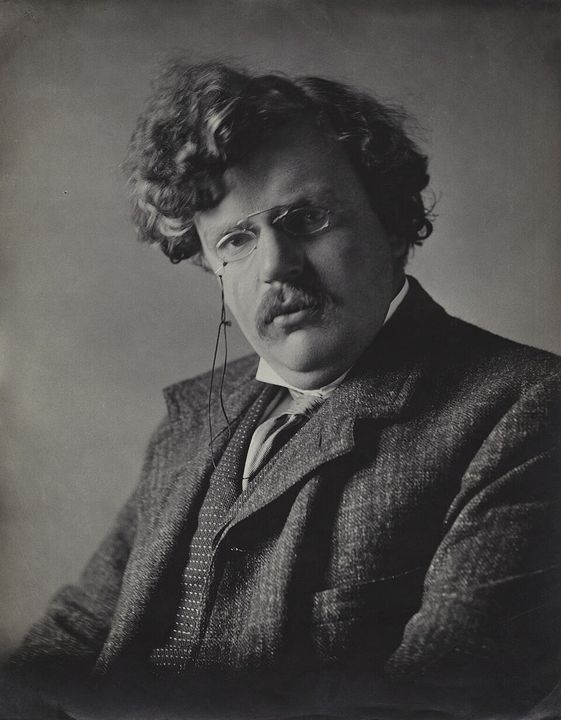
Gilbert Keith Chesterton (1874–1936) was born in Kensington, London, and studied art at the Slade School before turning to journalism. He wrote essays and columns for London papers for more than three decades, along with poetry such as The Ballad of the White Horse and Lepanto, novels such as The Man Who Was Thursday (1908), and the Father Brown detective stories beginning in 1911. He debated George Bernard Shaw, H. G. Wells and others in print and on the platform. An Anglican when he wrote Orthodoxy, he was received into the Catholic Church in 1922, and later wrote The Everlasting Man (1925) and lives of St Francis of Assisi and St Thomas Aquinas.
“Strong gongs groaning as the guns boom far, Don John of Austria is going to the war, Stiff flags straining in the night-blasts cold In the gloom black-purple, in the glint old-gold, Torchlight crimson on the copper kettle-drums, Then the tuckets, then the trumpets, then the cannon, and he comes.”
“I caught him, with an unseen hook and an invisible line which is long enough to let him wander to the ends of the world, and still to bring him back with a twitch upon the thread.”
Orthodoxy (1908) is G. K. Chesterton's account of how he came to believe the Christian creed. It answers a challenge from the critic G. S. Street, who, after Chesterton's Heretics (1905) had criticized the philosophies of his contemporaries, said he would begin to worry about his own philosophy when Chesterton had given his.
Lepanto is G. K. Chesterton's ballad of the naval battle fought on 7 October 1571 in the Gulf of Patras, off western Greece, where the galleys of the Holy League, assembled by Pope Pius V and led by Don John of Austria, defeated the Ottoman fleet. Chesterton published it in The Eye-Witness in October 1911 and collected it in his Poems of 1915.
The Innocence of Father Brown collects the first twelve stories about Father Brown, a short, round-faced Roman Catholic priest from Essex with a shabby umbrella and an armful of brown-paper parcels, who solves crimes by understanding the sinners who commit them. In "The Blue Cross" Aristide Valentin, head of the Paris police, lands at Harwich hunting the giant French thief Flambeau and follows a trail of absurdities across London: salt in a sugar bowl, soup thrown at a wall, a window broken and paid for in advance, price labels swapped on a fruit stall.