Work record
Orthodoxy
1908 · Early 20th Century · Essays · English
Abstract
Background. Three years after Heretics took aim at his contemporaries, Chesterton was told to produce a positive philosophy of his own. He responded with a spiritual itinerary, written while still in the Church of England.
Argument. Reason sealed off from mystery collapses into the airtight system of the lunatic, and modern scepticism and will-worship devour themselves. Nursery tales, by contrast, train the mind in astonishment and thanks. The Christian faith, attacked from opposite sides, proves to be a balance of fierce contraries that guards both sanity and liberty.
Structure. After an introductory parable come chapters on lunacy, self-destroying thought, fairyland, loyalty to the cosmos, Christian paradox, perpetual reform, the adventure of dogma, and finally why one may submit to ecclesiastical authority. The order is autobiographical rather than systematic, tracing doubts the author says he actually met before he found their answer already in the creed.
Method. Anecdote, analogy and epigram carry the case: an omnibus bound for an asylum, a sailor landing at home, Cinderella's deadline, a child shouting for an encore. Opponents such as Nietzsche, Shaw and Blatchford are named and answered with good humour rather than scorn.
Significance. C. S. Lewis and many later apologists drew on its manner, and it remains a staple of classical and Christian curricula and of English religious prose generally.
Key figures
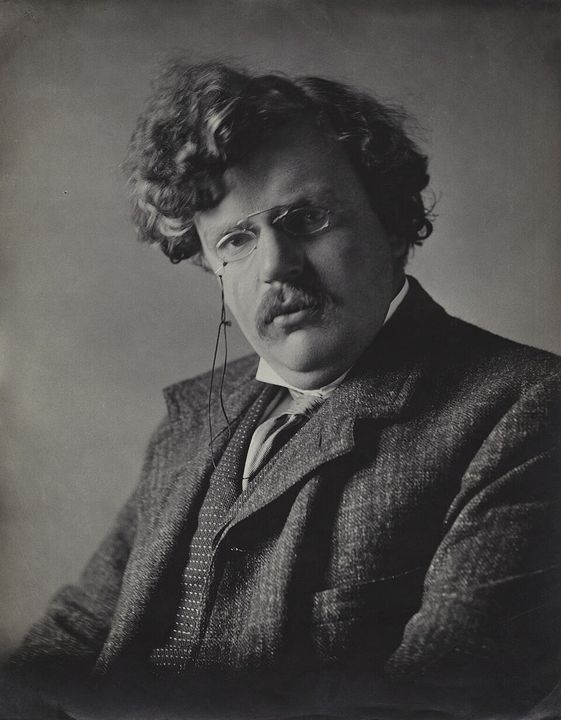
- G. K. Chesterton: Journalist narrating his own path from private philosophy to the creed
- G. S. Street: Critic whose dare after Heretics prompted the book
- Friedrich Nietzsche: Philosopher of will, cited as a modern dead end
- George Bernard Shaw: Friendly antagonist whose superman ideal is examined
- Robert Blatchford: Socialist editor whose determinism is likened to a madman's logic

Summary
Orthodoxy (1908) is G. K. Chesterton's account of how he came to believe the Christian creed. It answers a challenge from the critic G. S. Street, who, after Chesterton's Heretics (1905) had criticized the philosophies of his contemporaries, said he would begin to worry about his own philosophy when Chesterton had given his. He calls it a sort of slovenly autobiography. By orthodoxy he means the Apostles' Creed as Christendom has generally understood it. The library text is the complete Project Gutenberg edition. Chapter I, Introduction in Defence of Everything Else, offers the parable of an English yachtsman who sets out to discover a new island and lands, without knowing it, on the coast of England. So Chesterton tried to found a heresy of his own and found it was orthodoxy. Chapter II, The Maniac, argues that the madman is not one who has lost his reason but one who has lost everything except his reason, reasoning perfectly inside a small circle. The materialist and the determinist, he says, resemble him. Poets do not go mad; chess-players and mathematicians may; and the ordinary man stays sane by allowing mystery, as the cross opens outward where the circle closes. Chapter III, The Suicide of Thought, describes a modern scepticism that turns reason against itself and a worship of will, in Nietzsche and Shaw, that cannot choose anything in particular. Chapter IV, The Ethics of Elfland, is the heart of the book. From fairy tales learned in the nursery Chesterton draws his first convictions: that the world is a wonder and not a necessity, that joy often hangs on a condition, like Cinderella's midnight, and that the repetitions of nature may be the delight of a God who says to the sun each morning, do it again. Tradition is the democracy of the dead. Chapter V, The Flag of the World, asks how one can love the world enough to change it, rejecting both optimism and pessimism for a loyalty like patriotism, and contrasts the suicide, who insults all things, with the martyr. Chapter VI, The Paradoxes of Christianity, recounts how he found Christianity attacked for opposite faults at once, and concluded that the Church combines furious opposites, such as pride and humility, courage and meekness, by keeping both at full strength. Orthodoxy becomes a heavenly chariot thundering through the ages, reeling but erect. Chapter VII, The Eternal Revolution, argues that real progress needs a fixed ideal and that the doctrine of the Fall keeps reform perpetually alive. Chapter VIII, The Romance of Orthodoxy, holds that orthodox doctrine, not liberal theology, has guarded liberty and adventure. Chapter IX, Authority and the Adventurer, explains why he accepts the Church as a living teacher and ends with joy as the gigantic secret of the Christian and the suggestion that Christ concealed his mirth. Published by John Lane in 1908, fourteen years before Chesterton entered the Catholic Church, Orthodoxy has remained one of the most widely read works of English Christian apologetics.
Virtues in this work
- Humility: Chapter I admits that the heresy Chesterton thought he had invented was the old creed all along, and Chapter III asks for humility about oneself rather than about the truth.
- Hope: Chapter VII grounds perpetual reform in a fixed ideal, so that decay is never final and renewal is always possible.
- Faith: Chapter IX explains why Chesterton trusts the Church as a living teacher after finding it truthful where he could test it.
- Fortitude: Chapter VI describes Christian courage as a strong desire for life taking the form of readiness to die.
Plot or Argument
- Preface and Chapter I: Introduction in Defence of Everything Else
Chesterton explains that the book answers G. S. Street's challenge and is a personal account of how he came to believe, not a formal defence of the faith. He tells of the yachtsman who discovered England thinking it a new island, and confesses that he tried to found a heresy and found it was orthodoxy. He takes as given the Apostles' Creed and promises no argument about the Church's authority, only his own route.
- Chapter II: The Maniac
Prompted by an omnibus marked Hanwell, the London asylum, Chesterton argues that belief in oneself is a sign of madness, not success. The madman reasons with perfect logic inside a narrow circle and cannot be argued out of it. Materialism and determinism share that shape. Imagination does not breed insanity; poets stay sane and logicians crack. Sanity keeps a place for mystery, and the cross, which can extend its arms forever, stands against the closed circle.
- Chapter III: The Suicide of Thought
Humility has moved from the organ of ambition to the organ of conviction, so modern men doubt the truth rather than themselves. Reason that doubts reason destroys itself, and religious authority has historically served as a barrier to defend reason. Chesterton then turns to the worship of will in Nietzsche, Shaw and others, arguing that every act of will is a limitation and that praising will in the abstract paralyses choice.
- Chapter IV: The Ethics of Elfland
Chesterton sets out the philosophy he learned in the nursery from fairy tales. Elfland teaches that the order of nature is wonderful rather than necessary; that happiness often depends on keeping a strange condition, as with Cinderella's midnight; and that the repetition of daisies and sunrises may come from a God who never tires of making them. He defends tradition as the democracy of the dead and closes with gratitude for existence as a gift.
- Chapter V: The Flag of the World
Against both optimist and pessimist, Chesterton proposes a primary loyalty to the world, like a patriot's love for his country, that makes one want to improve it. He calls suicide not only a sin but the sin, the refusal to take an oath of loyalty to life, and contrasts it with martyrdom. Christianity, he finds, separates God from the cosmos so that man can love the world without worshipping it.
- Chapter VI: The Paradoxes of Christianity
Reading sceptical writers, Chesterton notices that Christianity was attacked for being too gloomy and too cheerful, too meek and too warlike. He concludes that the oddity lies in Christianity's balance, which holds opposites together at full strength: courage that desires life like water and drinks death like wine; humility and the dignity of man; charity that hates the sin and loves the sinner. Orthodoxy is pictured as a chariot driving through the heresies, reeling but erect.
- Chapter VII: The Eternal Revolution
Progress requires a fixed vision of the good, an ideal that does not change with the reformer's moods. Because the Christian doctrine of the Fall expects every institution and person to decay, it supplies the reason for perpetual vigilance and reform. Chesterton defends a democratic instinct against government by the rich or the well-bred, and answers reformers who say poverty leaves the poor unfit to govern themselves.
- Chapter VIII: The Romance of Orthodoxy
Chesterton argues that the liberal theology of his day, by denying miracles and doctrine, narrows freedom rather than enlarging it. Belief in the Trinity, in free will, in the Fall and in a God distinct from the world is what has kept Christian civilizations energetic and adventurous. He contrasts the open-eyed Christian saint with the Buddhist image of inward contemplation.
- Chapter IX: Authority and the Adventurer
Asked why he accepts the whole of a creed rather than its moral teaching alone, Chesterton answers that he has found the Church a truth-telling thing and a living teacher, like a key that fits a lock. He weighs evidence for miracles and the problem of authority, and ends with the claim that joy is the gigantic secret of the Christian and that the one thing God hid when he walked on earth may have been his mirth.
Characters
- G. K. Chesterton, narrator and author
Writes in his own voice as a journalist who discovered the creed while trying to invent a philosophy of his own.
- G. S. Street, challenger
Essayist and critic whose remark after Heretics, that he would worry about his philosophy when Chesterton gave his, occasioned the book.
- The yachtsman, parable figure
An English sailor who miscalculates his course and lands in England believing it a new South Sea island; Chesterton's image of himself.
- Friedrich Nietzsche, opponent
Cited in Chapters III and VI as a prophet of will and strength whose philosophy Chesterton thinks ends in paralysis.
- George Bernard Shaw, opponent and friend
Playwright whose praise of will and of the superman Chesterton answers with affectionate argument.
- Robert Blatchford, opponent
Socialist journalist whose determinism Chesterton cites as a modern creed resembling the maniac's closed circle.
- Cinderella, fairy-tale exemplar
In Chapter IV, her midnight condition illustrates the doctrine of conditional joy that Chesterton finds in elfland.
Lessons
Reason needs a larger world than reason
Chesterton's maniac reasons flawlessly inside a closed circle. Sanity, he argues, is not more logic but a wider horizon that leaves room for mystery, so that a person can laugh, doubt himself, and accept things he cannot fully explain. This is why he says that mysticism keeps men sane.
- Why does Chesterton say the madman has lost everything except his reason?
- What is the difference between the circle and the cross as he uses them in Chapter II?
- Can you think of an argument that is internally consistent but too small to be true?
Wonder and gratitude as the beginning of philosophy
In The Ethics of Elfland Chesterton claims that fairy tales taught him more truly than scientists that the world is astonishing and need not have been. Joy often comes with a condition, and the condition should be kept rather than resented. Gratitude for existence, he says, is the first response the world calls for.
- What does Chesterton mean by the doctrine of conditional joy, and how does Cinderella illustrate it?
- Why does he think repetition in nature might be a sign of God's delight rather than mere mechanism?
- How does he defend tradition as the democracy of the dead?
Holding opposites together
Chapter VI argues that Christianity does not find a dull middle between opposite virtues but holds both at full strength: a courage that wants to live and is ready to die, a humility about oneself and a high view of man. Chesterton thinks the heresies are each a single truth taken alone.
- What contradictory accusations against Christianity did Chesterton find in his reading?
- How does he explain Christian courage, and why is it a paradox?
- Why does he picture orthodoxy as a chariot reeling but erect, rather than as something calm and safe?
Loving the world enough to change it
In The Flag of the World Chesterton insists that reform must begin in loyalty, as a patriot loves his country before he improves it. The optimist excuses everything and the pessimist condemns everything; the Christian loves the world without worshipping it, and so can fight for it.
- Why does Chesterton reject both optimism and pessimism?
- How does he contrast the suicide and the martyr?
- Does his patriotic analogy work for a whole world, or only for a country?
Context
Edwardian England was a lively market of philosophies. Fabian socialism, the Nietzschean cult of will, the scientific materialism and determinism of popular writers like Robert Blatchford, Tolstoyan pacifism, and a liberal theology that set aside miracles and creeds all had articulate champions in the press. Chesterton, a journalist in his early thirties, had already argued with many of them in Heretics (1905) and in a newspaper controversy with Blatchford in 1903–04. He had passed through a period of doubt and gloom as an art student in the 1890s and emerged with a strong sense of gratitude for existence, which he traces in this book.
Composition
Chesterton wrote Orthodoxy in answer to G. S. Street's challenge after Heretics. It was published in London and New York by John Lane in 1908, the same year as his novel The Man Who Was Thursday. He wrote it as an Anglican; he did not enter the Catholic Church until 1922. The library text is the Project Gutenberg edition, proofread against a second scanned copy.
Reception
Orthodoxy was widely reviewed and became Chesterton's best-known non-fiction book. Later apologists acknowledged its influence; C. S. Lewis, for example, wrote that The Everlasting Man helped him back toward faith and spoke warmly of Chesterton's writing. The book has stayed in print for more than a century and is often read alongside Lewis's Mere Christianity as a classic of English apologetics. Its argumentative style, built on paradox and anecdote rather than system, has drawn both admiration and the criticism that paradox can substitute for proof, a debate Chesterton himself anticipated.
Comparisons
- lepanto
Chesterton's ballad of 1911 gives poetic form to the Chapter VI paradox of a Christianity that is fierce as well as meek, as Don John of Austria rides to battle for a faith he loves.
- the-innocence-of-father-brown
In The Blue Cross Father Brown sees through Flambeau because the false priest attacked reason, which is bad theology; the stories put into fiction the argument of Chapter III that orthodoxy defends reason.
- apologia-pro-vita-sua
Chesterton's preface names Newman's Apologia as a model: both are forced to be autobiographical in order to explain belief, though Newman gives a detailed history of his opinions and Chesterton a playful sketch.
- mere-christianity
Lewis, who acknowledged Chesterton's influence, sets out the shared core of the creed in plain broadcast talks; Chesterton reaches the same creed by paradox and personal discovery.
- pensees
Pascal's balance of greatness and wretchedness in man anticipates Chesterton's Chapter VI, where Christianity is found to hold humility and human dignity together at full strength.
- lewis-the-abolition-of-man
Lewis's defence of objective value against reductive education and Chesterton's attack on the closed circle of materialism both argue that a reason cut off from wonder and tradition shrinks.
Quotes
Frequently cited
“I did try to found a heresy of my own; and when I had put the last touches to it, I discovered that it was orthodoxy.”
Frequently cited
“The madman is not the man who has lost his reason. The madman is the man who has lost everything except his reason.”
Frequently cited
“Tradition means giving votes to the most obscure of all classes, our ancestors. It is the democracy of the dead.”
Frequently cited
“There was some one thing that was too great for God to show us when He walked upon our earth; and I have sometimes fancied that it was His mirth.”
“The poet only asks to get his head into the heavens. It is the logician who seeks to get the heavens into his head. And it is his head that splits.”
“It may be that He has the eternal appetite of infancy; for we have sinned and grown old, and our Father is younger than we.”
“Not only is suicide a sin, it is the sin.”
“Christianity got over the difficulty of combining furious opposites, by keeping them both, and keeping them both furious.”
For Students
A reading companion for classical Christian high school students. See the student guide.
Reading Guide
Watch for
- The yachtsman parable in Chapter I and how it frames the whole book as a discovery of the familiar.
- The omnibus marked Hanwell in Chapter II, and the contrast between the closed circle and the cross.
- The nursery lessons of Chapter IV: Cinderella's midnight, the doctrine of conditional joy, and God saying do it again to the sun.
- The list of contradictory accusations against Christianity in Chapter VI and the image of the chariot reeling but erect.
- The last paragraph of Chapter IX on joy as the Christian's gigantic secret.
Key terms and names
- Orthodoxy
- Chesterton's word for the Apostles' Creed as generally understood by Christians, not a particular church's full system.
- Hanwell
- The large asylum in west London whose name Chesterton uses as a byword for madness in Chapter II.
- Elfland
- The world of fairy tales, which Chapter IV treats as a school of philosophy teaching wonder, gratitude and obedience to strange conditions.
- Doctrine of conditional joy
- The fairy-tale rule that a great good is given on some small condition, such as returning by midnight, which must be kept without demanding its reason.
- Democracy of the dead
- Chesterton's description of tradition in Chapter IV as giving a vote to one's ancestors.
- Paradox
- An apparent contradiction that reveals a truth; the main tool of the book and, in Chapter VI, a feature of Christianity itself.
- Will-worship
- Chesterton's name in Chapter III for philosophies, like Nietzsche's and Shaw's, that praise will and strength without saying what to will.
Seminar Questions
- Comprehension What challenge led Chesterton to write Orthodoxy, and what does he say the book will and will not attempt?
- Comprehension What is the story of the yachtsman in Chapter I, and how does Chesterton apply it to himself?
- Comprehension What does Chesterton say he learned from fairy tales in Chapter IV?
- Interpretation Why, according to Chapter II, do poets stay sane while logicians go mad? Is he fair to logicians?
- Interpretation How does Chapter VI turn the contradictory attacks on Christianity into evidence for it?
- Interpretation In Chapter VII, why does Chesterton think the doctrine of the Fall makes reform more possible rather than less?
- Big Question Is wonder at the world a good reason for belief, or only a good feeling? What would Chesterton answer?
Faith Connections
- Matthew 18:3 (Scripture)
Unless you become as little children you will not enter the kingdom. Chapter IV's claim that God may have the eternal appetite of infancy, and its trust in nursery wisdom, echo this saying.
- 1 Corinthians 1:18-25 (Scripture)
Paul's foolishness of the cross that confounds the wise lies behind Chapter II's image of the cross that opens outward against the closed circle of the reasoning madman.
- Psalm 104 (Scripture)
The psalmist's delight in the regular wonders of sun, moon and creatures parallels Chesterton's reading of repetition in nature as God's untiring joy.
- Pascal, Pensées (Great Conversation)
Pascal's account of man's greatness and wretchedness held together in Christianity foreshadows Chesterton's Chapter VI on furious opposites kept in balance.
Logic and Rhetoric
Central argument: Sanity and joy require both reason and mystery; modern philosophies each keep one truth and lose the balance, ending in madness or paralysis; the Christian creed alone holds wonder, reason, humility, courage and reform together; therefore the creed is the best explanation of the world as Chesterton found it.
Rhetorical device: paradox. Chapter II's line that the madman has lost everything except his reason, quoted in the record, states a truth by apparently contradicting common sense; the method governs the whole book.
Debate: Resolved: that fairy tales teach truer lessons about the world than scientific materialism.
Memory Work
Tradition means giving votes to the most obscure of all classes, our ancestors. It is the democracy of the dead.
There was some one thing that was too great for God to show us when He walked upon our earth; and I have sometimes fancied that it was His mirth.
Writing Prompts
Essay: Explain how Chapter II's argument about madness prepares for Chapter VI's argument about the paradoxes of Christianity.
Comparison with The Innocence of Father Brown: In The Blue Cross Father Brown says that attacking reason is bad theology. Compare how the story and Chapter III of Orthodoxy each defend reason, one by a detective's deduction and the other by argument.
Medical Lens
Chapter II, The Maniac, is one of the best-known literary meditations on madness in English apologetics and is of real interest to a psychiatric reader. Chesterton's madman is not delirious or deficient but rigidly logical: his explanation of the world is complete and unanswerable within a small circle, he is unable to doubt himself, and he cannot laugh at his idea. This portrait echoes the nineteenth-century idea of monomania and the reasoning madness described by asylum writers, and it anticipates later clinical interest in the fixed, internally coherent delusion; it should be read as a moral and philosophical image, not a clinical description. Chesterton draws repeatedly on Hanwell, the large Middlesex county asylum in west London, as a byword, and remarks that alienists, however quietly they work, must be intolerant of the patient's system in order to cure him, comparing cure to exorcism. Chapters III and V treat suicide philosophically, as the end point of thought that destroys itself and as the ultimate refusal of loyalty to existence, in contrast to martyrdom; these are theological judgments rather than medical ones.
- Chapter II, The Maniac (opening)
Conversation with a publisher about self-confidence, prompted by an omnibus marked Hanwell; belief in oneself as a sign of insanity.
- Chapter II, The Maniac
The madman's argument described as a perfect but narrow circle that cannot be broken by reasoning, with examples of the man who thinks himself Christ or the target of a conspiracy.
- Chapter II, The Maniac
Remarks on doctors and psychologists who must treat a madman's system intolerantly, and the comparison of cure to casting out a devil.
- Chapter V, The Flag of the World
Suicide contrasted with martyrdom as the refusal of loyalty to existence.
Creative Prompts
- Fiction
Write the yachtsman's log from Chapter I: the day he plants a flag on a new island and slowly recognizes the Brighton Pavilion.
- Essay
Chesterton says fairy tales taught him that the world is a wonder and not a necessity. Choose one fairy tale and show what it teaches about conditional joy.
- Classroom
List the contradictory charges against Christianity that Chesterton collects in Chapter VI. In pairs, find a third example of a virtue that holds two opposites together at full strength.
- Dialogue
Write a conversation between Chesterton and G. S. Street in which Street explains why Orthodoxy has not yet answered him.
Further Reading
- Heretics, G. K. Chesterton
The 1905 essays on contemporary writers that provoked the challenge Orthodoxy answers.
- The Everlasting Man, G. K. Chesterton
His later account of man and Christ in history.
- Autobiography, G. K. Chesterton
Published after his death in 1936; it covers the same years of doubt and discovery.
- Gilbert Keith Chesterton, Maisie Ward
The first full biography, from 1943, by a friend of the family.
- The Man Who Was Thursday, G. K. Chesterton
His novel of the same year, a nightmare comedy on order, anarchy and Sunday.
Verification notes
All eight quotations were found by search in the stored Project Gutenberg text (content/texts/chesterton-orthodoxy.txt) and copied exactly; chapter locators follow the text's headings. Publication by John Lane in 1908, the challenge from G. S. Street (named in Chapter I), and Chesterton's reception into the Catholic Church in 1922 are standard facts. Hanwell is identified as the county asylum at Hanwell in Middlesex, the common meaning of the name in Chesterton's London.
- The years of Chesterton's newspaper controversy with Robert Blatchford (usually given as 1903–04).