Work record
Lepanto
1911 · Early 20th Century · Poetry · English
Abstract
Background. Chesterton wrote this ballad for the weekly paper run by his brother Cecil and Hilaire Belloc, near the 340th anniversary of the 1571 sea fight that checked Ottoman naval power in the Mediterranean. He was then an Anglican; his reception into Rome came eleven years later.
Content. Scenes alternate between courts and the advancing hero. Ottoman splendor and European apathy give way to drums in the hills as an illegitimate Habsburg prince arms himself. The prophet in his garden rouses jinn and giants against the returning crusader spirit. An archangel stirs in Normandy, a gloomy Philip fingers his vial, and Pius sees from his oratory the oared captives beneath the enemy hulls. Don John breaks through, the prisoners climb into daylight, and a wounded Spanish soldier pictures a comic knight he will one day create.
Form. Heavy stresses, alliteration, and chiming within lines make the verse a performance piece, and a recurring line about Don John changes its verb to track his progress.
Themes. Chivalry against indifference, deliverance of captives, and the glory of God over human fate.
Significance. Widely memorized in British and American schools, it is the best known of Chesterton's poems and the chief way many readers first meet the battle.
Main characters
- Don John of Austria: Young Habsburg commander of the Holy League fleet
- The Soldan: Ottoman ruler laughing among Constantinople's fountains
- Mahound: Prophet of Islam as imagined in medieval romance, summoning spirits
- Pope Pius V: Founder of the League, who watches the fight in prayer
- Philip II: Spanish king brooding over a crystal vial
- Cervantes: Soldier on a galley who foresees Don Quixote

Summary
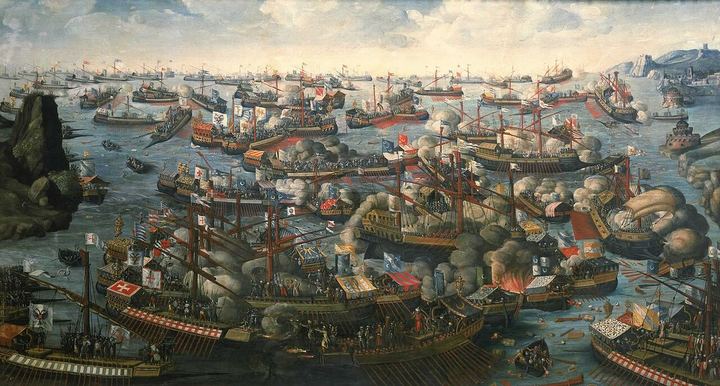
Lepanto is G. K. Chesterton's ballad of the naval battle fought on 7 October 1571 in the Gulf of Patras, off western Greece, where the galleys of the Holy League, assembled by Pope Pius V and led by Don John of Austria, defeated the Ottoman fleet. Chesterton published it in The Eye-Witness in October 1911 and collected it in his Poems of 1915. The poem is built for the voice: long rolling lines heavy with alliteration and internal rhyme, broken by short chant-like refrains, and above all the repeated line announcing that Don John of Austria is going to the war. It opens in the Sultan's court at Constantinople, where fountains play and the Soldan laughs as his ships threaten Italy. The Pope stretches out his arms and calls the kings of Christendom, but the cold queen of England looks in her glass and the Valois king yawns at Mass. Then, out of silence, drums are heard in the hills, and Don John, the crownless prince and last knight of Europe, takes his weapons from the wall. A scene in Mahound's paradise follows, where the prophet summons spirits and giants and warns that the old crusading voice has returned, the voice of Richard, Raymond and Godfrey. Chesterton cuts between figures in their rooms and Don John in motion: St. Michael on his mount in the north, where Christians quarrel; King Philip II in his black-velvet closet holding a phial; Pope Pius at prayer seeing the battle as in a mirror. The climax is the release of the Christian galley slaves chained below the Turkish decks, who rise white for bliss and blind for sun and stunned for liberty, with the shout Vivat Hispania, Domino Gloria. The poem ends with Cervantes, who fought and was wounded at Lepanto, sheathing his sword and seeing a lean and foolish knight riding a road in Spain, the future Don Quixote. Lepanto became Chesterton's most famous poem, much recited in schools, and is valued for its music and its picture of chivalry and deliverance.
Virtues in this work
- Fortitude: Don John, tiny and unafraid in an enormous silence, rides out when the great kings of Europe will not.
- Magnanimity: The poem's hero seeks a great deed, and its climax is his setting thousands of chained captives free.
- Faith: The victory cry gives the glory to the Lord with Domino Gloria, and the Pope's prayer is placed at the center of the battle.
Plot or Argument
- Stanzas 1-2: The Sultan laughs, Christendom sleeps
The Soldan's fleet menaces Italy while the Pope calls in vain on the kings of Europe; then drums stir in the hills and Don John, a crownless prince, takes up his arms.
- Stanza 3: Don John rides out
Gongs, flags, torchlight, kettle-drums, trumpets and cannon announce Don John riding to the sea with a refrain of hurrah.
- Stanzas 4-5: Mahound's paradise
Mahound rises in his garden and summons spirits from sky, temples and sea, warning that the crusaders' voice has returned and ordering his armies to crush it.
- Stanzas 6-7: Michael and Philip
St. Michael stirs in a divided North, and King Philip broods in his velvet closet over a phial, while Don John shouts to the ships and opens the cannonade.
- Stanza 8: The Pope's vision and the freeing of the slaves
Pope Pius at prayer sees the battle as in a mirror, the captives suffering below the Ottoman decks, and Don John bursting the line and setting his people free.
- Stanza 9: Cervantes sheathes his sword
Cervantes, at the battle, sees in a vision a foolish knight riding in vain on a road in Spain, while Don John rides home from the Crusade.
Characters
- Don John of Austria, hero
Illegitimate son of Emperor Charles V and commander of the Holy League fleet, the poem's crownless prince and last knight.
- The Soldan of Byzantium, adversary
The Ottoman sultan at Constantinople, laughing among his fountains at the start.
- Mahound, summoner of spirits
The prophet of Islam under his medieval European name, pictured in a fantastic paradise rallying spirits against the Crusade.
- The Pope, caller of the League
Pius V, who summons Christendom and later sees the battle in prayer.
- King Philip, Don John's half-brother
Philip II of Spain, brooding in a black-velvet closet with a phial.
- Cervantes, soldier and future novelist
Fighting at Lepanto, he glimpses the knight who will become Don Quixote.
Lessons
Sound as meaning
Lepanto is meant to be heard. Alliteration (Dim drums throbbing, Strong gongs groaning), internal rhyme, and the returning refrain give the poem the rhythm of a march and a battle, so that the coming of Don John is felt before it is understood.
- Read the third stanza aloud. Which sounds imitate drums, gongs and cannon?
- How does the refrain about Don John change as the poem goes on?
- Why break the long lines with very short ones such as Don John of Austria / Is riding to the sea?
One knight against indifference
Chesterton sets Don John against a sleeping Christendom: the queen at her mirror, the Valois yawning at Mass, the North quarrelling over texts, Philip brooding in his closet. Heroism in the poem is the willingness of one man to answer when the great powers will not.
- Which rulers fail to answer the Pope's call, and how does the poem picture each?
- Why does Chesterton call Don John a crownless prince on a nameless throne?
- Is the poem's hero a soldier, a knight, or something else?
The freeing of the captives
The climax is not a kill but a release: thousands of Christian galley slaves below the Ottoman decks come up into the light. Chesterton presents the battle as deliverance, and his Latin shouts give the glory to God.
- What does the poem say about the captives before they are freed?
- Why might Chesterton make liberation, rather than conquest, the climax?
- Why end with Cervantes rather than with the victory?
Context
In 1570 the Ottoman Empire invaded Venetian Cyprus, and Pope Pius V formed the Holy League of the Papacy, Spain, Venice and smaller Italian states. On 7 October 1571 its fleet of more than 200 galleys under Don John of Austria, then twenty-four, met the Ottoman fleet under Ali Pasha near Lepanto (Nafpaktos). It was the last great battle fought mainly between oared galleys; the League won decisively and freed many thousands of Christian rowers. Pius V instituted a feast of Our Lady of Victory, later the feast of the Holy Rosary. England under Elizabeth I and France under Charles IX took no part.
Composition
Chesterton published Lepanto in The Eye-Witness, the weekly edited by Hilaire Belloc and Cecil Chesterton, in October 1911, near the battle's anniversary. He drew on popular histories and on his sympathy for medieval chivalry and the Crusades, imagining the Ottoman side through the fantastic names of medieval romance. The poem was collected in Poems (1915).
Reception
Lepanto became Chesterton's best-known poem and a favorite for recitation in schools on both sides of the Atlantic. It has been reissued in annotated editions, notably Dale Ahlquist's of 2003, and is often taught as an example of ballad music and of historical poetry.
Comparisons
- the-song-of-roland
The medieval French epic also sings of Christian knights against Muslim armies, with a hero's horn-call where Chesterton has Don John's trumpet and refrain.
- don-quixote
The poem's last vision is of Cervantes, a veteran of Lepanto, seeing the lean and foolish knight he would later write, so Chesterton's crusader ballad ends in the birth of the great novel of chivalry.
- st-crispins-day-speech
Shakespeare's Henry and Chesterton's Don John are both young leaders who answer a moment of crisis with a call to glory, one in speech, the other in a ballad about him.
- the-raven
Poe and Chesterton both build poems on heavy internal rhyme, alliteration and a returning refrain, though Poe's music deepens despair while Chesterton's drives toward triumph.
Quotes
Frequently cited
“Strong gongs groaning as the guns boom far, Don John of Austria is going to the war, Stiff flags straining in the night-blasts cold In the gloom black-purple, in the glint old-gold, Torchlight crimson on the copper kettle-drums, Then the tuckets, then the trumpets, then the cannon, and he comes.”
Frequently cited
“Vivat Hispania! Domino Gloria! Don John of Austria Has set his people free!”
“The last knight of Europe takes weapons from the wall, The last and lingering troubadour to whom the bird has sung, That once went singing southward when all the world was young. In that enormous silence, tiny and unafraid, Comes up along a winding road the noise of the Crusade.”
“It is he that saith not 'Kismet'; it is he that knows not Fate; It is Richard, it is Raymond, it is Godfrey in the gate!”
“The hidden room in man's house where God sits all the year, The secret window whence the world looks small and very dear.”
“Cervantes on his galley sets the sword back in the sheath (Don John of Austria rides homeward with a wreath.) And he sees across a weary land a straggling road in Spain, Up which a lean and foolish knight for ever rides in vain”
For Students
A reading companion for classical Christian high school students. See the student guide.
Reading Guide
Watch for
- The refrain about Don John of Austria and how its verb changes: going to the war, riding to the sea, shouting to the ships, has set his people free.
- The parenthetical lines that cut from rulers in their rooms back to Don John in motion.
- The rulers who ignore the Pope's call in stanza 1: the cold queen of England and the shadow of the Valois.
- Mahound's speech naming Richard, Raymond and Godfrey, the crusaders of earlier centuries.
- The galley slaves who come up white for bliss and blind for sun, and Cervantes's vision at the end.
Key terms and names
- Battle of Lepanto
- The naval battle of 7 October 1571 in which the Holy League fleet defeated the Ottoman fleet off western Greece.
- Don John of Austria
- Half-brother of Philip II of Spain and commander of the League's fleet at twenty-four; the poem's crownless prince.
- Holy League
- The alliance of the Papacy, Spain, Venice and other states formed by Pope Pius V in 1571.
- Galley slaves
- Rowers chained to the oars of war galleys; thousands of Christian captives were freed from the Ottoman ships at Lepanto.
- Kismet
- Fate or destiny; Mahound fears the enemy who does not accept fate.
- Domino Gloria
- Latin for glory to the Lord, the shout Chesterton sets beside Vivat Hispania after the victory.
- Internal rhyme
- Rhyme within a line rather than only at its end, as in the gloom black-purple and the glint old-gold.
Seminar Questions
- Comprehension Who threatens Christendom at the start of the poem, and how do the kings of Europe respond to the Pope?
- Comprehension What happens to the Christian captives below the Ottoman decks in stanza 8?
- Interpretation Why does Chesterton describe Don John as the last knight of Europe and the last troubadour?
- Interpretation What is the effect of cutting back and forth between rulers in their rooms and Don John in motion?
- Interpretation Why does Mahound fear the one who says not Kismet and knows not Fate?
- Interpretation Why might the poem end with Cervantes and a foolish knight rather than with the victory?
- Big Question When is it right to take up arms to free captives, and what keeps such a war from becoming mere glory-seeking?
Faith Connections
- Isaiah 61:1 (Scripture)
The anointed one is sent to proclaim liberty to the captives and the opening of the prison to them that are bound, the image at the heart of the poem's climax.
- Psalm 115:1 (Scripture)
Not unto us, O Lord, but unto thy name give glory; the shout Domino Gloria gives the victory to God rather than to Spain alone.
- Revelation 12:7-9 (Scripture)
Michael and his angels fight the dragon, the warrior-archangel whom Chesterton places on his mountain in stanza 6, shaking his lance as Don John goes forth.
- Augustine, City of God XIX.7 (Church Fathers)
Augustine says the wise man wages just wars only with grief at the necessity; a sober counterweight to read beside Chesterton's exultant music.
Logic and Rhetoric
Central argument: Christendom is threatened while its rulers are indifferent, divided, or brooding. One knight answers the call, and his fight frees the enslaved. Therefore the old ideal of chivalry, courage in the service of the weak and the glory of God, is still alive and can act when the powerful will not.
Rhetorical device: refrain with incremental variation. The line about Don John of Austria returns in nearly every stanza with a new verb (going to the war, riding to the sea, has set his people free), so the refrain itself narrates the battle.
Debate: Resolved: that Lepanto is chiefly a poem about liberation rather than about conquest.
Memory Work
Strong gongs groaning as the guns boom far, Don John of Austria is going to the war, Stiff flags straining in the night-blasts cold In the gloom black-purple, in the glint old-gold, Torchlight crimson on the copper kettle-drums, Then the tuckets, then the trumpets, then the cannon, and he comes.
Vivat Hispania! Domino Gloria! Don John of Austria Has set his people free!
Writing Prompts
Essay: Analyze how Chesterton uses sound (alliteration, internal rhyme, and the changing refrain) to turn the history of Lepanto into a narrative of awakening and deliverance.
Comparison with Don Quixote: Lepanto ends with Cervantes seeing a lean and foolish knight. Compare Chesterton's heroic knight Don John with Cervantes's Don Quixote and argue what each author thinks chivalry is worth.
Medical Lens
Two brief images touch medicine. King Philip handles a crystal phial in which death is said to lie, a figure often read as an allusion to sixteenth-century court rumors of poisoning and to Philip's interest in alchemy; the reading is interpretive. The Pope's vision of the galley slaves includes captives who grow witless in their cells, a poetic picture of the mental toll of long captivity.
- Stanza 7
King Philip in his black-velvet closet touches a moon-colored crystal phial, his face pale and fungus-like, while the narrator says death is in the phial.
- Stanza 8
Christian captives below the Ottoman decks, sick and sunless, some grown witless in their cells, before Don John breaks the line and frees them.
Creative Prompts
- Classroom
Divide the class into voices for the narrator, the refrains, and Mahound, and perform the poem as a choral reading with drums marking the stressed beats.
- Poetry
Write a ballad of a historical event in long alliterative lines with a returning refrain naming the hero, letting the refrain change slightly each time it appears.
- Essay
Compare Chesterton's account of the battle with a historian's account and argue what the poem adds that history alone cannot supply.
Further Reading
- Lepanto, with Explanatory Notes and Commentary, G. K. Chesterton, ed. Dale Ahlquist
Annotated edition with historical essays on the battle and the poem.
- Empires of the Sea: The Siege of Malta, the Battle of Lepanto, and the Contest for the Center of the World, Roger Crowley
- G. K. Chesterton: A Biography, Ian Ker
- Orthodoxy, G. K. Chesterton
Chesterton's 1908 account of his faith, with its defense of romance and adventure.
Verification notes
The battle's date, place, commanders and the release of Christian galley slaves are well established; figures for ships and freed captives vary between sources and are given here only approximately. The stored Gutenberg text contains several transcription slips against printed editions (for example shake for shaken, Spuming for Spurning, swat for sweat, sex for sea, and the words room and soon missing from two line endings); every quote here is taken from lines unaffected by those slips and is found verbatim in the stored text. Readings of the phial as poison are interpretive.
- The stored full text has transcription errors in several lines (stanzas 1, 3, 6, 7 and 8); check it against a printed edition before reproducing the whole poem.