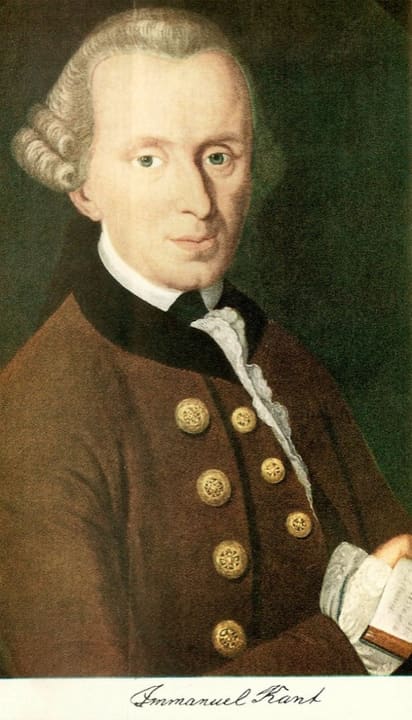
Immanuel Kant (1724–1804) spent his whole life in and around Königsberg in East Prussia, where he taught for decades as an unsalaried lecturer before becoming professor of logic and metaphysics in 1770. After this book he published the Groundwork (1785), the Critique of Practical Reason (1788) and the Critique of Judgment (1790). He was famous for his regular habits and wrote about his own hypochondria and its management in his late essay on the power of the mind over morbid feelings.
“Two things fill the mind with ever new and increasing admiration and awe, the oftener and the more steadily we reflect on them: the starry heavens above and the moral law within.”
Kant's first Critique asks whether metaphysics is possible as a science, and answers by examining reason's own powers before trusting any of its claims about God, the soul or the world as a whole. The first-edition preface describes human reason as burdened by questions it cannot dismiss and cannot answer, and the second-edition preface proposes a Copernican experiment: instead of assuming that knowledge must conform to objects, suppose that objects must conform to the forms of our knowing.
Kant's Grundlegung zur Metaphysik der Sitten (1785), translated by Abbott as Fundamental Principles of the Metaphysic of Morals, is a short book with a narrow and ambitious aim: to identify and establish the supreme principle of morality. It does not offer a full ethical system, which Kant postponed to the Metaphysics of Morals of 1797, but clears the ground by asking what must be true of moral obligation if it is to bind every rational being without exception.
Immanuel Kant's Critique of Practical Reason, published at Riga in 1788, is the second of his three Critiques. Where the first Critique limited what reason can know about God, freedom and the soul, this book argues that pure reason is practical by itself: it can determine the will without any help from desire, and in doing so it gives freedom, God and immortality a secure footing as matters of rational belief.
Perpetual Peace (Zum ewigen Frieden) is a short philosophical essay by Immanuel Kant, published at Königsberg in 1795, a few months after Prussia made a separate peace with revolutionary France at Basel. Kant cast it, with a touch of irony, in the form of a peace treaty.