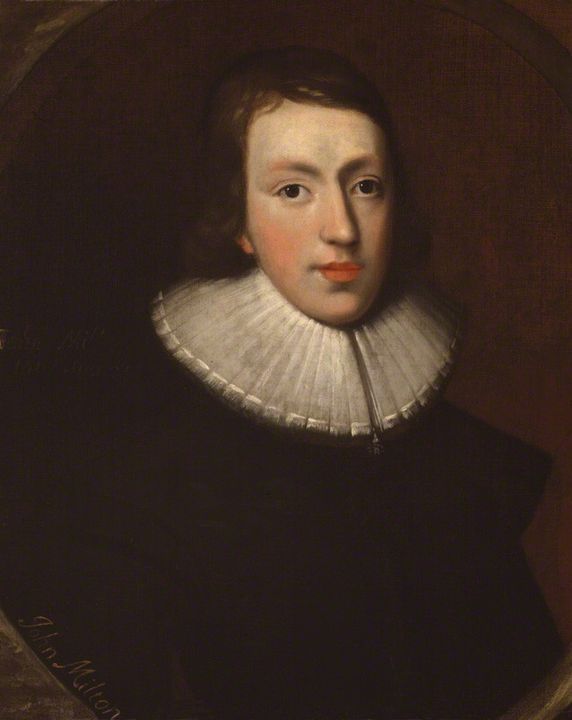
John Milton (1608–1674) was the son of a London scrivener and composer; he studied at St Paul's School and Christ's College, Cambridge, and spent several years in private study before touring France and Italy in 1638–1639, where he met Galileo. Returning as civil war approached, he wrote a series of prose tracts against bishops, for the lawfulness of divorce, on education and, in 1644, against the licensing of the press. Under the Commonwealth he served the Council of State as Secretary for Foreign Tongues and defended the execution of Charles I in Latin. Blind from about 1652, he dictated Paradise Lost (1667) and Paradise Regained and Samson Agonistes (1671).
“The world was all before them, where to choose Their place of rest, and Providence their guide: They, hand in hand, with wandering steps and slow, Through Eden took their solitary way”
Areopagitica: A Speech of Mr. John Milton for the Liberty of Unlicensed Printing, to the Parliament of England was published in London in November 1644, deliberately without a licence, a printer's name or registration with the Stationers' Company. It is written as an oration addressed to the Lords and Commons, though it was never delivered.
written c. 1652-1655; published 1673 · Renaissance Early Modern · Poetry
Milton's sonnet on his blindness is a fourteen-line argument between a complaining heart and a corrective voice. It was written in the early 1650s, after Milton, then in his forties and serving the Commonwealth government, had lost his sight entirely.
1667; revised 1674 · Renaissance Early Modern · Epic
Paradise Lost is John Milton's epic in twelve books of blank verse on the fall of man, written, as the opening invocation says, to assert Eternal Providence and justify the ways of God to men. It begins in the middle of things.