Alfred Nobel
1833–1896 · Swedish chemist who invented dynamite and founded the Nobel Prizes.
Alfred Nobel was born in Stockholm, Sweden, and grew up partly in St. Petersburg, Russia, where his father made mines and machinery. He was educated by private tutors, spoke several languages, and wrote poetry. He studied chemistry and became interested in nitroglycerin, a powerful but dangerously unstable explosive. In 1864 an explosion at the family's factory killed his younger brother Emil and several others. Nobel kept working and in 1867 patented dynamite, nitroglycerin mixed with a kind of fine earth so it could be handled more safely. Dynamite was used for building tunnels, canals, railways and mines, and also in war. He later invented gelignite and a smokeless powder, held over three hundred patents, and built factories in many countries, becoming very rich. When his brother Ludvig died in 1888, a French newspaper mistakenly printed Alfred's obituary, calling him a merchant of death. Nobel never married. In his will he left most of his fortune to establish prizes in physics, chemistry, medicine, literature and peace. He died in Italy in 1896.
Faith: Raised Lutheran and attended the Church of Sweden in Paris; he was agnostic in youth and later described as an atheist. Source: Wikipedia
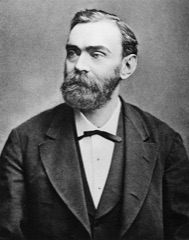
Key dates
- 1864 Factory explosion kills his brother
- 1867 Patents dynamite
- 1888 Mistaken obituary published
- 1895 Signs his will founding the prizes
- 1896 Dies at San Remo
- 1901 First Nobel Prizes awarded
Fun facts
- The chemical element nobelium is named after him. (Source: Alfred Nobel (Wikipedia))
Watch

Videos load from YouTube in privacy-enhanced mode only when you press play.
More lives
Charles Babbage · Alexander Graham Bell · Louis Braille · Isambard Kingdom Brunel · Andrew Carnegie · Thomas Edison