Charles Babbage
1791–1871 · English mathematician who designed the first programmable mechanical computer.
Charles Babbage was born in London, the son of a banker, and studied mathematics at Cambridge, where he later held the Lucasian chair once held by Isaac Newton. Frustrated by errors in printed tables of numbers used by navigators and engineers, he designed a machine to calculate and print such tables automatically. With government funding he began building this Difference Engine in the 1820s, but disputes with his engineer and rising costs stopped the work. He then designed a far more ambitious machine, the Analytical Engine, which could be programmed with punched cards like those used in Jacquard looms. It had a store for numbers and a mill for calculating, much like the memory and processor of a modern computer. Ada Lovelace wrote notes explaining how it could be programmed. Neither engine was completed in his lifetime. Babbage also wrote on economics and factories, helped found the Royal Astronomical Society, and campaigned against street noise. He died in 1871. In 1991 the Science Museum in London built a working Difference Engine from his plans.
Charles Babbage is also an author in the library: author page and works.
Faith: Raised a Protestant; later in life he wrote on natural theology and valued Christianity chiefly for its moral teaching rather than speculative doctrine. Source: Wikipedia
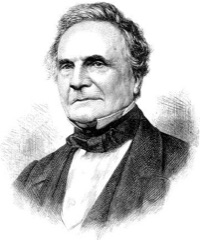

Key dates
- 1791 Born in London
- 1822 Proposes the Difference Engine
- 1828 Becomes Lucasian Professor at Cambridge
- 1837 Describes the Analytical Engine
- 1864 Publishes his memoir
- 1871 Dies in London
Fun facts
- A crater on the Moon and Babbage Island in Western Australia are named after him. (Source: Charles Babbage (Wikipedia))
Read about them
Grades 9–12
- Passages from the Life of a Philosopher · In the library
More lives
Edwin A. Abbott · Alexander Graham Bell · Claude Bernard · George Boole · Louis Braille · Josef Breuer